Get Full Government Meeting Transcripts, Videos, & Alerts Forever!
Get email alerts on the Workforce And Benefits topic
No spam. Unsubscribe anytime.
Panel extends funding discussions for summer unemployment insurance for hourly school staff; A‑1 amendment adopted, bill laid over
Summary
Committee adopted an A‑1 amendment and heard testimony on Senate File 2188, which would provide multi‑year funding for unemployment insurance benefits extended to hourly school workers (bus drivers, paraprofessionals, custodians, food-service staff). Witnesses described the benefit’s role in retention and the fiscal and operational trade-offs for
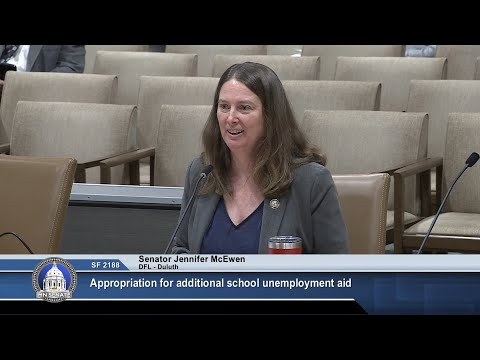
Senate File 2188 (A‑1 as adopted), presented by Senator McEwen, would continue funding support for unemployment insurance (UI) benefits for hourly school workers who experience seasonal layoffs. Committee members adopted the author’s A‑1 amendment and then heard testimony before laying the measure over for possible omnibus inclusion.
Background: The 2023 Legislature created a special revenue account and provided $135,000,000 to reimburse school districts for the employer share of UI for hourly school workers. Initial cost estimates were higher, but actual use was substantially lower in the first year. Committee testimony cited a first-year statewide cost of about $36,000,000 and a current estimated annual cost of about $58,000,000. The account balance was reported at roughly $30,000,000 at the time of the hearing.
The A‑1 amendment (adopted in committee) adds a one‑time appropriation of $30,000,000 for fiscal year 2026 and $70,000,000 for fiscal year 2027 to cover projected UI claims; language in the amendment also restores local levy authority beginning in 2028 (allowing districts to levy to cover the employer UI costs after the one‑time aid period) and provides that unspent funds would cancel to the general fund if not used by a specified date. The amendment also directs the Minnesota Department of Education to report job-classification breakout data, including counts of special-education hourly workers drawing on the benefit.
Staff and association witnesses asked for a stable funding solution. Scott Krunkquist (Association of Metropolitan School Districts and Minnesota Association of School Administrators) said districts support the principle but prefer a permanent state funding stream; absent that, the bill’s options (state one-time aid now, then levy or special-ed formula options later) provide alternatives. Denise Dietrich (Minnesota School Boards Association) urged continued state funding rather than shifting costs to property taxpayers, warning the impact would fall most heavily on property-poor districts that cannot pass levies.
Front-line testimonies described worker impacts. Kat Briggs, a school bus driver (ISD 196), said summer UI allowed partial benefits when summer routes were short and full benefits when no routes were available, providing economic stability that helped staff travel and retain employment; she supported the bill and said UI helped reduce fall staffing shortages. Anne Kramfitz, an education support professional, said UI has made it feasible for long-serving hourly staff to continue in the work despite low wages. Several district officials testified that the state reimbursement to date kept districts whole and that without continued state support they would face either property-tax increases or cuts to general fund programs.
DEED deputy commissioner Evan Rowe described eligibility rules: claimants must have sufficient base-period earnings, be able and willing to accept suitable work, actively seek suitable employment, and be prepared to begin suitable work without delay. Rowe said UI is partial wage replacement (roughly 50 percent of prior weekly earnings), and the department investigates employer challenges and fraud reports.
Operational trade-offs were raised: Noel Schmidt (Rock Ridge schools) warned some districts were short of funds and faced cutting staff and that the UI benefit has introduced some unintended consequences — for example, some would-be summer hires decline offers while collecting UI. Testimony from the Minnesota Department of Education’s Sami Rajab endorsed additional one‑time funds in the governor’s proposal and described projected FY2026 needs.
Committee action: the A‑1 amendment was adopted and Senate File 2188 as amended was laid over for possible inclusion in a future omnibus bill. The bill reauthorizes short‑term state funding (per the amendment) and restores local levy authority for districts to use beginning in 2028 if no permanent state funding is provided.