Get Full Government Meeting Transcripts, Videos, & Alerts Forever!
Get email alerts on the Ems Funding Telecom Fee topic
No spam. Unsubscribe anytime.
Senate proposal would create telecom fee to fund rural EMS grant pool; committee adopts amendment and lays bill over
Summary
Senate File 16-88 would create a grant program to support rural ambulance services, including reimbursement for treatment-without-transport, funded by a proposed telecommunications fee on cell-phone bills; the committee adopted an author's amendment and laid the bill over for possible inclusion while members debated the revenue mechanism.
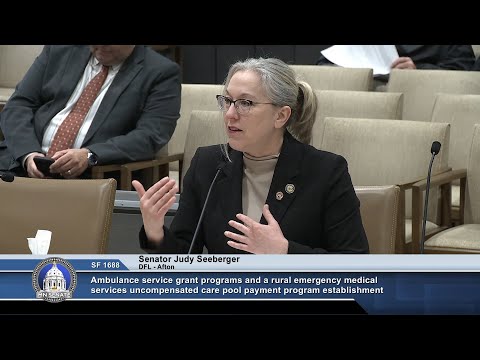
Senate File 16-88, presented by Senator Seaburger to the Health and Human Services Finance and Policy Committee, would establish a grant program to support rural emergency medical services, including funding for treatment-without-transport calls that currently receive no reimbursement.
The bill sets up multiple "buckets" of funding: a rural uncompensated care pool, cost-of-readiness grants for licensed ambulance services, and a section for political subdivisions to support local EMS improvements. To fund the program, the bill proposes a telecommunications fee attached to cell-phone service; discussion in committee described a potential retail charge of 80 cents per line, added to a cell phone bill, though the bill text did not include a specific fee amount in committee and sponsors said they would continue conversations about the funding design.
Senator Seaburger said rural ambulance services are "in a crisis" and described that ambulances are paid only when they transport a patient; treatment provided on-scene but not resulting in transport currently generates no reimbursement for the responding service. The author's A1 amendment (moved in committee and adopted by voice vote) added application and data-collection requirements for grant recipients, asking for information on total calls, dispatch reasons, response mode and other operational data to improve statewide EMS data collection.
Office of Emergency Medical Services Director Dylan Ferguson testified in support of funding options for EMS and described this proposal as one mechanism among several to provide needed funding. Fire Chief Mike Dobish also spoke in favor of the amendment and supported the bill.
Committee members questioned the proposed telecom fee and alternative funding options. Senator Otke asked about the revenue estimate for an 80¢ fee; Ferguson said the Office of EMS had not been provided a fiscal estimate and suggested questions be directed to Commerce. Senator Key recalled earlier estimates that penny-level fees previously would have produced $12–$14 million and said she favored funding from the general fund instead. Senator Seaburger and others said the cell-phone fee would provide a steady dedicated revenue stream; Seaburger argued the total need discussed last session was about $129 million.
Members also discussed whether other states use telecom or other fees to fund EMS; Ferguson said other states have used a variety of mechanisms, including license/registration fees, traffic citations and telecom fees for 9-1-1. Senator Schubert asked whether the bill should include a specific fee; Seaburger said he preferred to leave the exact amount to ongoing discussions.
The committee laid Senate File 16-88, as amended, over for possible inclusion.