Get Full Government Meeting Transcripts, Videos, & Alerts Forever!
Get email alerts on the Mobile Crisis Units topic
No spam. Unsubscribe anytime.
Philadelphia committee reviews mobile crisis units; council seeks faster response and more funding
Summary
City officials, DBHIDS leaders and community advocates reviewed the city's mobile crisis teams and 988 system, citing 14,302 dispatches from 2023'2025, reduced involuntary commitments and ongoing staffing and funding shortfalls. Council requested a plan to reach a 30'minute response benchmark and clearer data on 988/911 transfers.
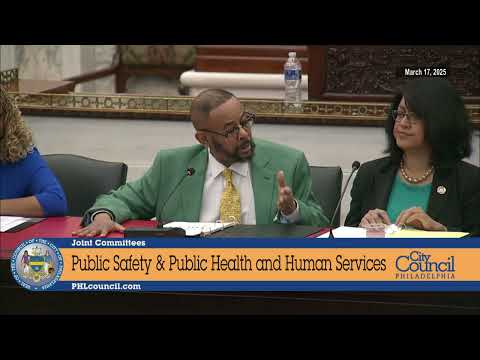
A Philadelphia City Council joint committee on public safety and public health on March 17 reviewed the operation, performance and funding needs of the city's mobile crisis response teams and the Philadelphia Crisis Line (PCL), the local hub for the national 988 Suicide & Crisis Lifeline.
Interim Commissioner Marquita Williams of the Department of Behavioral Health and Intellectual Disability Services told the joint Committee on Public Safety and Public Health and Human Services that "between January 2023 and January 2025, approximately 14,302 dispatches were recorded" by mobile crisis teams, and that the city's crisis system now operates 24/7 with expanded capacity including an adult behavioral health urgent care and a fifth crisis response center in West Philadelphia.
The hearing drew councilmembers, DBHIDS officials, providers and community advocates who described early program successes — including reductions in hospitalizations and police involvement — and persistent challenges such as staff turnover, uneven response times and the need for more funding and standardized training.
DBHIDS and providers: what the data show
Dr. Williams said the city's Crisis 2 framework has created a network of community mobile crisis response teams (CMCRTs) operated by four contracted providers ' Elwyn, PATH, JFK Behavioral Health Center and the Consortium ' that together manage roughly 29 teams across shifts. She said 988 and the PCL now handle about 6,000 calls per month and that the PCL has improved warm transfers from 911, noting a 36% increase in transfers from 911 to 988 after co-locating operations.
Williams reported several performance measures: DBHIDS data, she said, show that over 50% of mobile dispatches resulted in on-site resolution with no urgent or emergent service required, involuntary commitments ("302s") declined to about 17% of dispatches, and voluntary evaluations at crisis response centers were around 6%.
She said the department has a 50'minute citywide response benchmark aligned with national best practices and that recent technology upgrades, including GPS-enabled dispatching, have reduced median response time to roughly that target. Williams also identified staffing instability as the key operational risk and said a $3,000,000 increase in FY24 from City Council funded "bridge teams" to address peak-hour shortfalls.
Provider representatives described on-the-ground practice and training. Kenny Solanke of DBHIDS and Lindsay Eshelman of JFK Behavioral Health Center outlined how teams work: teams travel to homes, libraries and other sites to stabilize callers, use plain clothes and badges to preserve confidentiality, and provide warm handoffs to services such as the Merakey walk-in clinic or fast-track intakes. Eshelman said service encounters at the city's adult behavioral health urgent care totaled 1,133 in the first five months after opening in September 2024.
Independent evaluation and cost findings
Rebecca Stewart, an investigator from the University of Pennsylvania's Center for Mental Health, presented preliminary evaluation results. Using administrative Medicaid data, her team compared people who received mobile crisis services with a historical comparison group served via ambulance and 911 before mobile teams were widely available. Stewart said that mobile crisis services were associated with a 34% reduction in subsequent psychiatric hospitalizations and that the decline translated into an estimated $5 million in cost savings to the city over two years.
Council questions and requests
Council members praised the program's lifesaving role yet pressed for concrete plans to improve speed, workforce stability and transparency. Councilmember Gauthier recounted the Walter Wallace Jr. case as the impetus for change and urged ongoing investment. Councilmember Gauthier and others requested a written plan showing how DBHIDS could reduce median response time toward 30 minutes, what additional staffing and budget would be required, and the timeline for those changes.
DBHIDS agreed to provide data and options. During the hearing DBHIDS reported that PCL call volume from January 2023 through January 2025 totaled 47,375 calls, with an average call-answer speed of 11 seconds, and that average call length was about seven minutes. The department also acknowledged ongoing coordination with police on transports and involuntary commitment procedures and said it is exploring a dedicated behavioral health transport team to reduce police involvement in transports.
Community testimony and concerns
Members of the public and advocacy groups, including Treatment Not Trauma and the Amistad Law Project, urged rapid expansion of clinician-led, nonpolice responses and increased outreach so residents know how to access help. Several witnesses described traumatic experiences with police responses to mental health crises and called for more mobile teams, better pay and career supports to reduce turnover.
Operational gaps and next steps
DBHIDS and provider witnesses identified recurring operational gaps: high staff turnover, uneven geographic coverage (the consortium'served ZIP code 19143 was singled out as high-volume), reliance on police for involuntary transports, and the need for standardized training across providers. Council members asked for detailed budget numbers for scaling, data on 988-to-911 and 911-to-988 transfers, and plans to ensure continuity of care if any provider contracts change.
No formal actions or votes were taken at the hearing. Committee leaders asked DBHIDS to return with the requested plan and data during the budget cycle and for more detailed evaluations from the Penn research team as they complete their analysis.
The hearing underscores a shift in Philadelphia policy to prioritize clinician-led crisis response and to treat mobile crisis units as a core, budget-priority emergency service. DBHIDS officials said they will continue to work with City Council, providers and community groups to refine response standards, training and funding applications.