Get Full Government Meeting Transcripts, Videos, & Alerts Forever!
Get email alerts on the Community Development topic
No spam. Unsubscribe anytime.
Glendale officials review 3–5 year Community Development action plan, prioritize seismic retrofits and permit streamlining
Summary
City staff presented a draft Community Development Department (CDD) 3–5 year action plan that outlines near-term priorities including a seismic retrofit program, permit timeline reductions and enhanced public engagement. Council asked staff to prioritize green (near-term) items and return with refined staffing and budget requests.
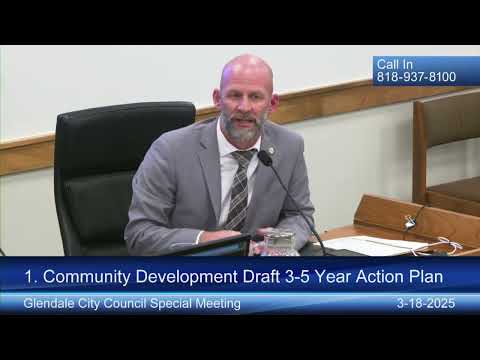
City staff presented a draft 3-to-5 year action plan for the Community Development Department at a special Glendale City Council meeting on March 18, 2025, asking the council to prioritize initiatives for the coming fiscal cycle.
“What we bring before you today is, essentially what we're referring to is a draft action plan for the department. We're aiming for a 3 to 5 year vision,” Mr. Calvert said, introducing the plan and describing it as a high-level set of recommended programs rather than a request for specific staffing or dollar amounts.
The presentation grouped proposed initiatives by division and color-coded them as near-term (green), mid-term (orange) and longer-term (red). Staff said the green items — those they view as most urgent — include a seismic retrofit program, enhanced communications, tenant-improvement fast-track permits, night-and-weekend enforcement and a focused project-screening “gatekeeper” to reduce queue times for submitted applications.
The seismic retrofit proposal drew particular attention. Mr. Calvert told the council the city has “over a thousand soft story apartment buildings” that could be at risk in a major earthquake and described retrofit work as both a public-safety priority and potential revenue generator through permitting and grant opportunities.
Council members repeatedly returned to permitting timelines and staffing. “How do you manage all that?” Councilman Managarian asked, expressing skepticism about the breadth of responsibilities grouped in a single department. “I mean how the hell is all this under your department — this is incredibly broad.”
Several council members said they saw meaningful reductions in permit review times after recent process improvements but emphasized that more work is needed. Mr. Calvert cited data showing declines in review times for accessory dwelling units (down 15.5% year over year in one recent comparison) and other permit categories, while acknowledging some permit types — notably multi-family condominium reviews and some residential fences and walls — had increased in review time.
Council members and staff discussed how the plan should feed into the city budget. Mr. Calvert said the report intentionally did not include fixed staffing or dollar requests: “It would be irresponsible for us to walk in and say I need x number of positions and x number of dollars today,” he said, instead proposing the council identify which items to move forward now so staff can return in the budget process with precise estimates.
Council members suggested two procedural options for refining priorities: (1) individualized briefings between staff and council members, with staff returning a summary to the full council, or (2) a special council session devoted to the action-plan priorities. Several members said a focused special session would be appropriate; others warned about Brown Act constraints on using individual briefings to create staff recommendations.
Other proposals described in the plan included: - A tenant-improvement fast-track pilot (originally a five-day target, with staff suggesting a potential two-day target for simple tenant improvements); - A business concierge program and foreign-direct-investment outreach, tied to trade missions and partnerships such as SelectUSA; - Reconstituting or expanding small-business grants and physical-improvement assistance programs similar to the existing Artsakh Creative Program; - Housing and homeless-services integration into Community Development, with homeless-services staff transitioning into CDD and proposed investment in data collection and case management to support Section 8 and compliance monitoring; staff said roughly four hourly staff would transition with homeless services and additional staff will likely be needed; - Project-screening staff (a gatekeeper) to check submittals for completeness immediately on intake, reducing later resubmittal delays; - Consultant retainer pools for environmental review and specialized preservation work to shorten consultant-selection delays; - Continued housing-element compliance work (staff said about 30 programs require ongoing monitoring and reporting to the state); and - Neighborhood-services work (code compliance, graffiti removal, vacation rentals, street vending enforcement, mediation services, and more night-and-weekend staffing for proactive enforcement).
Council members widely endorsed several green items. Multiple members voiced support for enhanced communications, the seismic retrofit work, the permit screening role and continuing night-and-weekend enforcement, while flagging the city’s limited budget as the central constraint. “We gotta figure out how to pay for the stuff that we need,” one council member said, noting earlier staffing reductions and the fiscal tradeoffs of adding positions.
A member of the public, Beth Brooks, urged sharper budget choices and more public involvement in prioritization. “If there are nice to have, you should take the money from the nice to have and give it to the must haves,” Brooks said during public comment.
Council direction and next steps Staff asked council to indicate which initiatives to move forward in the near term so staff can return during the budget process with concrete staffing and cost estimates. Multiple council members asked staff to schedule either a special session or individual briefings ahead of budget hearings to finalize priorities. City attorneys and staff cautioned regarding Brown Act limitations on using individual briefings to create staff recommendations; the mayor and city attorney recommended briefings be used for information and followed by a public session for any formal direction.
The meeting closed with procedural actions: the council agreed to move a planned closed-session labor-negotiation item to the next meeting and then took a motion to adjourn.
The Community Development report will return to the council with refined near-term priorities and estimated staffing and budget implications, timed to feed into the city’s upcoming budget-review schedule.
Ending details: The presentation noted a May 1 small-business summit and that Measure A funds will begin April 1; staff also said consultant requests-for-proposals are under review for an economic-development strategic plan and that some retrofit and assistance work could be grant-funded rather than solely city-funded.