Get Full Government Meeting Transcripts, Videos, & Alerts Forever!
Get email alerts on the School Safety topic
No spam. Unsubscribe anytime.
Committee approves panic-alerts and school-mapping bill; private schools removed from mandate
Summary
Senate Bill 17, known as Ricky and Alyssa's Law, was advanced after debate over panic-alert technology, first-responder building mapping, cost, data security, and whether private schools should be covered. An amendment removing private schools from the mandate passed; the amended bill received a do-pass recommendation.
Senator Anna Vittardee presented Senate Bill 17, called Ricky and Alyssa's Law, describing two central components: a requirement for mobile panic-alert systems and a requirement for first-responder building mapping so emergency personnel can navigate school campuses during incidents.
Senator Anna Vittardee said the bill builds on prior work with the Georgia Emergency Management and Homeland Security Agency (GEMA) and addresses lessons learned from the Apalachee school shooting. "This mapping requirement would basically take care of that," she said, describing the intent to give responders accurate building data and campus details when they arrive.
Committee members raised several concerns. Some representatives asked why private schools were included in the original text when public-school systems receive state school-safety grants. Others asked whether the bill would limit vendor competition, whether districts with existing panic-alert technology would have to replace it, and what the cost and cybersecurity risks might be. Senator Vittardee said the bill does not require districts to abandon existing systems and that many districts already have technology in place.
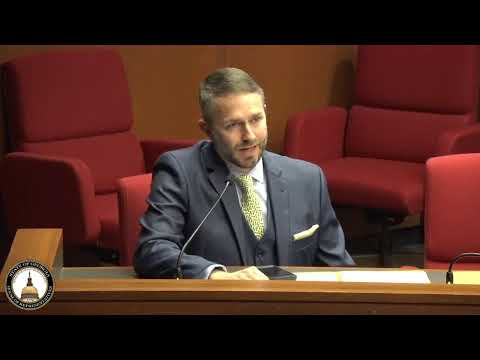
Alicia Wright, deputy executive director for GEMA Homeland Security, testified in opposition to carving out private schools: "Our preference is to leave the language in the bill as is," she said, arguing that attackers might target schools that are not bound by the same requirements and that multi-jurisdictional responses make uniform information valuable to responders. GEMA staff also told the committee that average vendor costs for panic-alert installations they reviewed were roughly $3,500 per school.
Representative (unnamed) offered an amendment to remove private schools from the bill by deleting the words "and private" at several lines. The amendment was seconded, debated, and approved by the committee. After the amendment passed, the committee voted to give the amended bill a do-pass recommendation. Representative Persinger was named as the House member expected to carry the bill.
The bill includes a timeline for implementation; the sponsor noted a provision that sets July 1, 2026, as a relevant date for school mapping procurement, giving districts time to comply. Committee members asked the Department of Education and GEMA to continue work on technical details including data security, vendor competition, and alignment with existing school safety plans.