Get Full Government Meeting Transcripts, Videos, & Alerts Forever!
Get email alerts on the Comprehensive Plan topic
No spam. Unsubscribe anytime.
Pitkin County planners review draft Vision 2050 comprehensive plan policies on water, housing, energy and wildfire evacuation
Summary
Pitkin County Planning and Zoning Commission members met March 18, 2025 and received a staff briefing and early draft policy language for the countycomprehensive plan being prepared as part of the Vision 2050 project.
Pitkin County Planning and Zoning Commission members met March 18, 2025 and received a staff briefing and early draft policy language for the countycomprehensive plan being prepared as part of the Vision 2050 project.
Staff described the comp plan as an advisory, countywide policy document that will guide future land use code and building/energy code changes, and explained how it relates to more geographically specific caucus area master plans. Planning staff said the first full draft is nearly complete and that the plan will feed a set of near-term implementation actions and code amendments.
Why it matters: staff advised commissioners that the comp plan will not itself change code or immediate permits, but the policy statements are intended to set direction for land use code and energy code amendments and for other county programs. The draft policies discussed at the meeting are intended to be the basis for subsequent regulatory changes, some of which staff said are already underway or expected to follow soon after plan adoption.
Draft policies and studies highlighted - Groundwater adequacy: Staff said the comp plan will include policies to "develop and deploy increased groundwater adequacy requirements for new development and redevelopment to assure renewable and sustainable physical water supply." A consultant-driven groundwater study is underway to establish a water adequacy baseline and identify possible gaps between supply and future demand; staff said results will be appended to the comp plan and will inform subsequent land use code language and monitoring approaches.
- Land use and smaller-house incentives: The draft contains policy direction, drawn from the CGAC (community advisory) recommendations, to incentivize smaller homes and reduce disturbance through code and permitting incentives. Staff said square-footage tiering and overlay approaches (where caucus plans already set lower maximums) are examples of tools that could be moved into the land use code.
- Energy and electrification: The draft calls for incentives and performance standards to encourage transitions of new and existing homes to 100% electric and renewable energy and to limit exterior energy use. Staff noted that an Energy Code update is already in progress and that aspects of the CGAC recommendations have been folded into that process.
- Housing: The draft repeats CGAC direction to broaden housing choices, including "middle-market" housing (staff said the phrase will be clarified in later drafts). Commissioners and staff discussed tensions among housing objectives, water availability, rural preservation and the limits of county authority. Staff told the commission that additional feasibility and intensity analyses are being done to map where certain housing types could be located relative to utilities, water and transportation.
- Wildfire mitigation and evacuation: The draft includes policy language to support coordinated emergency evacuation planning and to identify secondary egress routes and other infrastructure needed for natural-disaster evacuations. Commissioners raised enforcement and ongoing monitoring concerns similar to those they discussed about defensible-space maintenance.
- Regional coordination and economic diversification: The draft emphasizes strengthening regional partnerships on transportation and housing and identifies opportunities to support a more balanced local economy (healthcare, education and other sectors) while noting the county lacks a standalone economic development department.
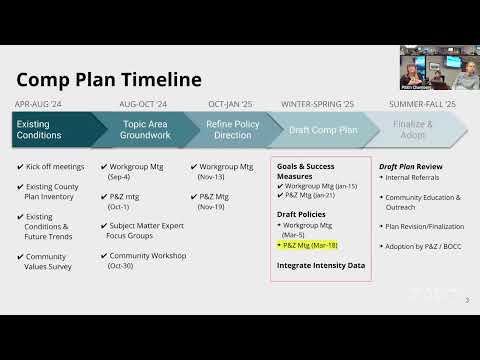
Process, timeline and next steps Staff summarized the project timeline: an existing-conditions report completed last year; community workshops and work-group meetings since then; a nearly complete first draft; and a plan to circulate the full draft for internal referrals, community education and outreach this summer, with adoption targeted in late summer or early fall. Staff also said they expect to return to the Planning and Zoning Commission with topic-specific packets ("bite-sized pieces") and to hold a joint work session with the Board of County Commissioners before formal adoption.
Formal actions No formal policy votes were taken at the March 18 meeting. The meeting concluded with a routine motion to adjourn, which passed.
Ending Staff and commissioners agreed to continue refining policy language, to complete the groundwater and intensity data studies, and to bring detailed draft sections of the comp plan back to the commission for targeted review before release of the full draft for public comment.