
Bensalem school leaders outline $187.8 million proposed budget, warn charter and pension costs strain district finances
Get AI-powered insights, summaries, and transcripts
Sign Up Free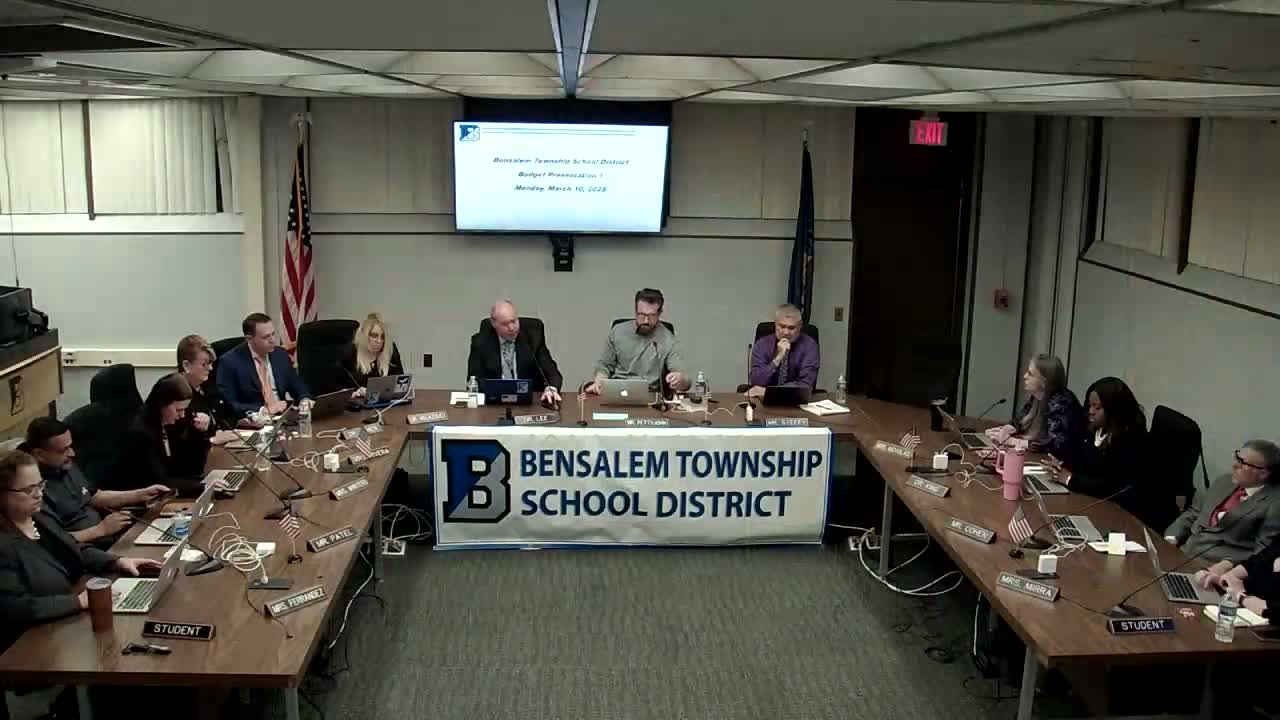
Summary
Superintendent and the district—usiness director presented the proposed 2025-26 budget, flagging charter-school special-education payments and rising PSERS pension costs as primary budget pressures and urging gradual tax increases and contingency planning amid uncertain federal funding.
Bensalem Township School District officials on Monday presented a proposed $187,821,653 budget for the 2025-26 school year and warned charter-school tuition and pension costs are key drivers of a projected operating shortfall.
"It's an honor to stand here to introduce the budget presentation for the 2526 school year for Bensalem Township School District," Superintendent Dr. Lee said, opening the presentation. Director of Business Operations John Steffey then reviewed revenues, expenditures and structural pressures facing the district.
The presentation said the district ended fiscal 2023-24 with a draw on fund balance for the first time since 2017-18, driven by a near-$5 million transfer to capital reserve, a roughly $1.99 million tax-assessment refund related to the Neshaminy Mall parcel, and other one-time items. Steffey said the district's current fund balance is about $13,000,000.
Steffey told the board the district faces several recurring costs that outpace revenue growth: charter-school tuition (which the district lists as the largest single category in its 500-series expenditures), special-education placements and services, and rising pension contributions to the Public School Employees' Retirement System (PSERS). "When we went over why we had a reduction in fund balance this year ... charter school" costs were a large part, he said.
The business director described an analysis showing School Lane Charter School's share of identified special-education students has risen sharply over several years. Using historical incidence rates, the district calculated it is paying roughly $2,600,000 more per year to School Lane than it would if the charter's special-education rates matched earlier years, Steffey said.
Steffey and board members also flagged uncertainty in federal funding after the end of ESSER grants. Steffey said the district currently receives federal Title and IDEA funds that, combined with state pass-through accounting, amount to several million dollars annually for special-education and related services. "ESSER funding ended last school year. Future of federal funding is an unknown," he said.
Pension costs were another central pressure. Steffey said the district's PSERS contribution rate is about 33.9% this year and is projected to rise, which will add six-figure increases to the district's annual costs. "Each year that increase is going to cost Bensalem six figures," he said.
Faced with those pressures, administration recommended a gradual, predictable pattern of annual real-estate tax increases rather than large, volatile jumps. Steffey suggested a range of 1.5% to 2.5% per year to help plan for rising contractual, benefit and mandated costs. Board member Mr. Pettyjohn pushed for a larger buffer, saying, "If you wanna address a potential shortfall in your IDEA money or your title programs ... I think you need to up that 1 and a half to 2 and a half to 2 to 3 over a number of years." Steffey responded that an additional half-percent of millage is approximately $550,000.
The presentation included state-revenue detail tied to the Act 1 index, which the business director said is 4.8% for the district for 2025-26. Steffey said the district is budgeting half of a proposed increase in the state's Accountability Block Grant (about $1,750,000 statewide increase affecting Bensalem), adding $876,000 to the draft budget rather than the full amount in case the state total does not materialize.
Public comment and board questions highlighted classroom and program-level concerns. Michelle Woodley, speaking during public comment, urged the board to prioritize proven classroom supports in the budget: "First, please budget for things proven through numerous studies to work," she said, listing smaller class sizes, 24/7 access to books, narrowing curriculum for mastery, a second adult in every K-2 classroom, and funds for school discipline positions such as a dean of students.
Board members asked for follow-up details and directed administration to return with additional options. Dr. Lee said the administration would prepare internal scenarios and present additional information in the next budget update: "We need a little bit of time to see what comes our way ... we need to internally prepare for what options we may need to exercise to maintain program continuity," he said.
Steffey provided several specific figures and clarifications during the meeting: the proposed 2025-26 expenditures total $187,821,653; the district's fund balance is "a little over $13,000,000"; IDEA and Title funds and state pass-throughs amount to several million dollars annually; and the district has budgeted conservatively for proposed state increases. He also outlined how the district uses contingency and transfers to capital reserves for HVAC and other one-time projects.
Board members and staff discussed options to reduce future debt service or borrow for projects such as a middle-school renovation, noting debt-service declines in the coming decade could create capacity for new borrowing if the board decides to proceed with capital projects.
No formal vote to adopt the 2025-26 budget occurred at the meeting. The board did approve a procedural motion to adjourn. The district's next budget meeting dates, as shared during the session, include a second budget meeting in April, a third meeting on Wednesday, May 7, and a public question-and-answer on the proposed final budget on Wednesday, May 21.
The presentation materials and a more detailed line-by-line budget will be brought back to the board for further review and public comment before any adoption vote.