Get Full Government Meeting Transcripts, Videos, & Alerts Forever!
Get email alerts on the Third Grade Ela Proficiency topic
No spam. Unsubscribe anytime.
Pittsburgh Public Schools reports mixed progress toward third-grade reading goal, urges more coaches and formal observations
Summary
Superintendent Wayne Walters told the school board education committee that district data show modest midyear gains for some groups but declines for others; district aims for 49.4% third-grade ELA proficiency by 2024–25 and says more literacy coaches, formal observations and targeted supports are needed.
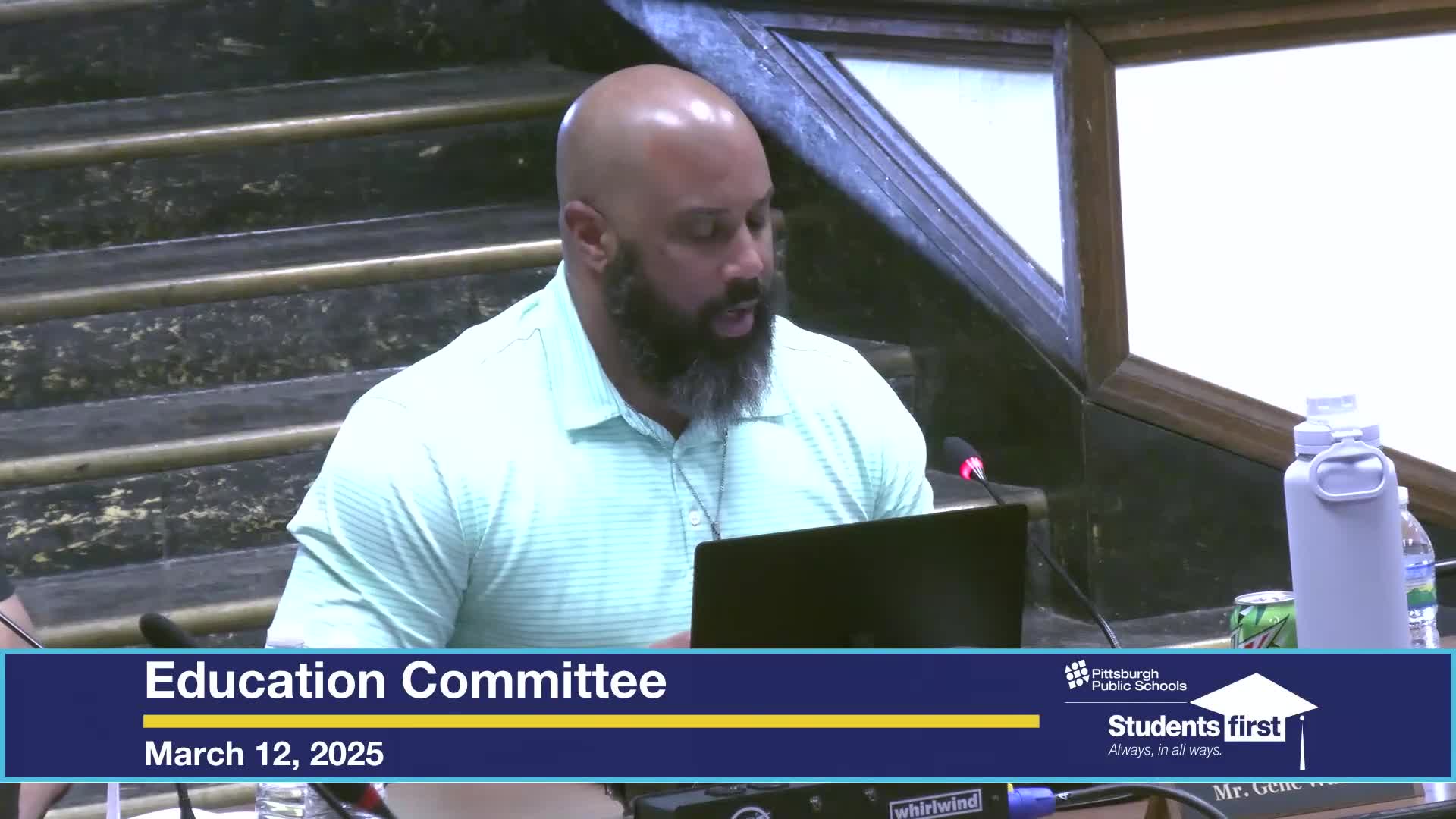
Superintendent Dr. Wayne Walters told the Pittsburgh Public Schools Education Committee on March 12 that district assessments show modest midyear gains for some groups of third graders but declines for others as the district continues toward a goal of 49.4% third-grade English language arts (ELA) proficiency on the state PSSA by the end of the 2024–25 school year.
Walters said the district uses two primary interim measures — the Classroom Diagnostic Tool (CDT) and DIBELS Acadience — to track foundational reading skills and to identify students who need concentrated support. "Third grade is an important milestone because it is a time when students move from learning to read to reading to learn," Walters said, adding that the district is focused on closing gaps for African American students, English learners, economically disadvantaged students and students with IEPs.
The district reported that after the first CDT administration only about 21% of first-time test takers were at or above grade level; the second administration rose to about 30.3% (reported in presentation materials as ~30.3–30.4%). Using CDT categories aligned to the PSSA, Walters said roughly 15.2% of students were classified as likely proficient or advanced on the second CDT administration, percentages that he said have remained similar to recent years.
DIBELS Acadience data presented at midyear showed that the district identified skill gaps across subtests: Walters said the midyear composite indicated approximately 54% of third-graders had "not yet mastered the skills necessary to access complex text." He added that the percentage of students performing below or well below benchmark increased from about 45% at the beginning of the year to a higher share by midyear in several subgroups.
Walters and executive director Dr. Ed Fillmore reviewed three district strategies aimed at improving outcomes: (1) lesson design supported by visual models, coaching and observations; (2) data-informed differentiated instruction using a unified analysis protocol and technology tools such as Imagine Learning, MyPath and Achieve3000; and (3) identifying and scaling best practices across higher-performing schools. Walters described the work as a continuous improvement cycle of planning, doing, checking and acting.
Board members pressed for implementation details. Dr. Tracy Reed asked how literacy academic coaches are deployed and how coaching cycles operate; Fillmore said coaches are assigned based on data and that "the average literacy academic coach is paired between 3 schools" with varying support. When asked how many coaches the district currently has, Walters and Fillmore said the district has 18 literacy academic coaches in total, 13 focused on K–5 and K–8, with one current vacancy; Fillmore said the district's ideal model would be one literacy coach per school.
Multiple board members urged that teacher observations be more formal and consistent. Walters and Fillmore explained the district distinguishes informal snapshot observations from unannounced formal and announced formal observations (which include pre-conference planning and a full-period classroom visit). They said most current observations had been informal and that the district is reinforcing an expectation that principals conduct full-period formal observations so observers can assess lesson progression, differentiation and fidelity to lesson design.
Board members raised questions about substitutes and staffing. Walters said the district tracks short-term and long-term substitute assignments and invites long-term substitutes to professional learning; he acknowledged post‑pandemic staffing challenges and said some principals are teaching multiple periods in buildings with vacancies. Board members recommended that the district align budget priorities to expand coach capacity and fund outside evaluation of reading initiatives.
Walters said the district administered the third round of the CDT between Feb. 24 and March 7, and that makeups were still being completed; those results were not included in the March 12 presentation but will inform end-of-year progress toward the PSSA goal.
The discussion repeatedly emphasized equity: Walters noted that while white students showed gains between the first and second CDT administrations, African American students, English learners, economically disadvantaged students and students with IEPs showed smaller gains or declines, and that targeted interventions are needed to close those gaps.
Walters asked for time, focused resources and budgetary priority to build teacher capacity in the science of reading. Board members — including Mr. Dean and Dr. Reed — urged that the board reflect the district's stated priorities in the budget and consider funding external evaluation of the work. No formal actions or votes were taken during the committee discussion.
The superintendent closed by framing the goal‑monitoring process as part of district governance and accountability: "this is more than just sharing numbers and strategies, but it's a commitment to a new way of governing our schools, focusing on transparency, accountability, and equity," Walters said.
Looking ahead, the district will incorporate the third CDT administration and ongoing observations into final end‑of‑year analyses to evaluate whether the current improvement strategies are sufficient to meet the 49.4% proficiency target by 2024–25.