Get Full Government Meeting Transcripts, Videos, & Alerts Forever!
Get email alerts on the Child Welfare Fiscal Analysis topic
No spam. Unsubscribe anytime.
Minn. committee lays over bill to commission fiscal review of child welfare funding
Summary
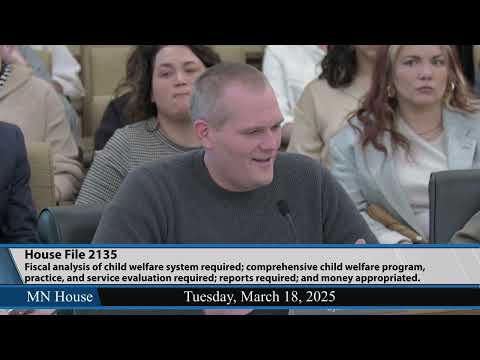
The Minnesota House Children and Families Committee laid over House File 2,135, as amended, which would direct the Department of Children, Youth and Families to contract with an external consultant to produce a comprehensive fiscal analysis of the state's child welfare system and identify untapped federal and other funding streams.
House File 2,135, as amended, was laid over for possible inclusion in a later omnibus bill after the Minnesota House Children and Families Committee voted to adopt a DE3 amendment and close public testimony.
The bill, introduced to the committee by Representative Pinto, would require the Department of Children, Youth and Families (DCYF) to contract with an independent consultant to perform a fiscal analysis of Minnesota's child welfare system and produce a report identifying how funding streams are currently used and where federal and other resources might be maximized. Representative Pinto told the committee House Bill 2,135 "is a bill that, a proposal that actually advanced out of our committee last term" and that the DE3 amendment "tightens the bill in many respects."
In testimony, Tracy Laliberte of the University of Minnesota School of Social Work told the committee a fiscal analysis is needed to understand Minnesota's unusual funding mix. "We know that in Minnesota, we are 1 of 2 states with the lowest state contribution for child welfare services in the country," Laliberte said, adding that counties and tribal governments carry a disproportionate share of child welfare costs and must "manage and mix local, state, and federal funding sources." She said independent analysis would help identify which federal resources — including those created or expanded in recent years such as provisions under the Family First Prevention Services Act — Minnesota is not fully accessing.
Committee members asked about cost and scope. Representative Olson noted the DE3 included a blank appropriation and asked for a sense of the cost; staff member Mr. Berg reported last year's similar effort carried a net cost of about $170,000 after federal matches and a $250,000 appropriation. Olson urged caution about commissioning studies that simply confirm what lawmakers already suspect, while others said the state's county-administered, state-supervised structure makes a centralized fiscal look valuable.
Representative Pinto and Laliberte said the study is designed to show where funding is being maximized and where opportunities remain, not to prescribe immediate policy changes. "This bill moves Minnesota into a position of understanding its fiscal health, risks, and opportunities," Laliberte said. The committee received no opposing public testimony.
Action: The committee adopted the DE3 amendment and laid House File 2,135 over for possible inclusion in a later omnibus bill.
Why it matters: Committee members and witnesses framed the bill as a tool to increase transparency about how state, county, tribal and federal dollars interact in Minnesota's child welfare system — information they said is necessary to target reforms and relieve county fiscal burden.
What’s next: The file was laid over for possible inclusion in a later omnibus package; no final appropriation or consultant contract was authorized by the committee at this hearing.