Get Full Government Meeting Transcripts, Videos, & Alerts Forever!
Get email alerts on the Victim Services Funding topic
No spam. Unsubscribe anytime.
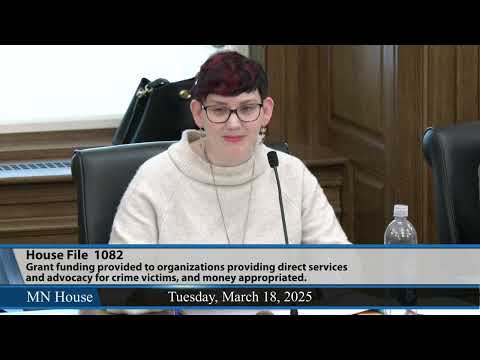
Committee backs re-referral of victim‑services funding bill after testimony that programs face funding crisis
Summary
Chair Mueller’s bill (House File 1082) to create a dedicated special revenue account for crime‑victim services was re‑referred to the Judiciary Finance and Civil Law Committee after testimony from victim‑service providers and Office of Justice Programs officials who described federal funding instability and unmet demand.
The House Public Safety, Finance and Policy Committee voted to re‑refer House File 1082 to the Judiciary Finance and Civil Law Committee after adopting a DE2 amendment that establishes a special revenue account intended to stabilize state funding for crime‑victim services.
Sponsor Chair Mueller described the bill as a response to “a crisis moment” in victim‑service funding caused by unstable federal dollars and increasing demand. Testimony from providers and OJP officials documented a wide gap between funds requested and funds available: Kim Beibine, interim executive director of OJP, said the most recent competitive funding process had roughly $62 million available and about $101 million in requests.
Child‑focused and community providers described the consequences of funding uncertainty. Sarah Reynolds, executive director of Child’s Place (a children’s advocacy center in Redwood Falls), said her three‑person center served 109 children last year and that “85% of our budget relies on grants from the Office of Justice Programs through state and federal funds. Any reduction in this funding would force us to close our doors.” Tammy McConkie, director of victim services at the Ramsey County Attorney’s Office, described advocates carrying caseloads of about 230 cases each—well above the 100–150 range she called ideal—and that advocates gave more than 10,000 hearing notices in a recent quarter.
OJP provided a breakdown of funding sources used to serve victims: roughly $30 million per year in state funding, about $6 million per year in relatively stable federal grants (including VAWA, SASP and FVPSA), and an unstable VOCA (Victims of Crime Act) pot that produced about $12.5 million the prior year but has ranged as high as $50 million in earlier years. OJP staff said if the federal VOCA funds are not available, grants that start in late 2025 will face cuts.
The DE2 amendment creates a special revenue account to accept diverse revenue sources and dedicate them to victim services; sponsors described the account as a starting point to identify revenue streams and help stabilize services while acknowledging the need for further work on allocation formulas and equity across regions. Committee members pressed OJP on geographic distribution, administrative (O&M) caps and how much of the appropriations go to metro versus greater Minnesota; OJP said it uses a competitive RFP process that collects service‑area and demographic information and produces maps showing distribution.
After lengthy discussion and multiple member questions about equity and fiscal details, the committee re‑referred the amended bill to Judiciary Finance and Civil Law for additional consideration; Chair Mueller said the bill will return to this committee because it is the committee of jurisdiction for final action.
Actions: The committee adopted the DE2 amendment and approved re‑referral of House File 1082 to Judiciary Finance and Civil Law (motion prevailed).