Get Full Government Meeting Transcripts, Videos, & Alerts Forever!
Get email alerts on the Police Interlocal Agreement topic
No spam. Unsubscribe anytime.
Pleasant View and North Ogden chiefs propose interlocal police merger; councils to study details
Summary
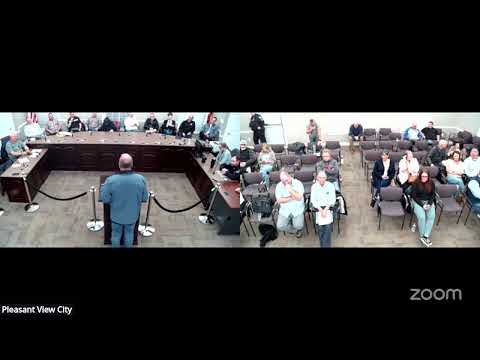
Pleasant View and North Ogden elected leaders on Tuesday heard police chiefs outline a plan to pool staff and services under an interlocal agreement that could merge administration or fully combine the two cities' police departments.
Pleasant View and North Ogden elected leaders on Tuesday heard police chiefs outline a plan to pool staff and services under an interlocal agreement that could merge administration or fully combine the two cities' police departments.
The chiefs said the proposal aims to improve officer safety, expand detective and specialty-unit capacity and reduce administrative duplication while preserving each city's existing budgets, vehicles and local courts. No formal agreement was adopted; both councils were asked to appoint two members each to a working committee and to return with recommendations as early as May.
Why it matters: Both cities rely heavily on public safety spending, and officials said consolidation could slow budget “bleed” while increasing available patrol and investigative resources. Chiefs and mayors presented staffing, response-time and benefits data intended to show the two departments already back each other up and that a merged approach could deliver faster response and more specialized detection capacity.
What the chiefs presented
Interim Lt. Stetson Talbot of the Pleasant View Police Department and North Ogden Chief Brian Inan described two main structural options: an administrative merge (shared administration while preserving separate departmental operations) or a full merge (one combined department). Talbot said the goal was “to provide a better service for less cost.” Inan described how a larger combined department would increase available officers on priority calls and expand detective capacity.
The chiefs provided these key figures from department records and 2024 data:
- Mutual aid and assistance: North Ogden assisted Pleasant View 1,228 times from January 2020 through August 2024; Pleasant View assisted North Ogden 1,355 times in that period. - Staffing: Pleasant View reported 15 employees (12 sworn officers, one community service officer and one secretary) and was two sworn positions down at the time of the presentation. North Ogden reported about 40 employees (22 sworn, two CSOs and three civilian staff) and was also two sworn positions down. - Combined staffing ratio: Chiefs said a merged department would equate to roughly 1 officer per 1,000 residents based on the combined populations and current staffing levels. - Response times: For 2024 priority-1 calls, Pleasant View's average response time was presented as 4 minutes, 10 seconds and North Ogden's as 3 minutes, 25 seconds; chiefs said combining patrol resources would increase officer availability and could reduce response times. - Investigations and specialties: A merged department would provide three full-time detectives and at least one sergeant dedicated to investigations, chiefs said, enabling specialization (fraud, domestic violence, special victims) that they argued would increase efficiency. - Compensation and benefits: The chiefs said total employer-paid benefit costs were similar when medical insurance and retirement contributions were combined. They reported Pleasant View pays about $394.29 more per month per employee for medical benefits while North Ogden currently contributes about $350 per month per employee to 401(k)-type retirement, producing an annual per-officer difference the chiefs calculated at $531. They also reported the averaged pay-range difference across ranks was about 3.44% in North Ogden’s favor — a difference the presenters said is driven mainly by lower starting wages in Pleasant View rather than differences at higher ranks.
Financial and organizational proposals
The presentation outlined operational details the chiefs proposed, including an assistant chief role filled by the Pleasant View chief, a single combined command (chief → assistant chief → lieutenants → combined squads) and the continued use of each city's human resources processes for discipline and payroll. Chiefs said vehicles, uniforms and local justice courts would remain under each city’s control and that civilian staff and part‑time officers would be included in a combined structure.
Cost sharing and facilities: The chiefs proposed sharing the chief's salary and listed a split in which Pleasant View would cover 35.29% of the chief cost and North Ogden the remainder (as stated in the presentation). The chiefs also noted North Ogden's existing public safety building could house a combined department; they emphasized Pleasant View would not be asked to pay North Ogden's building debt.
Growth triggers and governance
Presenters described objective triggers to add sworn personnel: (1) officers-per-1,000 population falling below a city-defined minimum (they suggested a planning minimum of 1 officer per 1,000, with a preferred target higher); and (2) an increase in Part 1 crime rate beyond a chosen threshold (the chiefs proposed a threshold example of 10 Part 1 crimes per 1,000 residents, noting North Ogden’s current rate presented as 5.3 per 1,000). They proposed regular monthly and annual reporting on those indicators.
Accreditation and policies
The chiefs discussed policy platforms used by departments. Pleasant View currently uses Lexipol, a subscription policy system; North Ogden is moving toward UCOPA (Utah Chiefs of Police Association) accreditation. The presenters said operating under a single, higher-accreditation policy would be a potential advantage of a merged structure.
Exit strategy and trial term
The chiefs proposed an initial trial term (for example, 12 months) with renewal and a formal termination clause (the example language cited a 90-day written termination provision used by other interlocal agreements). The presenters said the agreement would be designed to let each city retain its police budget, fleet and positions so either city could return to separate operations if the interlocal proved unsatisfactory.
Council and public reaction
Elected members and several residents largely expressed support for further study but raised questions about details and timing. Council members and the public sought clearer, comparable metrics (monthly breakdowns of priority-level calls, officer time spent inside each city, and uniform definitions for calls for service) and asked how promotions, human-resources cases and disciplinary decisions would be handled under a combined structure.
Council directions and next steps
No formal vote to approve an interlocal agreement was taken. Mayors and council members directed staff and the presenters to form a working group: each council was asked to select two representatives to work with the chiefs and outside advisors to draft a formal interlocal agreement and return recommendations by the councils' next meetings; presenters suggested that, if the councils choose to proceed, an interlocal could be ready for consideration by May. The chiefs recommended an oversight body (mayors plus an independent or rotating council representative) to review key performance indicators monthly.
Public comments
Speakers from both cities supported further study but repeatedly requested more precise, comparable data before any decision. Topics raised by residents included: whether officers paid by Pleasant View would spend proportionate time in Pleasant View; how time-at-location would be tracked; who disciplines officers when incidents cross jurisdictions; and whether May was sufficient time for councils to review the detailed agreement.
Ending
Councils adjourned after public comment; the motion to adjourn was made and approved by voice vote. The matter will return to each council for specific committee appointments and further review before any binding interlocal agreement is brought forward.
Direct quotations used in this article are from participants in the March 18, 2025 joint workshop and are attributed to the speaker names included in the meeting record.