Get Full Government Meeting Transcripts, Videos, & Alerts Forever!
Get email alerts on the Economic Development topic
No spam. Unsubscribe anytime.
Broomfield staff, consultants warn Interlochen office district facing structural decline; staff to study taller residential options
Summary
Consultants told the City and County of Broomfield City Council that older office buildings in the US 36 West/Interlochen area face structural market challenges tied to hybrid work and aging floor plates. Council directed staff to pursue community outreach and research taller, higher‑density housing options for parts of the district.
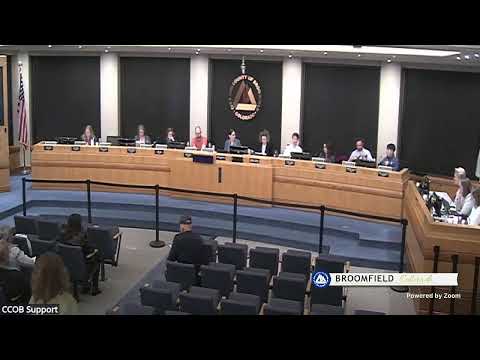
Consultants and city staff told the City and County of Broomfield City Council that the US 36 West/Interlochen corridor — including Flatiron Crossing, Interlochen and Arista — is a major local employment center that faces structural challenges as office demand changes.
The consultants, Chris Brewer and Sarah Murphy of AECOM, and Robert Smith, director of economic vitality, said the area contains many older office buildings built in the 1980s and 1990s whose design and parking configurations make them difficult and costly to adapt to today’s market. "Many of the buildings, single use, single occupancy, the market isn't looking at those buildings the same way," Brewer said, adding that properties with large floor plates and surface parking often require substantial renovation or demolition to be repurposed.
Why it matters: More than half of Broomfield jobs are located in the study area, and property tax values tied to older office buildings have been under pressure. Consultants and staff said any decline in assessed values for office properties could reduce the city’s property tax base unless new development or reinvestment offsets those declines.
Key findings and council response
AECOM’s presentation summarized historic job growth and recent trends: Broomfield had strong pre‑pandemic job growth but has not recovered employment in the study area to prior levels, even while jobs in other parts of Broomfield have rebounded. The consultants noted that hybrid and remote work patterns have altered office utilization and that newer buildings with amenity spaces have outperformed older stock.
Sarah Murphy said, "We're having a moment in time where real estate values for office buildings are becoming highly speculative, highly volatile." The consultants identified vacancy rates around 25% in some subareas and said apartment and multifamily development currently commands higher land values than many office properties.
Council members asked about ownership, reuse prospects and incentives. Smith said the city prepared a parcel inventory showing diverse ownership — in‑state and out‑of‑state investors, REITs and developers — and noted some owners hold buildings free and clear while others are highly leveraged.
On incentives and reuse options, AECOM said adaptive reuse is viable in select cases depending on floor plate, parking and floor‑to‑floor height, but some buildings may require demolition and redevelopment to achieve market rent and unit mixes. "If a developer can get a premium in value for a residential conversion, they will look at it," Brewer said.
Council direction and next steps
City staff said the market study will form a baseline for follow‑up work including a financial outlook tied to recent revenue questions (staff said a preliminary financial update is scheduled for April) and additional annual updates.
Council repeatedly encouraged staff to engage property owners, developers and the public. Mayor Pro Tem Schaff and several members emphasized the need for a coordinated master‑planning approach to reduce entitlement risk and guide infrastructure investments. Staff said the study will be updated annually as a base condition report and that staff will bring forward options for implementation as the comprehensive planning process proceeds.
Clarifying details
- Consultants noted a roughly 25% vacancy figure in parts of the study area and said multifamily and newer amenity‑rich buildings currently command premiums relative to older office stock. - The study area as presented includes four subareas: Flatiron (mall/retail), Interlochen (office/tech workspace), South of Highway 28 (near the airport) and Arista (mixed‑use). - Staff said a parcel inventory of owners has been prepared; ownership is mixed (in‑state, out‑of‑state, REITs, spec developers).
What’s next
Staff will continue outreach with property owners and stakeholders as part of the comprehensive planning work and will present a preliminary financial outlook in April. Council also asked staff to incorporate the market findings into the city’s long‑range financial planning and to return with specific implementation and infrastructure considerations for potential adaptive‑reuse, mixed‑use infill and zoning changes.
The presentation and the council discussion will inform future hearings and staff recommendations tied to Broomfield’s comp plan and infrastructure priorities.