Get Full Government Meeting Transcripts, Videos, & Alerts Forever!
Get email alerts on the Development Water Cumulative Impacts topic
No spam. Unsubscribe anytime.
Ouli Farms bridge application withdrawn after commissioners, residents raise water, cultural and segmentation concerns
Summary
The Ouli Land Company withdrew its stream channel alteration permit application for a proposed bridge across Wailaula Stream after lengthy public comment and sustained commissioner questioning about environmental review, water supply and cultural consultation.
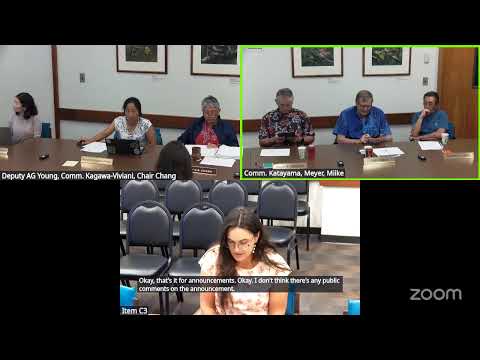
The Commission on Water Resource Management on March 18, 2025 heard a prolonged public and commissioner review of a stream channel alteration permit (SCAP) for a proposed bridge at Ouli Farms (Wailaula Stream, phase 1). The applicant withdrew the application during the meeting after commissioners and numerous public speakers urged a fuller record addressing environmental review, water availability, and cultural resources.
Why it mattered: The Ouli Farms proposal — a bridge spanning a wide channel as part of a larger subdivision — raised questions about whether the single permit before the commission was being considered in isolation from a much larger, phased development on roughly 847 acres, and whether that segmentation avoided a required environmental assessment under HRS chapter 343. Commissioners repeatedly asked for more context about the project’s full scope and water needs before taking action on the channel‑alteration request.
What happened at the meeting - Project and scope: Dean Eno of the Commission’s Stream Protection and Management Branch described the request as a SCAP for a bridge for phase 1 of the Ouli Farms subdivision. The bridge design presented was a broad crossing that staff said would accommodate a 100‑year flood and included wing walls and abutments. - Commissioner concerns: Commissioners pressed staff and the applicant about whether the bridge permit was part of a larger phased project large enough to require an environmental assessment (HRS chapter 343). Commissioners flagged potential segmentation (approving a single construction permit without consideration of the larger subdivision), the absence of an EA in the publicly posted record, and the need for fuller archaeological and cultural consultation documentation. - Public comment: Multiple residents and Native Hawaiian stakeholders testified. Comments included: - Requests that the developer make publicly available archaeological and ethnohistorical studies (several commenters referenced prior studies and the presence of petroglyphs downstream from the proposed bridge), and for more thorough consultation with Native Hawaiian organizations. - Objections and requests that the commission require an EA because the bridge appears tied to a much larger development (the applicant described phase 1 as about 300 acres within an 847‑acre property, with eventual plans for dozens of residences and ag activity). - Water supply concerns from Department of Hawaiian Home Lands (DHHL) representatives and others who noted DHHL and other public water needs in the Waimea area: speakers noted large current DHHL requests for water and stressed the commission’s duty to consider cumulative effects on aquifer sustainability. - Applicant response and withdrawal: Applicant representatives said phase 1 was meant to support agriculture and about 42 home sites and that access and utilities would connect to existing infrastructure tied to the Mauna Kea Resort area. The applicant acknowledged the public concerns and told the commission the developer would withdraw the application to provide a fuller record. The applicant formally withdrew the SCAP before the commission voted.
Why commissioners objected or asked for deferral - Environmental review and segmentation: Commissioners repeatedly emphasized that approving a single permit tied to infrastructure for a much larger subdivision could effectively segment review and avoid the broader HRS chapter 343 analysis that would examine cumulative impacts. - Water availability and management: Testimony and staff discussion highlighted the lack of an updated Waimea Aquifer water plan and lingering questions about sustainable yield and how much water the subdivision’s farms and residences would require. DHHL representatives noted substantial existing water needs for homesteads and said an adjudicative or planning review would better protect public trust uses. - Cultural resources and consultation: Public commenters and consultants asked for more explicit documentation of archaeological inventory survey results, the Kapa‘akai analysis, and outreach/consultation records with Native Hawaiian organizations (OHA and others had been contacted during the application process but commissioners and public asked that those materials be integrated into the record).
Applicant next steps and staff directions - Applicant withdrew the SCAP and told the commission it would return with a more complete submittal that addresses the commission’s concerns and provides the missing materials: the applicant agreed to coordinate with staff on resubmittal guidance. - Commission staff noted it would coordinate with the applicant on what additional documentation is necessary (EA if required; full Kapa‘akai and AIS materials; clearer water demand and funding documentation; DHHL consultation) and recommended applicants resubmit with a comprehensive record.
Speakers (selected) - Injon Angelo — Ouli Land Company LLC, applicant (owner representative) - Winston Ng — Civil engineer, Hirota Inc. (applicant consultant) - Matt Clark — Archaeologist, ASM Affiliates (consultant) - Dr. Jonathan Luke K.K. Schwer — Department of Hawaiian Home Lands reviewer (government) — provided DHHL comments on water needs - Eklani (Ed) Flores — resident, community testimony - Momi (Mommy) Naughton — historian, resident (public commenter) - Dean (Dino) Eno — Stream Protection and Management Branch (staff presenter) - Dawn Chang — Chairperson, Commission on Water Resource Management (presiding)
Clarifying details recorded at the meeting - Applicant described phase 1 as roughly 300 acres with about 42 home sites; applicant stated irrigation and domestic water would be sourced from existing Mauna Kea Resort system and private wells on the property, and estimated a potential irrigation demand figure of roughly 400,000 gallons per day for eventual farming at full buildout (applicant acknowledged details were preliminary and discussions with Mauna Kea water providers were ongoing). - DHHL noted large existing reservation and development needs in Waimea and adjacent areas and asked the commission to consider cumulative water demand and public trust implications before permitting infrastructure that enables large buildout.
Why this matters locally - The Ouli Farms discussion tied land‑use, cultural heritage, and water resource management in a single case. Commissioners signaled the need for holistic review when an apparently isolated engineering permit sits at the nexus of larger subdivision entitlements and resource demands. The withdrawal gives staff and the applicant time to assemble a fuller environmental and consultation record before resubmitting.
Provenance (evidence spans) - topicintro: transcript timestamp 4506.485–4574.295 — Dean Eno staff presentation describing the bridge and permit scope. - topfinish: transcript timestamp 9165.57–9199.17 — Applicant withdraws SCAP application and states intent to resubmit with fuller materials.
Searchable tags: Ouli_Farms, Wailaula_Stream, stream_channel_alteration, Ouli_bridge, water_supply, DHHL, environmental_assessment