Get Full Government Meeting Transcripts, Videos, & Alerts Forever!
Get email alerts on the Homeownership topic
No spam. Unsubscribe anytime.
National City council advances RFP for homeownership on six city-owned sites
Summary
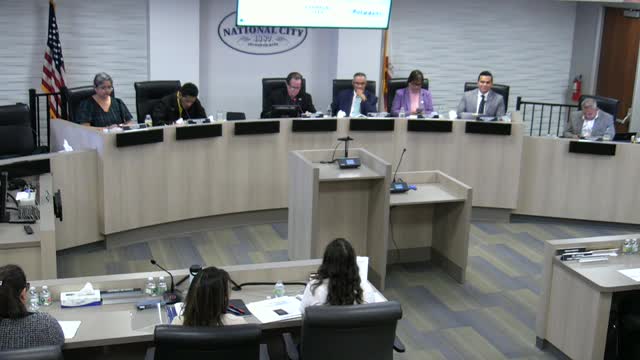
At a special workshop, National City staff and consultants presented the "Own National City" homeownership study and a request-for-proposals (RFP) process for six city-owned parcels, funded by a $450,000 SANDAG grant; the council voted unanimously to accept the report and move the RFP forward.
National City Council members at a special workshop accepted a consultant report on the city’s “Own National City” homeownership study and authorized staff to proceed with a request for proposals (RFP) process for six city‑owned parcels. The RFP was described as scheduled for release March 19; respondents will have roughly 75 days to submit proposals, with staff and consultants reviewing packets and returning recommendations to council in early October.
The study and RFP are funded in part by a $450,000 housing-acceleration grant from SANDAG, city staff said. Angelita Palma, community development manager with the National City Housing Authority, introduced the project as “presenting on Own National City, a grant funded study on home ownership, and will briefly introduce the RFP for 6 city owned properties.” Lenny Gavino of consulting firm Kaiser Marston and Associates described the submission process, saying respondents must register on the PlanetBids platform to receive updates and submit proposals.
The nut graf: National City’s housing profile shows roughly twice as many renters as owners, staff said, and the council has directed city-owned sites zoned residential to prioritize homeownership with an affordability requirement that 75% of units be sold to National City residents. The RFP is intended to test multiple development and ownership models — including deed-restriction limited-equity, community land trusts and limited-equity housing cooperatives — and to surface specific financing approaches from developers for closing feasibility gaps.
Staff and consultants described six sites and key constraints that respondents must consider. Diego Velasco of City Thinkers summarized site conditions: the Highland and Etta Street site (the “Purple Cow” site) is roughly 68,000 square feet and could support compact single-family or townhome formats but requires substantial grading and fire-access planning; the Division Street/R Street site is about 6,400 sq. ft. with a 10-foot grade change and limited frontage; the Roosevelt Avenue/11th Street lot is about 4,791 sq. ft. in the downtown specific plan and could suit compact row homes; an A Avenue/E. 11th Street parcel is roughly 3,911 sq. ft.; a Plaza Boulevard/E Avenue corner near Central Elementary (the Lambs Theater area) has about a 15-foot drop and transit access; and the Plaza Bonita Center Way parcels are high‑speed thoroughfare sites with topography and fire‑access considerations.
Consultants flagged that shared-equity models retain long-term affordability but do not erase initial feasibility gaps. Julie Romy, senior principal at Kaiser Marston and Associates, summarized three limited-equity approaches and stewardship needs: deed restrictions (the city’s current approach), community land trusts (where a nonprofit owns the land and leases it to homeowners), and limited-equity housing cooperatives (resident-owned shares). Romy said the models “require a one time public investment to meet the feasibility gap,” and that ongoing stewardship is critical to preserve affordability.
The RFP timeline given in the presentation: release March 19, roughly 75 days for developer responses (proposals due June 6 was cited), 60 days for staff and consultant review, then about 30 additional days to finalize a short list and prepare presentations for the council; staff expects to return with findings and recommendations in early October.
Public commenters pressed the council to prioritize affordable homeownership on other parcels and raised concerns about certain sites. Michael Aguirre urged the council to “restore the Sweetwater Orange property to zoning 18.6 0.01. That will give you 50 additional affordable housing units.” Another commenter argued that the Plaza Bonita/Center Way parcels are in a rural area and are hazardous to develop, and urged the city to prioritize infill or bayfront sites for housing.
Council members asked technical questions about land ownership and stewardship. When asked whether the city would retain land ownership under deed-restriction models, staff answered that in many proposals National City would relinquish fee title while retaining long-term restrictive controls — for example covenants of 55 to 99 years — to secure perpetuity of affordability. Councilmember Yamani, who moved to accept the report, and Vice Mayor Busch, who seconded, presided over a voice vote reported as unanimous; the mayor noted the motion passed and the council asked staff to return with the shortlist and analysis.
Staff said they will continue pursuing public and private grant funding to support affordable homeownership and encouraged developers and other stakeholders to monitor the city web page for the Own National City program and the PlanetBids RFP posting.
The council adjourned the workshop after the vote and planned to reconvene for the regular council meeting.