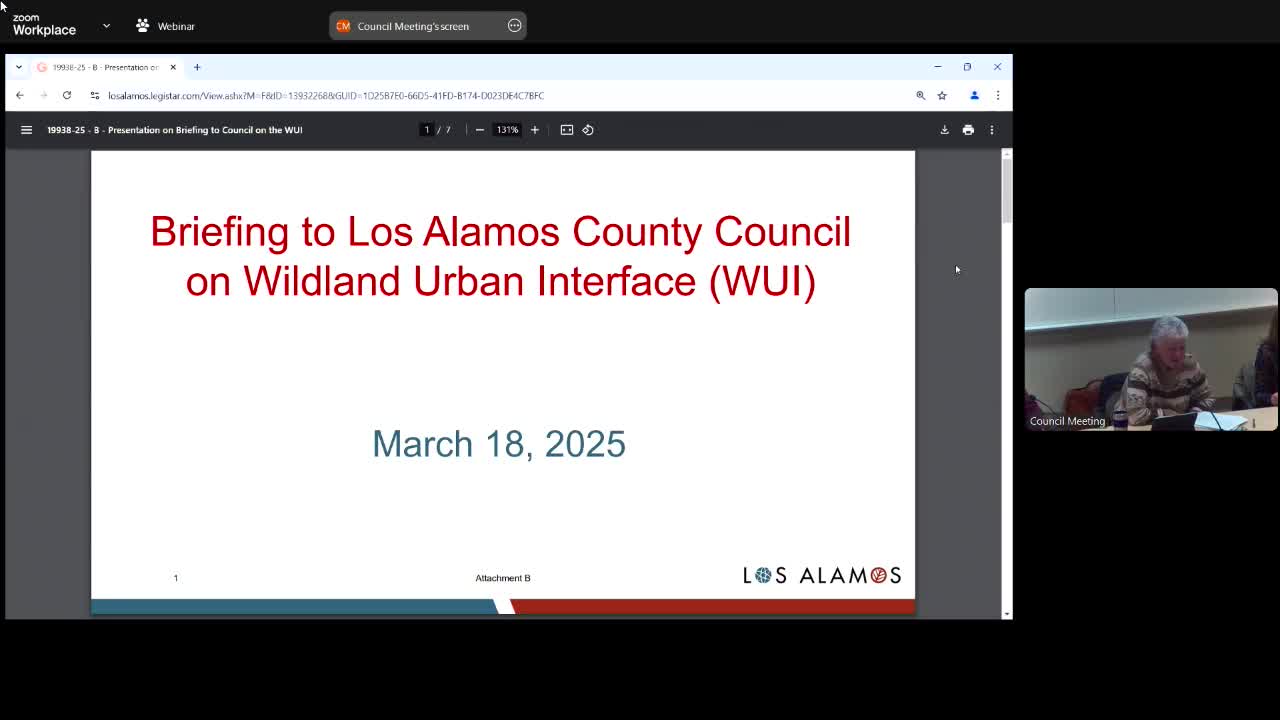
County staff introduces proposed Wildland-Urban Interface rules, outlines building and defensible-space requirements
Loading...
Summary
County building and fire officials presented a draft Wildland-Urban Interface (WUI) approach to the County Council on March 18 that would adopt 2021 IWUI Code provisions for roofs, exterior walls, decks and accessory structures and emphasize defensible-space education.
Los Alamos County staff and the fire department briefed the County Council on March 18 about proposed wildland-urban interface (WUI) provisions the county is considering to reduce wildfire risk in the community.
The presentation, led by Juan Veil (Community Development/Fire division liaison), included David Martinez, the county's chief building official, and Kelly Stern, wildland division chief for the Los Alamos County Fire Department. Staff said the briefing was introductory and not a formal ordinance adoption; they proposed a public education meeting, an April ordinance introduction and a potential May public hearing.
What the draft would require
- Roofing: Chapter 5 of the 2021 International WUI Code would be used as a model; roofs would need a class A covering tested under ASTM E108 or UL 790, which reduces ignition from embers and radiant heat.
- Exterior walls and underfloor enclosures: Materials or assemblies would be required to meet specified fire-resistance or ignition-resistance standards; underfloor areas would be enclosed to the ground to limit ember entry.
- Appendages and projections: Attached decks, stairs, porches and similar projections would have to be built with approved noncombustible materials, exterior-rated fire-retardant-treated wood or ignition-resistant materials that meet the WUI test standards.
- Detached accessory structures: Any detached structure located within 50 feet of a building containing habitable space would be required to meet construction standards equivalent to the WUI exterior-wall requirements.
- Sprinklers and multifamily buildings: The draft references building-code thresholds that typically require sprinkler protection for multifamily structures beyond certain heights or occupancy types; the consultants noted those thresholds are intended to provide additional evacuation time in taller or denser structures.
Fire-prevention emphasis and outreach
Chief Kelly Stern emphasized the county's Ready-Set-Go program and the concept of defensible space, urging property-level actions such as clearing combustible material from the 0-to-5-foot zone around homes and removing ladder fuels that allow fire to climb from ground to canopy. Stern said the department now performs dozens of free home assessments a month, compared with very few a year previously, and urged residents to keep documentation of mitigation steps for insurance purposes.
Staff stressed that the intent of this ordinance project is to improve safety and guidance rather than immediately trigger widespread enforcement; they said the draft is meant to be educational and to focus on mitigations that demonstrably reduce ignition or firefighter risk.
Questions from councilors and clarifications
Councilors asked which parts of the county would be covered; staff recommended applying extreme-hazard designations countywide, including White Rock. Councilors asked whether the draft would create new permit requirements for small homeowner tasks (gutters, downspouts); staff said routine maintenance tasks that are not currently permitted would not be converted into new permit triggers, but building work that already requires a permit (for example, a deck replacement) would be reviewed against the new WUI standards.
Staff also clarified that many of the architectural elements (class A roofs, ignition-resistant exterior materials) were being reintroduced in updated language after parts of the county code had been changed in prior years; they said a majority of existing roofs in town already meet class A standards.
On insurance, staff acknowledged that insurers can apply stricter rules than local codes and that county action cannot compel private insurers; staff said discussions are underway at the state level about insurance availability and the New Mexico Fair Plan coverage limits.
Next steps
Staff proposed an educational public meeting, a formal ordinance introduction as early as April and a May public hearing with a 30-day appeal period before finalization. They asked council for early direction and said technical briefings can be provided for neighborhoods, the public and Tribal partners.