Get Full Government Meeting Transcripts, Videos, & Alerts Forever!
Get email alerts on the Economic Development Incentives topic
No spam. Unsubscribe anytime.
Incentive board recommends expanding 485b zone, proposes citywide 485a mixed-use exemption to encourage housing
Summary
The Industrial Commercial Incentive Board asked the City Council to expand the city's 485b commercial exemption area and to consider adopting a citywide 485a residential-commercial exemption to encourage mixed-use development, subject to guardrails tied to housing outcomes.
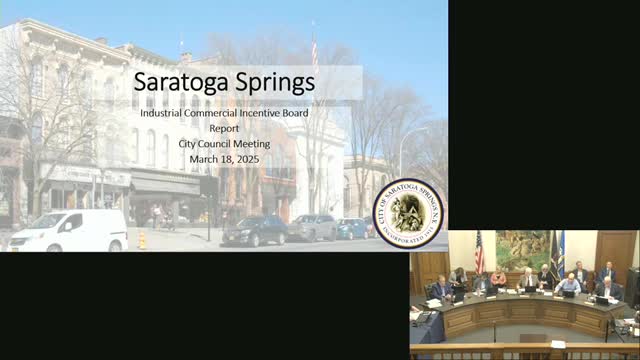
Supervisor Matt Feach presented an update from the Industrial Commercial Incentive Board on Wednesday, asking the council to consider changes to the city's local law implementing Sections 485b and 485a of New York State Real Property Tax Law.
Feach told the council that the board recommends keeping the existing urban-core 485b area downtown and expanding the exemption'eligible area south to include the neighborhood-center zone from Circular Street to the Spa State Park boundary. The board also recommended attaching a clear defining map to the city code so that eligible areas are explicit, and updating the code's industry classification language from the older Standard Industrial Classification (SIC) system to the North American Industry Classification System (NAICS).
Feach explained that a 485b (business investment exemption) provides an assessment reduction — typically a multi-year, phased assessment benefit — to encourage commercial and industrial investment, subject to eligibility rules. He told council members that 485b is limited to commercial/industrial uses only and does not apply to residential components in mixed-use projects. To allow mixed-use projects (commercial with residential, including apartments above storefronts) to benefit from an assessment-exemption incentive, the board recommended the council adopt a separate local law enabling the 485a residential-commercial urban exemption citywide (subject to zoning). Feach said 485a would allow incentives for mixed-use projects that otherwise would not qualify under 485b because 485b excludes residential uses.
Council members asked how the city could guard against developers seeking assessment reductions for luxury condos rather than workforce housing. Feach and county/city officials described possible guardrails the council could consider later, such as targeted application criteria or requirements tied to affordable or workforce-housing components. The city assessor and other members present said the city would need to take care in drafting local law language to avoid unintended vested-rights effects and to clarify the assessor's role in administering exemptions.
Feach said the board also wants the local law to better define the Industrial Commercial Incentive Board's procedures and the assessor's responsibilities following council approval of any exemption request. The board recommended continuing the 485b program to encourage suitable commercial investment and asked the council to consider whether adopting 485a would help achieve the city's housing and mixed-use development goals.
Why it matters: Sections 485b and 485a provide local governments tools to encourage property improvements and investment through temporary assessment reductions. Expanding the eligible area and creating a clear code map could make more properties eligible for commercial incentives. Adopting 485a could create a new citywide pathway to incentivize mixed-use development, which proponents say could support housing objectives if the council places targeted requirements on eligible projects.
Next steps: The board offered to prepare the map and draft code language. Council members signaled interest in further study and asked staff to examine guardrails, assessor procedures and the housing outcomes that a 485a local law should require before the council considers adopting it as local law.