Get Full Government Meeting Transcripts, Videos, & Alerts Forever!
Get email alerts on the Land Use Rezoning topic
No spam. Unsubscribe anytime.
Council denies request to rezone 1405 North Graves Street to townhome zoning after neighborhood opposition
Summary
The council rejected a request to rezone a vacant lot at 1405 North Graves Street from single‑family to townhome residential (TR‑1.8) following multiple residents’ testimony citing parking, scale and neighborhood character concerns.
The McKinney City Council on March 4 denied a rezoning request to change a vacant lot at 1405 North Graves Street from RS‑8/RS‑84 single‑family zoning to TR‑1.8 (townhome residential) after a public hearing in which multiple neighbors spoke in opposition.
Jennifer Arnold, director of planning, described the site as a quarter‑acre vacant lot within an established neighborhood and noted Planning & Zoning recommended approval by a 4–3 vote. The applicant, represented by Ahmed Hilaluzaman, said the plan was to develop two units consistent with the immediate duplex/townhome pattern on nearby lots and to follow city standards for TR‑1.8.
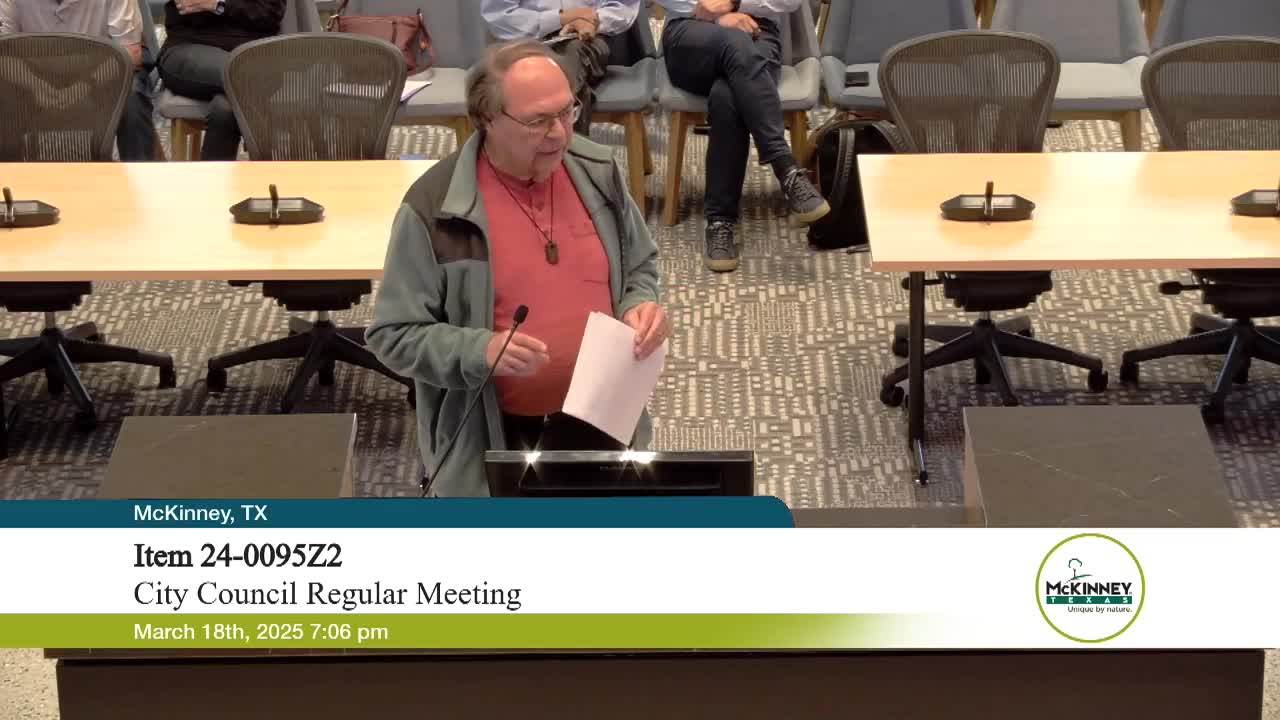
Multiple adjacent homeowners and neighbors — including Leonard Edgar (property owner next door), Aaron Manley and Juan Carlos Cortez — spoke in opposition, citing the established single‑family character of the neighborhood, on‑street parking limitations, the likely scale of a two‑story, multi‑bedroom townhome next to single‑story houses, and potential property‑value impacts. Edgar said the proposed townhome units would be larger and carry more bedrooms (and vehicles) than surrounding houses and expressed concern about spillover parking on narrow local streets.
Several council members debated the issue. Some council members noted that similar density and rental outcomes can occur under single‑family development (accessory dwelling units or large single‑family rentals) and discussed the city’s broader policy objectives for missing‑middle housing. Other members emphasized respect for existing neighborhood character and precedent; one council member cited the council’s prior practice of protecting neighborhood expectations.
After debate, a motion to deny the rezoning passed. The transcript records a motion to deny, a second and that the motion passed; the record does not include a detailed roll‑call tally.
Next steps: Because the council denied the rezoning request, the applicant may revise the proposal and return at a later date; any new proposal would need to meet planning staff standards and follow the city’s rezoning procedures.