Get Full Government Meeting Transcripts, Videos, & Alerts Forever!
Get email alerts on the Airport Infrastructure Funding topic
No spam. Unsubscribe anytime.
McKinney boards, council approve $30 million CDC grant and authorize sales-tax bonds to fund Eastside Airport work
Summary
The McKinney Community Development Corporation (CDC) and McKinney Economic Development Corporation (EDC) on March 18 approved measures to fund Eastside Airport infrastructure and a small passenger terminal, and the McKinney City Council authorized the related sales-tax bond resolutions.
McKINNEY, Texas — The McKinney Community Development Corporation (CDC) and McKinney Economic Development Corporation (EDC) on March 18 approved measures to fund Eastside Airport infrastructure and a small passenger terminal, and the McKinney City Council authorized the related sales-tax bond resolutions.
The CDC voted to approve a $30,000,000 project grant application to finance Eastside Airport infrastructure and terminal elements, and the EDC approved a sales-tax revenue bond authorization that includes $22,400,000 designated for the airport project. City staff and municipal advisors said the CDC and EDC bonds are intended as interim financing until a long-term TIFIA loan from the U.S. Department of Transportation can replace the interim debt at a substantially lower interest rate.
City Chief Financial Officer Mark Holloway (chief financial officer) and Dave Gordon (senior managing director, Estrada Hinojosa) described transaction structure and next steps. Gordon said the CDC financing will be arranged as a private placement and that Truist Bank submitted the winning proposal; the CDC notes are interest-only for the near term and callable to allow refinancing with the federally backed TIFIA loan. Gordon gave a pro forma interest rate for the private placement and described a roughly 4.27% rate for that instrument.
Barry (staff member) described project phasing and revenue assumptions. Staff explained the Eastside work is being treated as four subprojects — terminal and roundabout (to proceed now if funding is approved), taxiway and other infrastructure (to be staged later) — and that approximately $5.3 million in prior design grants had been awarded. The CDC and EDC approvals were presented as steps needed to issue interim sales-tax revenue bonds that would be retired when the TIFIA loan closes.
City and consultant presentations included a recently updated economic-impact analysis. For the construction phase staff summarized a one-time economic output of about $122 million and an estimated 610 combined direct, indirect and induced construction jobs. Projected airline operations under the current airline partnership showed roughly 130,000 enplanements in the first year (described as three to five average daily departures) and a ramp to about 430,000–450,000 enplanements by year three; staff said the year-three operating level would generate roughly $394 million in annual economic output and about $10.4 million in annual local tax receipts (direct, indirect and induced) split among local taxing entities.
Staff outlined operating and capital revenue streams and constraints. Barry noted, “The revenues generated from the airport have to remain on the airport. We cannot divert those revenues.” He and other staff said passenger facility charges (PFCs) are restricted to eligible capital costs and could, by year three in the pro forma, generate an estimated $1.7 million annually; a portion of PFC receipts would be available to offset debt service on the CDC/EDC financing. Staff also said operating revenues and airport facility charges could be used to fund airport-related public-safety costs but cannot be diverted to general non-airport uses.
Council members and board members pressed staff on contingencies and cost exposure. Council and board members were told that, if the TIFIA loan does not materialize, the CDC interim private placement can be refinanced in the public markets into a 30-year sales-tax revenue bond; Gordon said the TIFIA loan rate would be roughly half the 30-year U.S. Treasury rate in current markets (about 2.33% at the time of the briefing), while public municipal market rates would be materially higher. Staff estimated additional annual public-safety operating costs tied to the airport at roughly $2 million–$4 million per year depending on staffing and service levels; staff said those public-safety costs are part of the city’s budget process and may require future general-fund budget adjustments.
Votes and procedural steps: the CDC approved the $30,000,000 project grant application and later adopted a resolution delegating pricing and sale parameters for CDC sales-tax revenue bonds. The CDC’s private placement transaction was described as a seven-year structure with an interest-only period and a 4.27% illustrative rate; staff said the CDC will seek to replace that interim debt with a TIFIA loan if available. The EDC approved the related EDC bond authorizations, structured as two series (a taxable series for certain project pieces and a tax-exempt series for others); staff presented a pro forma total project fund figure and estimated public-sale yields (taxable about 5.8% pro forma, tax-exempt about 4.7% in the slides). In each case, the city council subsequently authorized the corresponding resolutions to permit issuance.
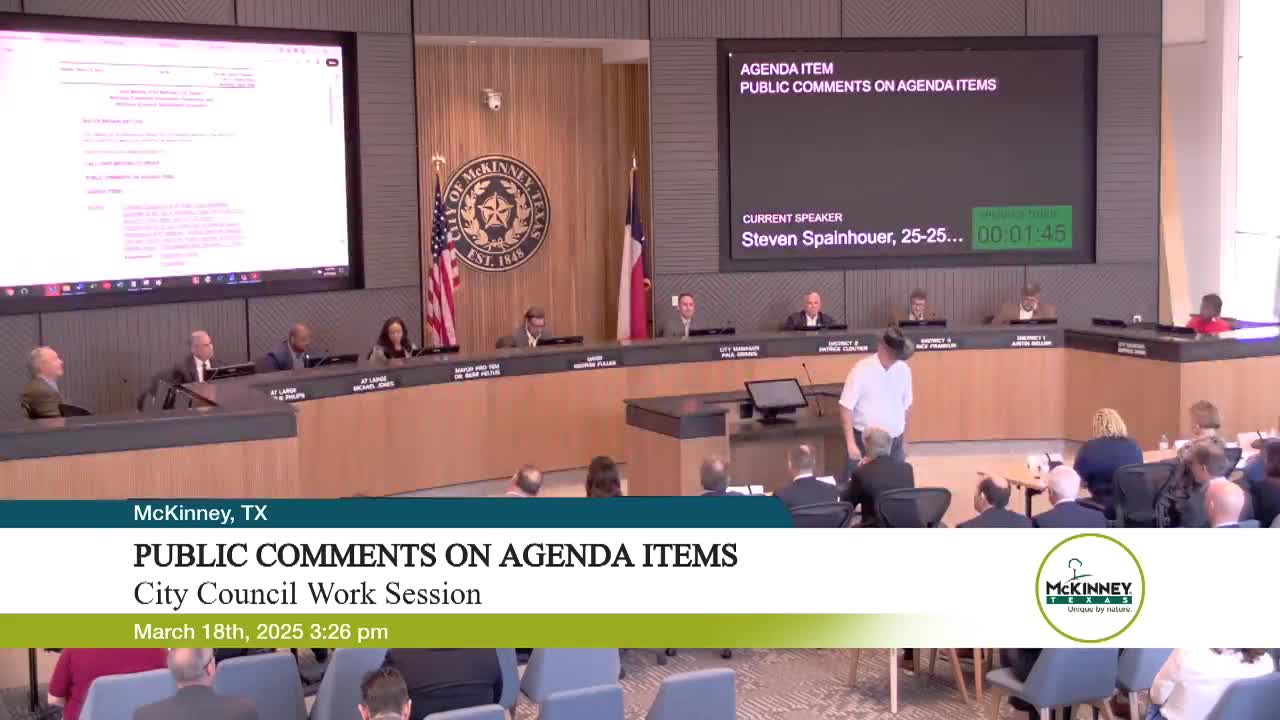
Public comment included a statement of support for the project. Resident Steve Spainhour told the boards, “...let’s get this airport built,” and thanked officials for their work on the project.
Next steps: staff said they expect further administrative steps including final pricing and closing dates if bond authorizations are used, an anticipated rating call and pricing for any EDC public sale in early April, and continuing pursuit of federal and state grant resources to reduce the local funding need. Staff also said the schedule anticipates closing a TIFIA loan if awarded, which would replace interim debt at a lower interest cost.
Meeting materials and staff presentations contained multiple pro forma assumptions; staff emphasized the difference between capital and operating revenues and noted some operating and capital costs (for example, additional police and fire staffing) were excluded from the 10-year operating pro forma shown to the boards.