Get Full Government Meeting Transcripts, Videos, & Alerts Forever!
Get email alerts on the Water Billing topic
No spam. Unsubscribe anytime.
City manager outlines water-billing process; council asks for impact study on irrigation base fee
Summary
City Manager Cliff Blackwell briefed the council on water billing, automated meters and policies after an apartment billing error prompted review. Council asked staff to prepare an impact study on removing or modifying the irrigation base fee for months of nonuse and to return with findings.
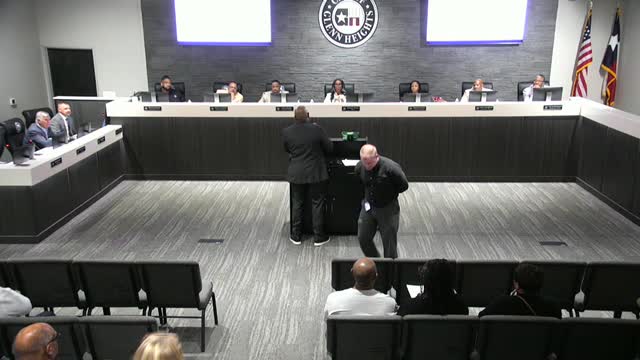
City Manager Cliff Blackwell provided a detailed presentation on March 20 about Glen Heights’ water and irrigation billing processes, meter technology and customer protections after a complaint from an apartment complex highlighted billing inconsistencies.
Blackwell said the city reads most meters on the 12th of each month and uses an automated meter infrastructure (AMI) system for digital meters that the city installed about four years ago at a cost of approximately $3,400,000. He said roughly 95% of the city’s approximately 11,304 meters are AMI-enabled, with the remaining 5% read manually; about 4,200 meters are irrigation meters.
The city manager explained the billing workflow: reads are pulled into the billing system, staff run meter-edit and high/low reports to flag missing reads or unusual usage, and bill calculations are reviewed before a third party prints and mails roughly 6,500 bills. Blackwell described the city’s leak-adjustment policy (one adjustment per rolling 12 months, with staff splitting the difference 50/50 after verifying usage and a customer-provided plumber invoice) and said the city will pursue an IVR payment option and continue evaluating its billing software.
Council members asked for operational detail. Council Member Bruton asked how many accounts require manual review; staff said rereads range from roughly 20 to 50 per month for physically read meters and that calculation-review flags can generate 25 to 80 accounts for closer inspection depending on month and season. Blackwell said the city will continue to check for errors and work with customers when bills appear inaccurate; he cited one recent case where an apartment customer received an incorrect bill and the city adjusted the account.
Mayor Brown and others raised questions about irrigation billing during months of nonuse. The council asked whether a credit system, a seasonal suspension or other change could be implemented so residents who do not use irrigation in winter months would not feel they are paying for unused service. Blackwell said the irrigation base charge helps meet the water fund’s revenue requirement (he cited a 2024 revenue requirement of about $9,900,000 and reported pre-audit revenues for the year were about $11 million). He explained that rate design spreads the fund’s fixed costs across base charges and volume charges and that removing a base charge for irrigation would require reallocating revenue across other charges or meters.
Following discussion, council requested staff prepare an impact study showing the effects of removing or altering the irrigation base fee for a four- to six-month winter period and return with that analysis, with discussion targeted for an upcoming meeting (council indicated April 1 as a potential follow-up). Blackwell also said staff will continue to promote the mymeterinfo monitoring tool to customers and explore further AMI coverage and meter vault options for RV parks and similar locations.
No formal action was taken at the March 20 meeting on rate changes; council directed staff to provide the requested impact analysis.