Get Full Government Meeting Transcripts, Videos, & Alerts Forever!
Get email alerts on the Emergency Medical Services topic
No spam. Unsubscribe anytime.
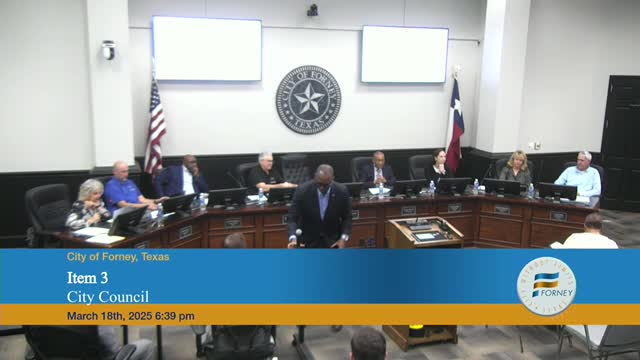
Forney reviews EMS assessment; consultant outlines options to shorten response times
Summary
Consultant Fitch & Associates presented an EMS assessment showing average Forney response times of 9.3 minutes (13.7 at 90th percentile), modeling options that would require between two and six ambulances to meet different travel-time goals; council members and residents pressed for more data and next steps.
Fitch & Associates told the Forney City Council on Tuesday that the city’s current EMS response performance averages 9.3 minutes from 911 call to first unit on scene and 13.7 minutes at the 90th percentile, and outlined options that range from contracting for dedicated ambulances to building a municipal ambulance service.
The consultant’s report, presented by Thomas Moore of Fitch & Associates, summarized five years of call and CAD data and modeled multiple staffing and deployment scenarios to show what it would take to reach travel-time goals commonly used in emergency medical services planning.
Moore said dispatch times averaged 1.6 minutes (2.7 minutes at the 90th percentile), turnout time averaged 1.6 minutes (2.7 at the 90th), and travel time averaged 6.1 minutes (10 minutes at the 90th). “Response time — the citizen’s experience, from call to first unit on scene — averaged 9.3 minutes and was 13.7 minutes at the ninetieth percentile,” Moore said.
Why it matters: For high-acuity incidents such as cardiac arrest and drowning, research cited by Fitch shows outcomes improve with faster first-response times; the city must weigh how much improvement it wants against the cost of adding staffed units or changing service models.
Fitch presented modeled options by travel-time target and estimated resources. To achieve a 7-minute travel-time goal to roughly 93.8% of incidents, Fitch estimated five post locations and six staffed ambulances would be required. A 10-minute target would require about three post locations and four staffed ambulances and would cover about 95% of incidents; longer thresholds (12–14 minutes) required fewer units but yield lower clinical performance on the small subset of very high-acuity calls.
Moore described several delivery models. Because Forney is within Kaufman County’s service area, CareFlight currently provides transport under the county contract; the state of Texas places EMS obligations across a range of possible providers and does not force a single municipal provider model. Options the consultant outlined included: - Issuing a detailed RFP for an exclusive or performance-based contract, a process that could take roughly two to three months to draft and about six to eight months to complete through award and negotiation. Moore said a city that began the process immediately might expect a provider selection by October or November on the timetable he described. - Building a municipal ambulance service, which Fitch estimated could require 36 to 60 months to recruit staff, acquire vehicles and equipment, obtain state and federal licensing (including CMS and DEA registrations where applicable), and stand up operations.
Moore also presented cost and revenue modeling. He said municipalities nationwide have paid roughly $800,000 to $1,000,000 per staffed ambulance per year for full 24/7/365 coverage in recent procurements; Fitch’s modeling put possible annual net transport revenue in Forney in a broad range roughly between $1.2 million and $1.8 million depending on transport volume and payer mix. Fitch estimated 59–63% of transports in the modeled area would be reimbursed by government payers (Medicare/Medicaid) based on regional patterns.
Interim Fire Chief John Holcomb framed the study as the start of a “thorough review and assessment” of Forney’s EMS, adding the fire department could be part of a municipal response model if the council chose that path. “With the right strategies and investments, we can ensure Forney remains a city where every resident receives the fast, reliable emergency medical care they deserve,” Holcomb said.
Public comment at the meeting reinforced urgency. Resident Millionaire Williams, who said she lives outside the city limits but in Kaufman County, told the council she and other residents have experienced or reported long waits for care and urged the council to act: “We must ensure we keep up with the growth and demand for services within our city, including fire and EMS response,” she said, recounting a personal medical emergency in which she said delayed care nearly cost her life.
Council members pressed Fitch on details. Questions included whether modeled growth rates account for new housing unit build-out, how to handle interfacility transfers (IFTs) in a municipal model, whether the city can contract for peak-hour coverage rather than full 24/7 units, and how railroad crossing delays should be factored into deployment plans. Moore said Fitch can model alternate shift patterns, peak-hour units, and minute-by-minute travel thresholds on request and offered to provide additional data tables and minute-by-minute outcome summaries the council requested.
Moore noted data limitations: Forney’s municipal CAD and CareFlight’s CAD are not directly linked by an API, so some timestamps are entered manually; Fitch audited and compared both sources and found no large variances, but manual entry can reduce data fidelity. Moore said establishing an automated CAD linkage could cost in the range of $25,000–$70,000 depending on vendor complexity.
City Manager Charles Daniels thanked Fitch for the report and said the study provides a baseline for future decisions. No formal action was taken at the meeting; council members requested additional modeling and data and discussed possible next steps including an RFP or phased municipal build-out.
The council repeatedly returned to three trade-offs: clinical outcomes tied to shorter first-response times, the marginal cost to reach each minute improvement, and how to fund either a contract or a municipal system. Fitch recommended the council decide what performance thresholds it wants (for example, a 7- or 10-minute travel-time target), and then use that policy choice to drive procurement or service-design decisions.
Next steps mentioned at the meeting included Fitch supplying additional tables (population-to-housing build-out overlays, minute-by-minute outcome tables and alternative staffing/shift scenarios) and staff evaluating whether to draft an RFP or pursue in-house service development.