Get Full Government Meeting Transcripts, Videos, & Alerts Forever!
Get email alerts on the Chicken Ordinance topic
No spam. Unsubscribe anytime.
Hanford council reviews chicken‑keeping rules; members favor keeping a three‑chicken default but discuss permits for larger lots
Summary
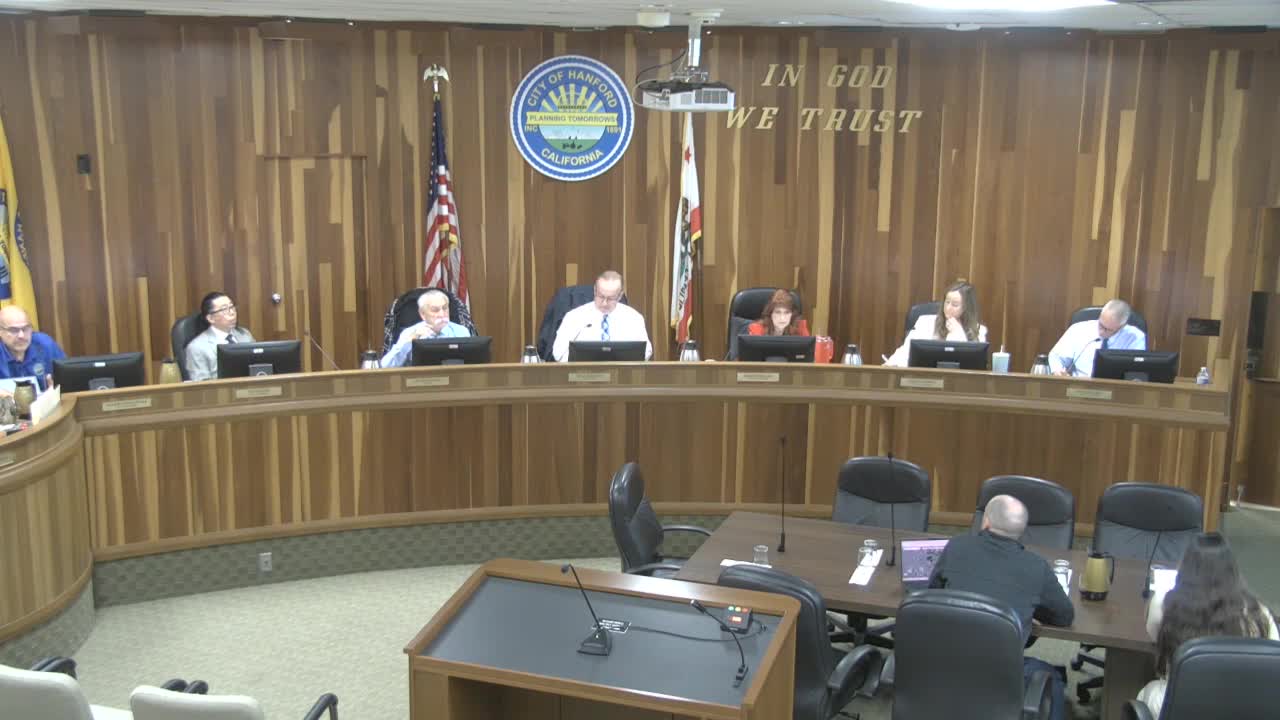
Hanford City Council members, staff and members of the public spent substantial time revisiting the city’s municipal code on keeping chickens, debating whether to retain a flat three‑chicken allowance or tier allowances by lot size.
Hanford City Council members, staff and members of the public spent substantial time revisiting the city’s municipal code on keeping chickens, debating whether to retain a flat three‑chicken allowance or tier allowances by lot size.
The nut graf: Staff presented comparative ordinances from other Central Valley cities and told council that Hanford currently allows up to three chickens in residential zones (RL‑5, RL‑8 and RL‑12) with a required coop/run, 10‑foot setback from property lines and 5 feet from habitable buildings; council focused on whether to move allowances to a parcel‑size standard, keep a single default limit, or create a permit/exception process for large lots.
Planning staff explained that parcel size varies inside zoning districts (for example, some RL‑5 parcels are only ~3,000 sq ft while others are acres), which complicates zoning‑based tiers; staff noted some cities tier by lot area and cited Rancho Cucamonga and Moraga as examples of lot‑size based approaches. Staff also cautioned that changes could trigger environmental review under CEQA: Bakersfield’s 2021 attempt to expand chicken allowances prompted litigation and a CEQA challenge, staff said.
Council members expressed mixed views but converged on keeping the current three‑chicken allowance as a straightforward, enforceable rule while considering options for larger lots. Vice Mayor Paden and other councilmembers suggested a petition or permit route for lots above a certain size that would allow more chickens with review and possible fees; staff noted a permit/application pathway would be discretionary and could trigger CEQA review and additional administrative workload.
Several residents spoke: Larry Ferreira supported a modest increase for families’ needs but urged enforcement against large, business‑like backyard flocks; other residents described positive personal experiences with backyard chickens. Staff confirmed enforcement has been mainly complaint‑based and said citations are rare because most residents comply after notice; the usual enforcement sequence is notice of violation followed by a compliance period.
Council discussion also touched on setbacks and coop sizing as mitigation tools: larger setbacks or minimum open area requirements can limit maximum flock size on narrow parcels without requiring owners to know exact lot area. Staff recommended that if council wants tiered allowances, a clear parcel‑size table and enforcement approach should be prepared for a future ordinance draft.
Ending: Council did not adopt a change at the session. Staff will return with options if council wants a formal ordinance change including (a) a simple three‑chicken default with an application process for larger lots, or (b) a lot‑size tiered schedule. Any discretionary permitting scheme may require additional environmental review.