Get Full Government Meeting Transcripts, Videos, & Alerts Forever!
Get email alerts on the Energy Development topic
No spam. Unsubscribe anytime.
Port Arthur council approves ground lease with Diligence Offshore after heated public debate over turbines and environmental risks
Summary
The Port Arthur City Council approved a ground lease with Diligence Offshore Services LLC for roughly 2,274 acres of city-owned land for energy-related development after council members and residents debated environmental, permitting and financial concerns.
Port Arthur City Council on March 18 approved a resolution authorizing the city manager to execute a ground lease with Diligence Offshore Services LLC for about 2,274 acres of city-owned land for energy development, including “solar energy facilities, a substation, data center, offshore energy hub and other necessary facilities.”
The vote followed more than two hours of public comment and council debate that focused largely on proposed wind-turbine construction in areas around Sabine Lake and Pleasure Island. Supporters said the project could bring jobs, training and community benefits; opponents warned of ecological, navigational and long-term economic harm and questioned the contract language and permitting pathway.
Why it matters: Council approval clears a narrow municipal step — leasing city property — but does not itself authorize construction or operation. Permits from state and federal agencies would still be required, and critics argued the lease leaves the city exposed to financial and environmental risks.
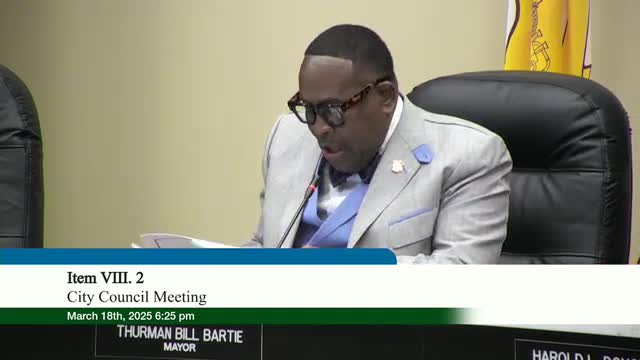
Council members who spoke described competing priorities. Councilman James Lewis moved the resolution; Councilman Frank seconded it. During a later roll-call vote Mayor Pro Tem Beckham voted no; Councilman Doucette and Councilman Frank voted yes; Councilwoman Hamilton Everfield voted no; Councilman Lewis and Mayor Thurman Bill Barty voted yes. The mayor announced the measure passed.
Opponents and concerns raised in public comment: Several Pleasure Island residents and fishermen said turbines could harm fishing, shrimping and birding and cited possible dredging, pile-driving and increased turbidity in Sabine Lake. Hilton Kelly, founder and director of the Community and Power Development Association, urged the council to focus on existing industrial pollution in local waterways and air. Sean Clifford, a Pleasure Island resident and former Siemens employee, questioned decommissioning and maintenance costs, saying blade disposal and replacement could leave communities with long-term hazards. Kyle Kimball of the Port Arthur Harris Shrimpers Association said turbine parts and oils are toxic and would affect bottom-feeding shrimp.
Developer response and supporters: Harry Crawford, identified as the developer, said his company would use what he described as environmentally friendly materials, cited an initial lease payment of $227,300 and presented a community-benefits plan he said would include $31 million in local commitments: workforce training, housing and business seed funding. Reverend Simeon Queen and other residents said the project could increase jobs and tax base.
Council discussion and legal/permit context: Council members repeatedly noted that the lease is distinct from state and federal permits. Councilman Doucette and others said lease authorization does not mean turbines will be permitted or built; those decisions rest with agencies such as the U.S. Army Corps of Engineers, the Texas Commission on Environmental Quality and other state and federal regulators. Councilwoman Everfield said she had spoken with TCEQ, the U.S. Army Corps of Engineers and the Texas General Land Office and was told those agencies could limit permitting of facilities and transmission lines in the proposed area.
Contract-specific concerns: At least one council member referenced outside legal review saying the lease contains timelines, mortgage and decommissioning provisions that favor the developer, raising the risk that the city could lose control of the land or be left with minimal legal protection and low royalties if a project failed. Critics also said no appraisal had been done and that enforcement remedies were not “friendly to the city.”
What happens next: The lease approval allows the developer to proceed with next steps that may include seeking state and federal permits and, according to the developer, beginning the process for site work. The council’s vote was on the lease only; further approvals and external permits would be needed before construction could begin.
Ending: The approval capped a meeting that included lengthy public comment and divided council debate. Several speakers asked the council to delay or seek stronger contract protections; the final vote signaled a narrow majority willing to allow the property lease to proceed as the project moves into regulatory review and permitting.