Get Full Government Meeting Transcripts, Videos, & Alerts Forever!
Get email alerts on the Utilities Water Rates topic
No spam. Unsubscribe anytime.
Resident presses council on irrigation meter charges; staff says owners can remove meters and city will notify holders
Summary
A Cross Creek Ranch resident told the Fulshear City Council on March 18 he is being charged a $13.44 base fee on an irrigation meter even when he uses no irrigation water; staff said 148 residential irrigation meters are active and that owners may request meter removal at no charge.
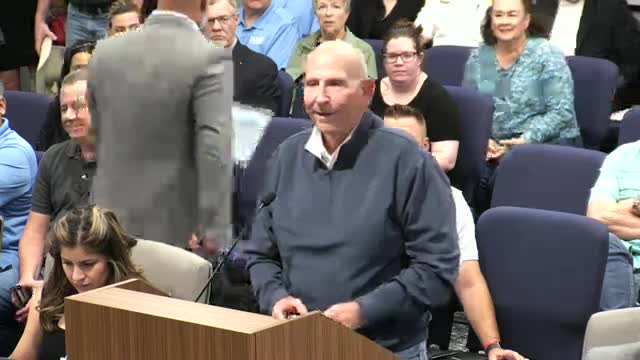
During the public comment and utility item portions of the March 18 meeting, resident CJ McDaniel raised concerns about irrigation meters and recurring base charges. McDaniel said he and other residents install irrigation meters to avoid paying sewer charges on water that does not enter the sewer system, but that during months when irrigation is turned off he continues to be billed a roughly $13.44 base charge despite using no water.
City staff response - Staff explained that since the city adopted a winter averaging policy a few years ago, sewer charges are calculated to exclude most irrigation use, and that irrigation meters were originally used to prevent sewer billing on irrigation water when winter averaging did not exist. - The city reported there are 148 residential irrigation meters. Staff said removing an irrigation meter is an option and can be done at no charge; removing a meter saves the meter maintenance costs and the monthly base charge, and the physical meter can be redeployed elsewhere in the system. - Staff noted a citywide utility rate study is under way (or about to be launched) and that staff can request the consultant examine how irrigation meters and base‑rate treatments should be structured; staff also said it is not necessary to add that study specifically for the small number of residential irrigation meters but can include an analysis if council wishes.
Council and staff direction - Council asked staff to notify residential irrigation‑meter owners about the option to remove their meter and explained that staff will handle such requests on a case‑by‑case basis if owners ask for removal. - For commercial irrigation meters (the city reported there are 347 commercial irrigation meters), staff said those accounts are managed separately and typically involve larger base rates and irrigation demand; council indicated commercial meters likely should remain in place because many are required for landscape obligations and higher irrigation volumes.
Quotes - "I feel it's like taxation without representation — being charged for product I'm not really getting," resident CJ McDaniel said of the base charge. - "If they don't want it, they ask, we'll remove it," a utilities staff member told council when describing the removal procedure.
What this means: Staff will notify residential irrigation‑meter customers of the removal option. No formal policy or ordinance change occurred at the meeting; staff said the existing winter averaging policy and the pending utility rate study provide the framework to evaluate longer‑term rate structure changes if council requests that analysis.