Get Full Government Meeting Transcripts, Videos, & Alerts Forever!
Get email alerts on the Infrastructure Roads topic
No spam. Unsubscribe anytime.
Council hears citywide pavement condition index; sets target to keep roads in satisfactory or better condition
Summary
City staff and consultant presented a citywide pavement condition index (PCI) showing more than 93% of streets in good condition. Council gave staff direction to adopt a target of ‘‘satisfactory or better" (roughly PCI 70 and above) as the planning threshold for maintenance and rehabilitation.
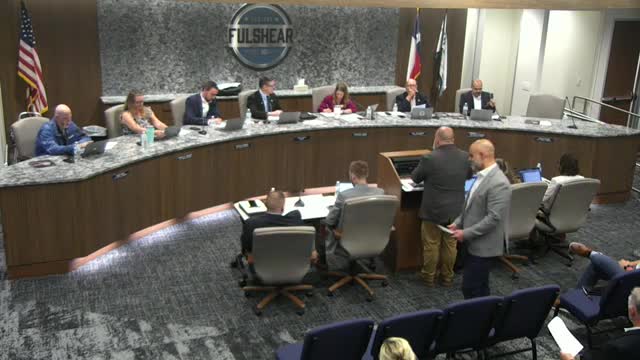
The Fulshear City Council received a presentation March 18 on a new citywide pavement condition index (PCI) and an associated pavement‑management approach intended to guide maintenance and capital spending.
Cliff Goodlander, city staff, summarized the scope: the study conducted by KSA Engineers (now part of Pape Dawson) evaluated roadway surfaces, sidewalks and signage, and produced a GIS‑linked inventory staff can use to schedule maintenance. Consultant Bill Carrillo said the PCI assigns a score from 0 to 100 based on observed surface distresses; higher scores indicate better pavement condition. Carrillo briefed the council on typical treatment types (preventive maintenance, rehabilitation such as mill‑and‑overlay, and full reconstruction) and on cost relationships—preventive work is far cheaper in lifecycle terms than reconstruction.
Key findings and next steps - The consultant reported that more than 95% of roadway lane miles are in the city's highest categories (new/good condition); areas of older pavement with greater wear are concentrated in the historic downtown sector and along portions of Bois D'Arc/Bodark Lane. The study identified roughly 352 sidewalk locations that meet the city's defect criteria and created a database for repairs. - Carrillo described PCI as a planning tool to catch pavements early on the life‑cycle curve, before they require expensive reconstruction. - Staff said the full survey and the base GIS dataset represent an initial investment; future rescans would be targeted and significantly cheaper.
Council direction: The council debated whether to use a target of "fair or better" or a stricter threshold. Council members said Fulshear's overall high score justifies a more protective standard. Council reached consensus to adopt a target of "satisfactory or better" (the staff reference ranged roughly to a 70–75 PCI boundary) as the planning threshold for preventative and maintenance work. Staff said the PCI results will inform the city's pavement management and be used to prioritize projects in future budgets; staff recommended rescanning in about five years given the current high average condition.
Quotes - "For every dollar of preventive maintenance, a rehabilitative project is about three times more expensive and reconstruction roughly 15 times more expensive," consultant Bill Carrillo told the council. - "This gives us a good starting point so we can be proactive rather than reactive," said Cliff Goodlander, city utilities/public works staff.
What this means for budgeting: Staff said the PCI and the GIS inventory will be referenced in the 5‑year capital and maintenance planning cycle; because the overall network score is high, staff indicated rescans could be spaced out (e.g., five or six years) and future updates could be targeted to downtown and corridors seeing greater wear.
Evidence: The PCI presentation and the council's consensus were recorded in the meeting packet and the March 18 staff presentation.