Get Full Government Meeting Transcripts, Videos, & Alerts Forever!
Get email alerts on the Pro Housing Program topic
No spam. Unsubscribe anytime.
Senate committee advances bill to expand "pro housing" designation to include tenant protections and homeless services
Summary
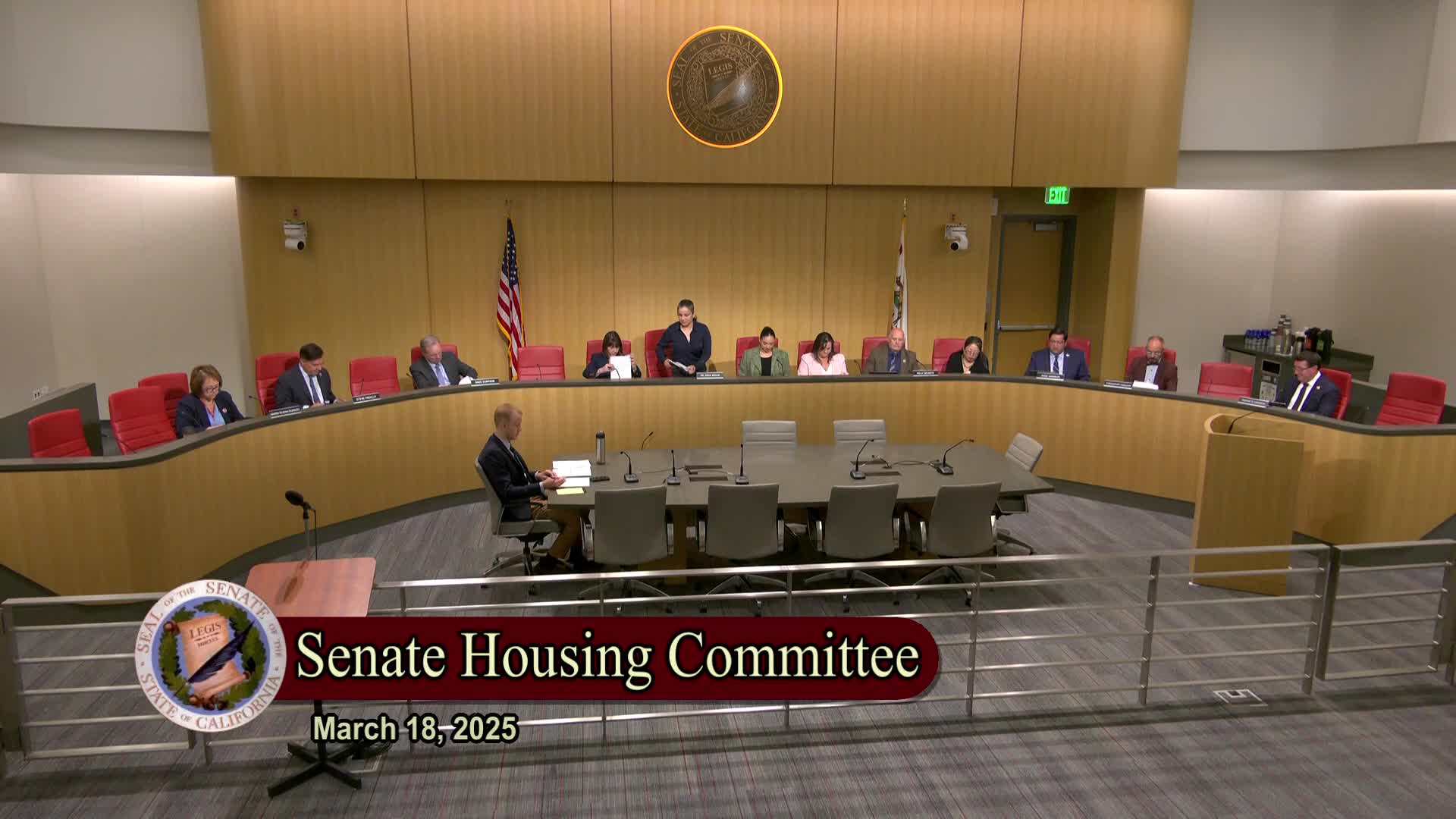
The California Senate Housing Committee voted to pass SB 262, a bill by Sen. Wahab that would broaden the state's pro housing program to allow jurisdictions to receive recognition for tenant protections, preservation and services for people experiencing homelessness; the measure passed as amended and is headed to appropriations.
SACRAMENTO — The Senate Housing Committee on Tuesday voted to pass SB 262, a bill by Senator Wahab that would expand the state'designated "pro housing" program so local jurisdictions can be credited for policies that protect residents from displacement and provide services for people experiencing homelessness.
Supporters said the bill broadens the state's existing focus on housing production to include preservation and protection measures such as tenant protections, rental assistance, legal services, low-barrier navigation centers and safe camping programs. "This bill does not require any city or county to enact these policies or programs," Wahab told colleagues during the hearing. "This just leaves how these additional policies and programs are weighted up to the agency."
The bill's author framed the change as part of a three-pronged approach to California's housing crisis: production, preservation and protection. "Pro housing is not just about constructing housing," said Rand Martin of the AIDS Healthcare Foundation. "Pro housing is making sure that people have a roof over their heads. Whatever that roof looks like ... it is important to make sure that they are protected and housed." Martin testified in support on behalf of AHF's Housing as a Human Right division.
Opponents urged a no vote, arguing that tying rent stabilization and tenant-protection measures to the pro housing designation would undercut the statute's original purpose of incentivizing housing construction. "Rent control does nothing to incentivize housing construction," Deborah Carlton of the California Apartment Association told the committee, citing research and prior local examples she said show rent control can reduce net new housing production. Adam Redley of the California Chamber of Commerce testified in respectful opposition, saying the change could create a perverse incentive structure for jurisdictions competing for limited state funds.
Several committee members said they supported advancing the bill even as they warned that the measure will require refinement in later committees. Senator Cabaldon, who said he previously supported the pro housing designation for production-focused priorities, suggested the committee might ultimately need more than one designation to reflect different local capacities and goals. Senator Durazo and others emphasized that protecting tenants and preventing displacement are central to achieving housing stability for vulnerable groups, including seniors and those exiting homelessness.
A motion to pass SB 262 as amended to the appropriations committee was made and accepted. The committee reported the bill out by a recorded tally of 7 yes, 2 no. The bill will go next to the Senate Appropriations Committee, where funding-related and technical details will be considered.
Votes at a glance: SB 262 —Motion: Do pass as amended to appropriations (mover: Senator Padilla). Outcome: Approved. Tally: 7 yes, 2 no. (Names and roll-call details recorded on the committee transcript.)
The bill text, as discussed, instructs the administering agency to consider, among other items, tenant protections, legal assistance funding, low-barrier navigation centers and safe camping programs when scoring jurisdictions for the pro housing designation. The author emphasized repeatedly that the bill is intended to be permissive, allowing jurisdictions to adopt protective policies without mandating them.
The committee hearing included roughly a dozen witnesses and multiple committee questions and amendments; proponents and opponents said they will continue to negotiate technical language as SB 262 moves through the legislative process.