Get Full Government Meeting Transcripts, Videos, & Alerts Forever!
Get email alerts on the Technology Gen Ai topic
No spam. Unsubscribe anytime.
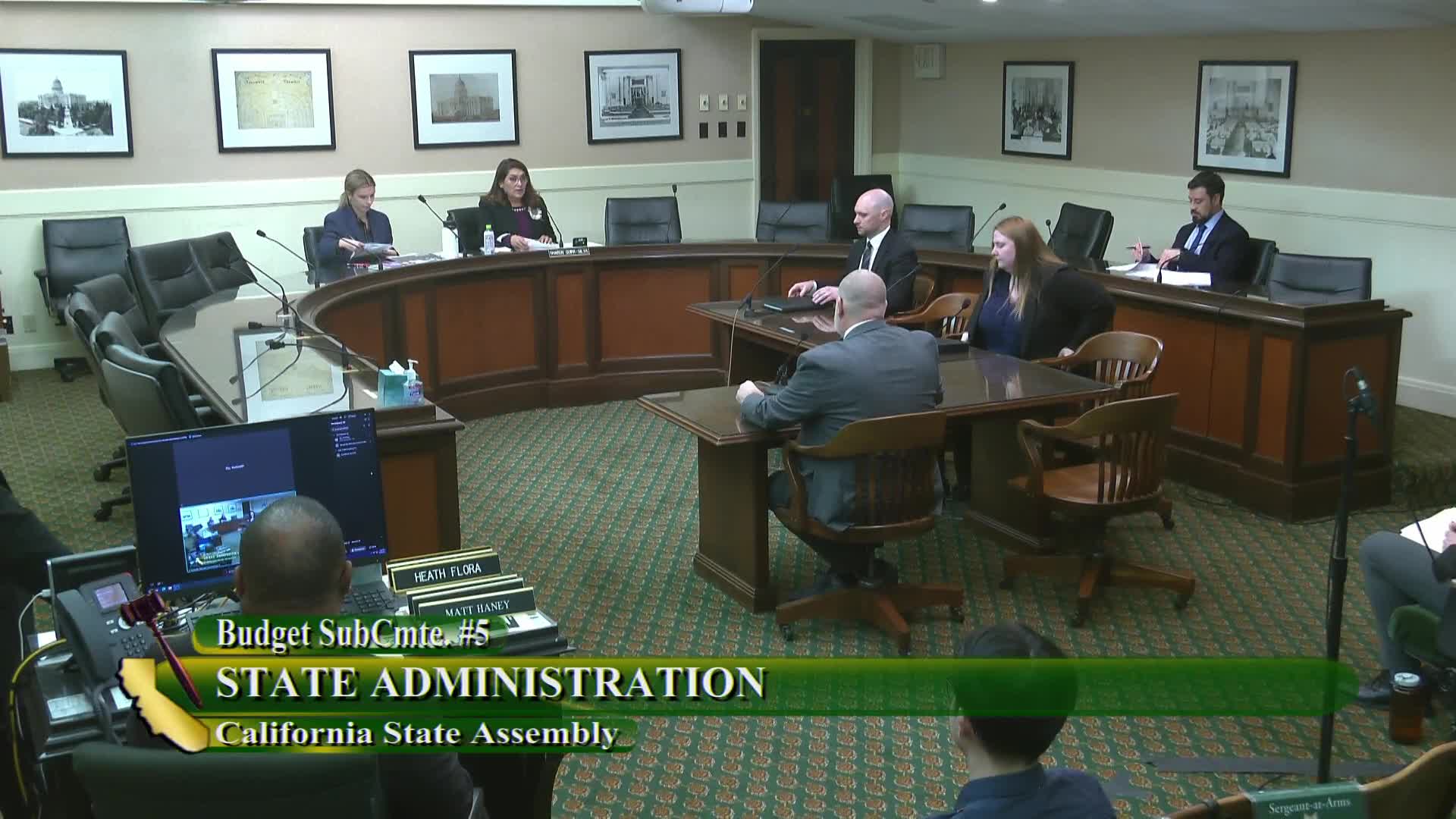
Assembly subcommittee hears GovOps update on state generative-AI pilots; most deliverables complete
Summary
The California State Assembly Budget Subcommittee No. 5 received an update from the Government Operations Agency on the state'wide generative‑AI pilot program; GovOps said it has completed nearly all deliverables under Executive Order N‑12‑23, with one workforce item still under review.
The California State Assembly Budget Subcommittee No. 5 received an update on the administration’s statewide generative‑AI pilot projects and related policy work on [date not specified]. Justin Howard, deputy secretary for fiscal policy administration at the Government Operations Agency (GovOps), told members that most deliverables required by Governor Newsom’s Executive Order N‑12‑23 have been completed and that one workforce deliverable remains under final review.
Howard said the administration has produced a series of reports and guidance documents and “we have met nearly all the deliverables that have been outlined in the governor's executive order. We only have 1 outstanding deliverable to go.” He described partnerships with the Department of Technology, Department of General Services, Department of Human Resources, Office of Data and Innovation and academic partners including UC Berkeley and Stanford, and said GovOps has coordinated stakeholder engagement with labor and federal partners.
Why it matters: the executive order directed state agencies to inventory AI uses, identify risks and put procurement and project approval processes in place so departments can adopt generative‑AI tools while safeguarding data and vulnerable communities. The administration says the work is intended to allow departments to pursue deliberate technology projects that incorporate generative AI while following new controls.
Most substantive facts first: Howard and GovOps staff summarized work that includes a November 2023 benefits-and-risks report, March 2024 procurement guidelines and a “project delivery lifecycle” (the EO3C Executive Summary) intended to integrate generative‑AI procurement into existing project approval processes. GovOps described two rounds of proof‑of‑concept projects being tested across state departments; most are on track to finish.
Examples of pilot projects listed by GovOps include: a call‑center productivity GenAI project at the Department of Tax and Fee Administration; two Caltrans projects aimed at vulnerable roadway user safety and traffic mobility insights; a Department of Public Health project for health‑care facility inspections; an HHS language‑access project; and a second round with the Department of Finance (bill analysis), Labor & Workforce Development/EDD (forecasting/data accuracy), and the Department of Housing and Community Development and BCSH (housing plan tracking).
Legislative and oversight concerns: Brian Metzger of the Legislative Analyst’s Office warned the subcommittee that the new project delivery lifecycle will likely replace existing approval processes for IT projects and that “it’ll be important that the legislature knows how this new process works as well as understands its role in providing oversight through that process and through the annual budget process.” Metzger said the LAO will continue monitoring proofs of concept as they transition to implemented projects.
Labor and workforce questions were raised during public comment. Daniel Sherrill, legislative advocate for SEIU Local 1000, said union members remain concerned about the potential impact on workloads and collective bargaining and requested continued dialogue ahead of the 2026 master labor agreement. He said bargaining‑unit chairs have been consulted and that members worry about data privacy and “the possibilities of workload increase with some of these programs.”
GovOps emphasized its coordinating role and said project‑level operational questions are typically answered by the departments running the specific pilots. The agency reiterated that the remaining workforce deliverable is under final review and expected to be released soon.
Looking ahead: subcommittee members pressed for clear explanations they can convey to constituents and for plain‑language summaries of the reports. The LAO and GovOps both stressed continued legislative engagement as proofs of concept mature into production projects.
Provenance: this article is based on the GovOps presentation and subsequent Q&A and public comment recorded in the subcommittee hearing transcript; the segment began with GovOps remarks introducing the EO and deliverables and concluded with the chair closing issue number 1.