Get Full Government Meeting Transcripts, Videos, & Alerts Forever!
Get email alerts on the Mining Extraction topic
No spam. Unsubscribe anytime.
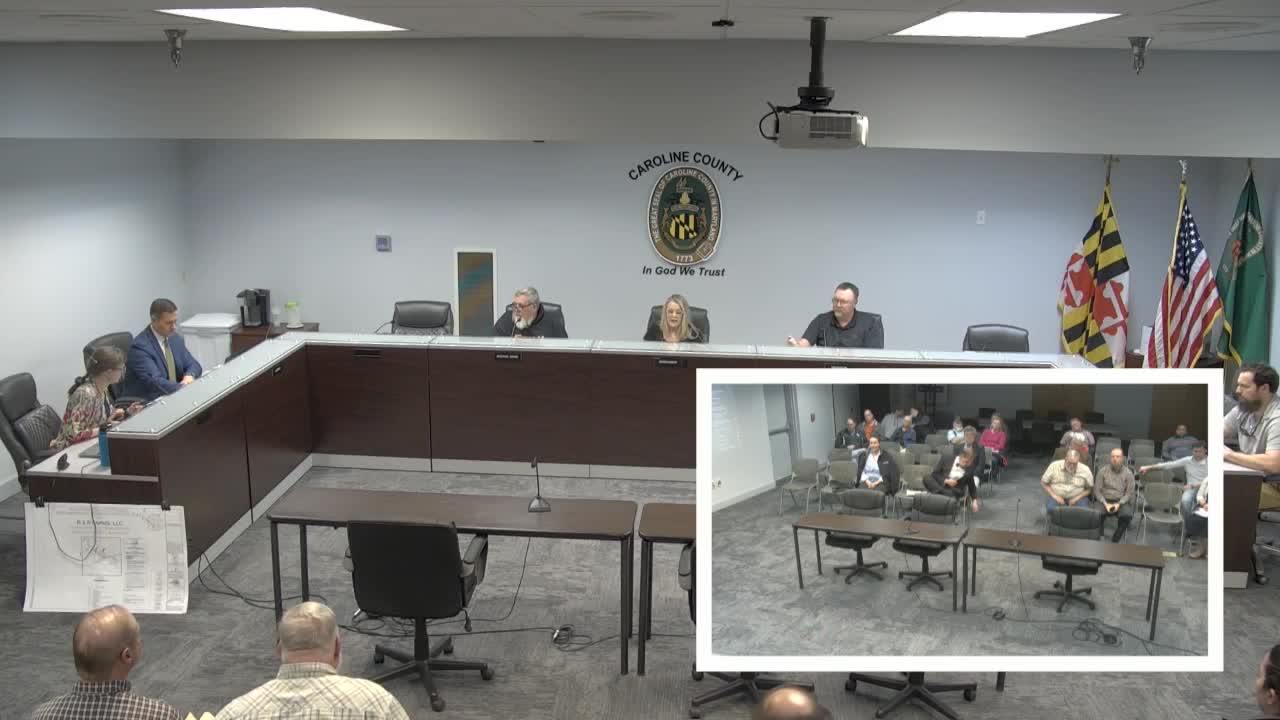
Board OKs R and R Farms sand and gravel operation with conditions on setbacks, hours and traffic
Summary
Caroline County Board of Zoning Appeals approved a special use exception for R and R Farms LLC to operate a new mineral extraction and wash plant on 111.08 acres at 25100 Goldsboro Road, subject to multiple conditions addressing setback reductions, hours of operation, truck routes, noise, water monitoring and required state permits.
The Caroline County Board of Zoning Appeals on March 18 approved special use exception 24-0026, allowing R and R Farms LLC to develop a new mineral extraction operation and wash plant at 25100 Goldsboro Road in Henderson.
The application covers a proposed mining operation on about 111.08 acres that includes a wash plant, the removal of several agricultural structures, and conversion of an existing dwelling to an office. The applicant sought a reduction of a 200-foot zoning setback in three narrowly defined areas to 100 feet; the planning commission had reviewed preliminary site plans and recommended conditions. Staff identified the requested setback reductions as the principal zoning issue for the board to decide.
At the hearing, Lane Engineering project manager Sean Callahan presented the 22-page mining permit site set, haul-route exhibits and a traffic analysis. Callahan described the site’s planned access directly onto State Route 313/312 and told the board the applicant was in final review with the Maryland State Highway Administration; he said, “we believe we can have a permit issued in the next 30 days.” Callahan explained that reducing the setback in small areas would allow more efficient recovery of on-site mineral resources; the submission included neighbor consent letters for the adjacent properties where the setback would be reduced.
Noise, water and property-value impacts were the main technical topics. VibraTech noise and vibration specialist John Ferdinand reviewed a noise model and a sound-study exhibit produced for the applicant; he reported that his conservative analysis projected daytime sound levels below Maryland’s 65-decibel daytime limit. Ferdinand told the board the modeled range in decibels was generally between 60 and 63 dB at sample receptor points.
Mary Wakefield, vice president for Earthdata (hydrogeology and water resources consultant), testified about groundwater and water-quality monitoring. She said baseline monitoring and a program of monthly (then quarterly if stable) sampling would be implemented and concluded in professional testimony that, based on regional experience and planned monitoring, “It should not” — meaning she does not expect atypical or adverse impacts to neighboring wells or drinking-water quality from the proposed surface mining operation.
Real-estate appraiser William Fitzhugh Turner presented local sales comparisons and said his analysis found no consistent adverse effect on nearby residential property values from comparable mining operations in the region.
Residents and neighbors raised concerns about traffic, truck routes, early-morning noise, tailgate slamming, dust and safety for school buses. Multiple neighbors who live near Hollingsworth Circle and Goldsboro Road asked that trucks be prevented from using small local cut-throughs; several speakers requested strong operational limits and clear signage.
State and federal agency reviews were submitted as exhibits: Maryland Department of the Environment permit application materials, Army Corps of Engineers correspondence about local tax ditches, a DNR heritage letter, and State Highway Administration correspondence regarding entrance geometry and sight distance. Staff cited Exhibits 6 (stormwater management) and 9 (traffic concepts letter and SHA responses) as relevant technical inputs.
After questions and deliberation, the board approved the special use exception subject to the conditions listed below. The board’s approval included: (a) a site-specific modification of the 200-foot setback to 100 feet in the limited areas identified in the applicant’s plans while retaining a 200-foot buffer along portions of the site adjacent to clustered residences (notably Hollingsworth Circle); (b) a set of operational and mitigation conditions addressing traffic, hours and nuisance controls; and (c) an explicit requirement that the applicant obtain all state and federal permits (MDE, SHA, Army Corps) and county permits before commencing operations.
Key conditions the board attached
- Implementation of all conditions in the staff report (Exhibit 2). - Setback modification approved to 100 feet only in the three specific plan areas requested by the applicant; the portions abutting Hollingsworth Circle and other nearby residences must retain a 200-foot buffer as shown on the approved site plan. The board recorded that neighboring property owners in the reduced-setback areas had submitted no-objection letters in the record. - Hours: Monday–Friday start up to 05:30 for on-site setup and maintenance, with truck loading and outbound hauling prohibited before 7:00 a.m.; operations to cease by 5:30 p.m. Saturdays limited to 6:30 a.m.–noon for general operations, with the wash plant allowed to run as needed until 3:00 p.m.; no nighttime operations. - Truck routing and traffic controls: no through trucks on Hollingsworth Circle; applicant must coordinate signage with SHA (e.g., “Trucks entering/exiting — use caution”) and use internal site controls to avoid stacking trucks on the state highway. - Nuisance controls: no tailgate slamming, no use of engine compression braking on site ("no Jake brakes"), active dust mitigation (water trucks and control measures) consistent with MDE requirements, and on-site signage and procedures to minimize noise and dust. - Monitoring and mitigation: applicant to implement baseline and ongoing groundwater and water-quality monitoring (monthly during startup, then quarterly if stable) administered by a qualified hydrogeologic consultant, with reporting to county staff and MDE as required. - Bonding, reclamation and performance guarantees as required by state and county mining rules; reclamation plan to return the site to the approved end use (pond/landscape) after mining.
Board members said the conditions aimed to balance the county’s mineral resource policy and the applicant’s right to efficient extraction against neighbors’ concerns about traffic, noise and water. After deliberation the chair announced the motion carried.
What happens next
The applicant must secure SHA entrance permits, MDE approvals, any Army Corps approvals and local building/zoning permits and meet the staff-report conditions (Exhibit 2) before beginning mining. Monthly then quarterly monitoring will be required; county staff will receive monitoring reports. Neighbors were told to report verified regulatory violations to county staff and the relevant state agencies.
Proponents and opponents said they expect follow-up on operational details as permits are issued and the project phases proceed.