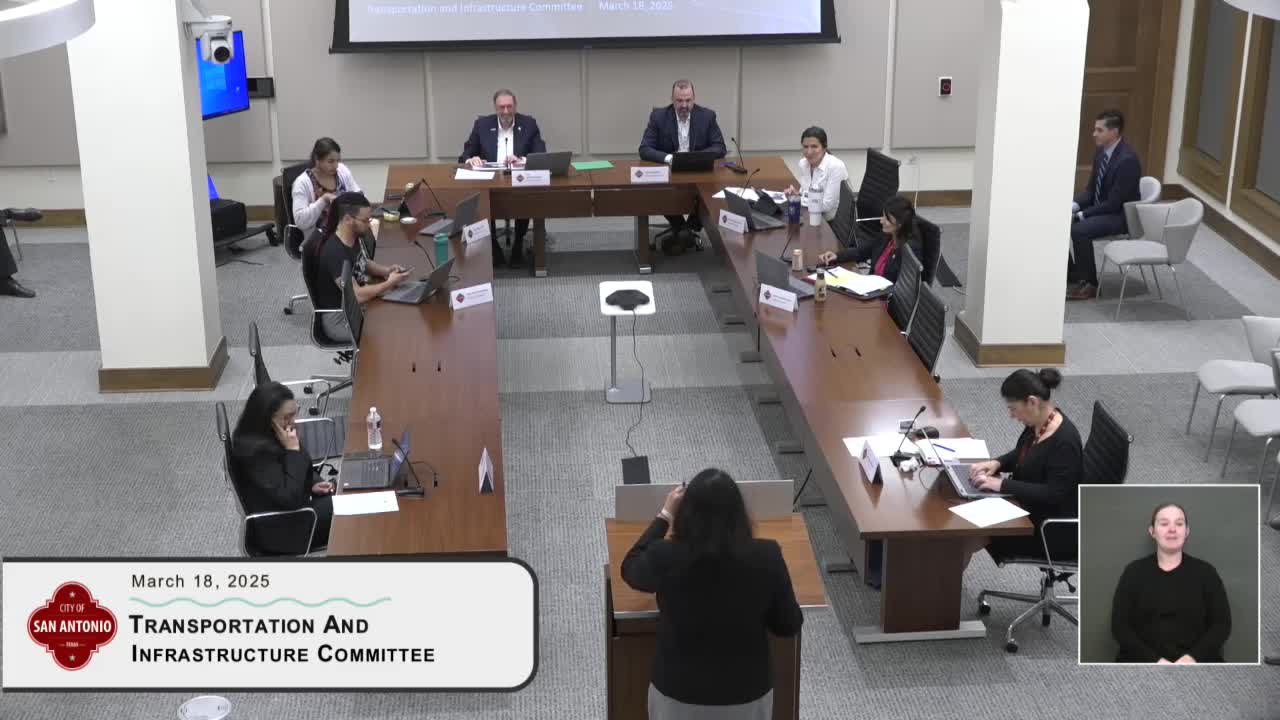
VIA details Silver Line, Green Line and Better Bus timelines; utility coordination delays construction
Loading...
Summary
VIA Metropolitan Transit updated the Transportation Infrastructure Committee on three major capital projects — the Silver Line, Green Line and a second bus operations facility — and the Better Bus plan, citing utility investigations and federal funding milestones as schedule drivers and committing to expanded public outreach.
VIA Metropolitan Transit staff told the Transportation Infrastructure Committee on March 18 that the agency remains on track to open the Green Line by the end of 2027 and the Silver Line by the end of 2029, but that subsurface utility investigations and federal grant timing have delayed some construction milestones.
The Silver Line — described by VIA staff as the ‘‘VR Rapid Silver Line’’ or East–West corridor — is estimated at 7.3 miles with 26 stations, 10‑minute weekday frequency and a year‑of‑expenditure cost of $289,200,000. Manchiri Akalkotkar, VIA’s major capital program officer, said the project’s financial plan assumes roughly 50% federal funding (about $145,300,000) and local commitments including roughly $100,000,000 from Bexar County. ‘‘The total cost is estimated to be 289,200,000.0 in the year of expenditure dollars,’’ Akalkotkar said.
Why it matters: the Silver and Green lines, together with a new maintenance facility and VIA’s Better Bus plan, are intended to increase frequency and travel speed across San Antonio’s central corridors and to expand access to jobs and groceries for residents with limited auto access.
Key project details and schedule
- Silver Line: 7.3 miles, 26 stations, off‑board fare collection, a mix of dedicated lanes and mixed traffic, and planned revenue service at the end of 2029. VIA is at about 40% design and has begun NEPA environmental documentation; staff plan a Small Starts (Capital Investment Grants) application in 2026 and construction starting in early 2027 if funding is awarded. Akalkotkar said the agency has ‘‘two rounds of public engagement’’ informing design and plans to open East‑ and West‑side project offices for outreach.
- Second operations & maintenance facility: required to store and service additional vehicles for rapid and standard bus service. VIA expects construction to start in 2027 and finish early 2029; the site is being planned to accommodate 52 articulated rapid vehicles and about 50 additional standard buses and to be adaptable to future propulsion technologies.
- Green Line: project budget set at $480,800,000, 25 stations and a planned opening by the end of 2027. VIA told the committee it had secured a full funding grant agreement (FFGA) and federal obligation last December, but has delayed the start of heavy construction to complete subsurface utility engineering (SUE) and reduce community impacts.
- Better Bus Plan: Sandeep Sen, VIA director of service planning and scheduling, said the plan will increase the number of people with access to high‑frequency service by about 17% and make nearly 44% more jobs reachable within 30 minutes by transit. The service plan is slated for a final presentation in spring 2025 with phased implementation beginning summer 2025 through 2029.
Funding, technology and fleet
VIA’s financial packages rely heavily on federal matching grants, local bond proceeds and county commitments. Akalkotkar said the agency has received STBG and pre‑award planning funds and that the federal/local match is critical to grant competitiveness. Committee members pressed VIA on vehicle propulsion choices. Sen said VIA currently operates about 500 revenue vehicles and eight electric buses, and that CNG remains the primary vehicle technology for planned expansions. ‘‘We already have 8 electric buses, and we are trying to, you know, provide service on all the corridors,’’ Sen said, noting electric vehicles present charging and range constraints in San Antonio’s summer climate.
Utility coordination and outreach
VIA officials emphasized subsurface utility investigations as a principal cause of schedule adjustments for the Green Line and explained that earlier or deeper potholing and utility locating is being used to reduce future construction interruptions. Akalkotkar and VIA staff described ongoing outreach measures — block walking, bilingual teams, business contacts and open houses — and said VIA’s board approved four additional outreach staff positions dedicated to the Silver Line.
Committee reaction and next steps
Council members pressed VIA for greater clarity on construction phasing and individual property and turning impacts, and urged more and earlier business and residential outreach. VIA committed to return with refined outreach materials and to continue coordination with city staff, the Federal Transit Administration and local utilities. VIA said it will seek the Small Starts application window next year and return to council with project milestones as federal processes advance.
Ending
VIA told the committee it will continue work on environmental clearances and design milestones, advance outreach and return to City Council and the committee with grant applications, updated schedules and further details on electrification planning and construction phasing.