Get Full Government Meeting Transcripts, Videos, & Alerts Forever!
Get email alerts on the Public Transit topic
No spam. Unsubscribe anytime.
Victoria Council approves $600,000 local match to stabilize transit pending route overhaul
Summary
City council approved an amendment to the interlocal agreement with the Golden Crescent Regional Planning Commission to raise the city's local match to $600,000 for FY2025 to keep Victoria Transit operating while a route study's recommendations are scheduled for implementation in 2026.
The Victoria City Council on Tuesday approved a resolution increasing the city's local match for Victoria Transit to $600,000 for fiscal year 2025 to avoid further service reductions while staff and regional partners prepare to implement a new route plan in 2026.
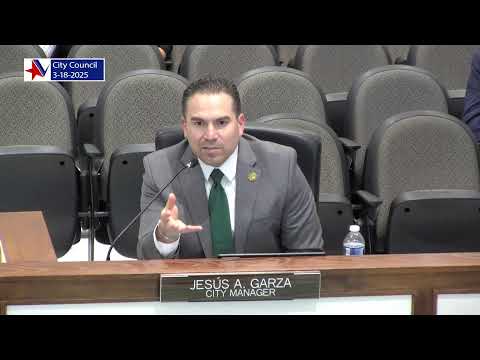
City Manager Jesus Garza told the council the increase — an added $371,000 over the current budgeted contribution — is intended to “make the transit system whole for this year” so staff can focus on implementing recommendations from a recent route study. The study, conducted by KFH Group and funded in part through a state grant, proposes replacing looping routes with six more linear lines that would meet at a transfer point near the H-E-B on Rio Grande, increase stop frequency, improve stop placement and provide service to sites now hard to reach, such as the community center and portions of Main Street.
The transit provider, Golden Crescent Regional Planning Commission, said federal grant levels and ridership drops since fares were reinstated have left the system short. Alejandra Cruz, regional service director at Golden Crescent RPC, said federal award amounts for FY2025 totaled about $1.4 million but based on first-half expenditures the system expects to draw roughly $1.2 million. Without the additional local match, she said, “there could be a lot of unknowns. We can't control fuel prices… We can't guarantee if we get that $600,000 we're going to not have to make any cutbacks, but I can guarantee you we're going to make it stretch as far as we can.”
Council members debated whether eliminating fares would increase ridership and thus future funding, but staff cautioned fare changes take effect slowly in state and federal funding formulas and any increase in ridership would likely be reflected in funding with a delay of one to two years. Mayor Duane Crocker, who led the discussion, framed the council's decision as buying time for the system to implement the new network: “Let's give the transit system a chance and an opportunity to basically be successful and be self‑sustainable,” he said.
Council voted to adopt the amendment by voice vote. The council and staff said they expect to set a new baseline local contribution for FY2026 as part of ongoing budget and sales-tax development corporation discussions; staff estimated the longer-term annual contribution will likely rise above the current $228,000 but did not fix a number at the meeting.
The transit provider projects the new routes would not take effect until 2026 to allow for necessary procedural steps, procurement and coordination with rural services. In the interim, staff said the $600,000 local match is intended to minimize service disruptions and preserve staff capacity for the route implementation work.
The council's action amends the FY2025 interlocal agreement with the Golden Crescent Regional Planning Commission to increase the city's local match to $600,000.