Get Full Government Meeting Transcripts, Videos, & Alerts Forever!
Get email alerts on the Legacy Funding topic
No spam. Unsubscribe anytime.
Minn. Senate panel hears legacy funding requests for arts, museums and cultural groups; lays multiple bills over for possible inclusion
Summary
The Minnesota Senate Environment, Climate and Legacy Committee on Tuesday, March 18 heard testimony from more than a dozen cultural organizations seeking legacy or arts-and-cultural-heritage funding and laid multiple Senate files over for possible inclusion in the legacy omnibus bill.
The Minnesota Senate Environment, Climate and Legacy Committee on Tuesday, March 18 heard testimony from more than a dozen cultural organizations seeking legacy or arts-and-cultural-heritage funding and laid multiple Senate files over for possible inclusion in the legacy omnibus bill.
Committee members heard from Latino, Hmong, Somali and Native organizations, public television representatives, libraries and museums. Witnesses described requests ranging from program support and traveling exhibits to documentary and commemorative projects; committee members repeatedly laid the measures over “for possible inclusion” rather than taking final votes.
Why it matters: The legacy (arts and cultural heritage) fund supports cultural programming, museums, public media, and educational outreach across Minnesota. The committee’s decisions will shape how state legacy dollars are distributed in the next biennium and which organizations receive direct appropriations.
CLUES: Latino cultural programming Ruby Lee, president of the nonprofit CLUES, told the committee CLUES serves “45,000 Latinos in 2024” and asked the committee to support Senate File 2,070, a legacy appropriation that would expand CLUES’s arts and cultural work. Lee said the organization’s 45-year history combines social services with cultural programming and credited prior legacy funding: “Thanks to a half a million dollar appropriation from the legacy fund in 2023, we have been able to foster cultural engagement, communal and community celebrations.” Dr. Carla Mansoni, CLUES’s director of arts and cultural engagement, gave attendance and program figures — including “2,000 people visited our CLUES Gallery” and “16,000 people participated in culturally specific programming” — and said additional funds would support traveling exhibits, digital gallery shows and artist development. Artist Adriana Gordillo described reaching new audiences through bilingual materials and a CLUES solo exhibit. The committee laid Senate File 2,070 over for possible inclusion.
Phyllis Wheatley Community Center: music and trauma recovery Senate File 21‑58, sponsored in committee by Senator Champion, drew testimony from Phyllis Wheatley leadership. Mondo (Armando) Dickerson, managing director, described programs that integrate arts into trauma recovery and youth development, citing HOPE (Helping Our People Evolve) and a Digital Tech Works partnership with Walker West. Zena Johnson, director of the Mary T. Welcome Child Development Center, described music and dance programming used with children, including those on the autism spectrum. Committee members asked about prior funding and scalability; staff said final dollar figures would be supplied if the bill is laid over. The committee laid SF 21‑58 over for possible inclusion.
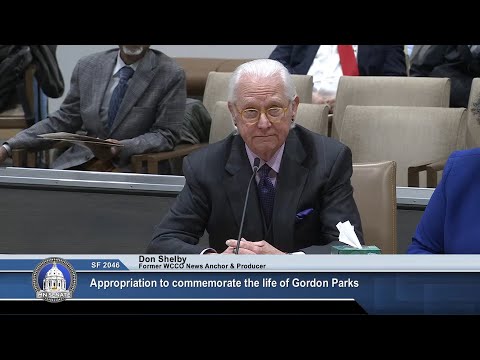
Gordon Parks commemoration Senate File 2,046 requests an $800,000 appropriation from the arts and culture heritage fund for a Gordon Parks exhibit and related programming, to be administered through the Minnesota Humanities Center in partnership with production partners. Robin Hickman (introduced in testimony as a Gordon Parks family member) described Parks’s impact and the project’s ambition to place a public arts installation in downtown St. Paul and to involve young people in its creation. Former news anchor Don Shelby testified in support, saying of Parks, “shooting my camera proved to be more powerful than shooting a gun.” The committee laid SF 2,046 over for possible inclusion.
Minnesota Fishing Museum and Hall of Fame Senate File 17‑08 requests $100,000 from the arts and cultural heritage fund for the Minnesota Fishing Museum and Hall of Fame in Little Falls. Executive director Brenda Perlowski and board member Gary Osberg described the museum’s educational programs, the master angler program managed for the Minnesota DNR, school tours, youth outreach and a 270‑gallon aquarium used for conservation education. The committee laid SF 17‑08 over for possible inclusion.
Regional libraries and legacy funding (SF 24‑48) Senate File 24‑48 would continue legacy funding for the 12 regional public library systems that distribute arts and cultural heritage programming statewide. Testimony from library staff, including Saint Paul Public Library and multiple regional library system directors, emphasized rural access, intergenerational programming and partnerships with local artists and historical societies. Committee discussion included past appropriations and remaining balances; Senator Kunish noted ongoing federal threats to library funding and urged continued state support. The committee laid SF 24‑48 over for possible inclusion.
Minnesota Public Television Association Representatives of the Minnesota Public Television Association requested funding in Senate File 21‑13 (a proposed $5 million per year figure was discussed as a request) to support public television production and statewide programming. Patty Mester, CEO of PBS North, and colleagues described statewide veterans-history documentaries and educational content with millions of online views. The committee laid SF 21‑13 over for possible inclusion.
Somali Museum Senate File 02/1954 (presented in committee as the Somali Museum appropriation) sought multi‑year funding the museum said would help expand staffing, space and programs; founder Osman Ali testified the museum hosts annual cultural events that draw 1,500–2,000 attendees and that the organization holds more than 1,500 artifacts in its collection. The committee laid the file over for possible inclusion.
Hmong Cultural Center and Hmong veterans oral histories Senate File 9‑11 (Hmong Cultural Center) and Senate File 15‑76 (a separate request to preserve oral histories of Hmong veterans who served in the U.S.-backed conflict in Laos) both received testimony. Hmong Cultural Center director Hongkawi (Hongkaw) Li outlined museum visits, instrument classes and an annual music festival; the center said it served thousands of visitors and school groups. Megan Lee testified for the veterans‑history project that the organization documented 73 veteran oral histories with prior grants and sought additional support to record the remaining veterans; she noted roughly 400 Hmong veterans remain in Minnesota and that the group is “racing against time” as veterans age. The committee laid both files over for possible inclusion.
Minnesota Asian Film and Music Festival Senate File 2,048 (as amended in committee) would fund a Minnesota Asian film and music festival administered by the Asian Economic Development Association. ADA executive director Vah Ming Thao and actor/writer Bee Vang described the festival’s possible cultural and economic benefits and estimated local economic impact; the committee adopted an amendment to correct the implementing organization name and laid the bill over for possible inclusion.
Minnesota Humanities Center Senate File 16‑05 would continue and expand programming at the Minnesota Humanities Center; testimony from Director Kevin Lindsey outlined programming that includes Indigenous language symposiums, teacher professional development, veterans programming and Smithsonian Museum on Main Street partnerships. Lindsey described a request for $2.5 million for fiscal years 2026–27 to expand statewide convening and educational materials. The committee laid SF 16‑05 over for possible inclusion.
Votes at a glance All of the measures heard in the hearing were laid over for possible inclusion in the legacy omnibus bill rather than receiving final votes in committee.
What’s next Committee members repeatedly used “laid over for possible inclusion” as the formal disposition. Several senators asked applicants to provide more detailed budgets or to clarify previous-year balances; staff and authors said numbers would be provided when bills move toward omnibus consideration. Final decisions on funding will depend on omnibus negotiations later in the session.
Meeting context and tone Testimony totaled roughly two hours and included elected sponsors, nonprofit leaders, artists and veterans. Committee members pressed for financial detail in some cases and repeatedly framed the legacy fund as a vehicle for statewide cultural access. No final appropriations were approved at the hearing.