Get Full Government Meeting Transcripts, Videos, & Alerts Forever!
Get email alerts on the Hunger Free Campus Grants topic
No spam. Unsubscribe anytime.
Senate panel advances change to Hunger Free Campus grants distribution, adopts amendment
Summary
The Minnesota Senate Higher Education Committee heard testimony on SF 2481 to streamline administration of the Hunger Free Campus grant program, adopted an A-1 amendment and laid the bill over for further consideration.
Senate file 2481, a bill to change how Hunger Free Campus grants are distributed, was presented and discussed before the Minnesota Senate Higher Education Committee, which adopted an A‑1 amendment and laid the bill over.
The bill would rework the existing competitive grant program established under the Hunger Free Campus Act so that Minnesota State and the University of Minnesota receive direct appropriations and the remaining funds continue as a smaller competitive pool for private and tribal colleges. Supporters said the change would reduce application burdens and speed funding to campus food programs.
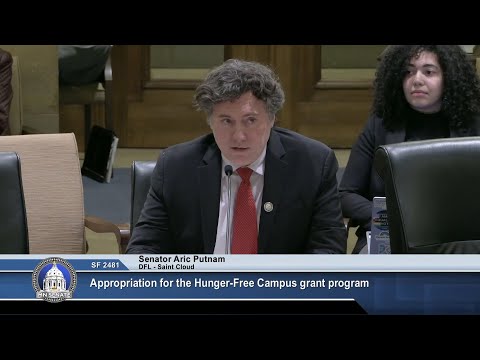
Senator Richard Putnam (Senator Putnam) told the committee the bill “makes some administrative changes. It will cut red tape and streamline the existing Hunger Free Campus Act and provide help [for] more campuses get more money for hunger prevention.” He described a direct appropriation split that would allocate $600,000 per year to the Minnesota State system, $200,000 per year to the University of Minnesota system and keep $200,000 for a competitive grant program for private and tribal colleges.
Student and campus officials testified in support. Shay Horning, director of state affairs for the University of Minnesota Undergraduate Student Government, said nearly one in five Twin Cities undergraduates face food insecurity and urged passage of SF 2481. “These grants will provide campuses with the funding they need to give more students access to fresh food, allowing them to focus on their education instead of where their next meal will come from,” Horning said.
Michelle Trumpy, public health director at Boynton Health who oversees the Nutritious U food pantry, described expanded pantry usage and told the committee the systemwide rate of reported food insecurity is substantial. “On the Twin Cities campus, the Nutritious U Food Pantry served approximately 400 more students per month last year than the previous year, for a total of 2,000 student visits per month,” she said, noting increased hours and culturally specific offerings.
Other student witnesses described personal experiences relying on campus pantries and argued for more timely, predictable funding. One testified that current reimbursement timelines cause service interruptions when campus accounts run dry before February reimbursements arrive.
The committee adopted an A‑1 amendment moved by Senator Putnam. The voice vote on the amendment was recorded as “aye” and the chair declared the amendment adopted. The bill was then laid over by the committee for further consideration.
Votes at the hearing were voice votes; detailed roll-call tallies were not provided in the transcript.