Get Full Government Meeting Transcripts, Videos, & Alerts Forever!
Get email alerts on the Tax Omnibus Hf 2274 topic
No spam. Unsubscribe anytime.
House Tax Committee lays over HF 2,274 after rehearing omnibus tax provisions; adopts two technical amendments
Summary
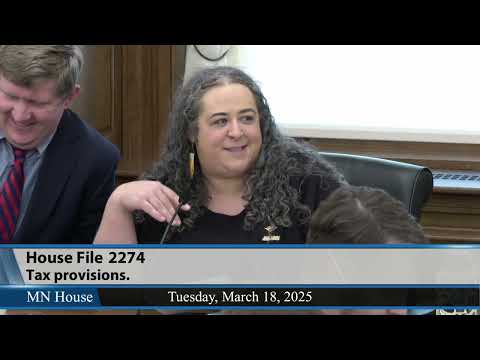
The Minnesota House Tax Committee on a voice vote adopted two technical amendments to House File 2,274 and laid the bill over for possible inclusion in the House tax omnibus after nonpartisan staff reheard provisions carried over from the 2024 tax package.
The Minnesota House Tax Committee on a voice vote adopted two technical amendments to House File 2,274 and laid the bill over for possible inclusion in the House tax omnibus after a nonpartisan staff rehearing of provisions carried over from the 2024 tax package.
Committee chair Gomez opened the meeting by moving the A1 amendment and later the A2 amendment; both were approved by voice vote. "All those in favor of adopting the A1, please signify by saying aye," the chair said before the committee approved the amendment, and later the A2 was adopted in the same fashion.
The bill is being handled as a "rehearing" of last year’s omnibus and is intended to assemble a set of provisions the House tax chairs may carry into conference work later in the session. Nonpartisan staff walked members through six articles covering individual and corporate income taxes, property taxes and local aids, sales and use taxes, tax-increment financing, special local taxes and a miscellaneous article.
Nonpartisan staffer Mr. Williams summarized Article 1, which covers individual and corporate franchise taxes. He said Article 1 "contains changes that establish an electronic filing system for the political contribution refund," and includes a corporate disclosure provision that would require public reporting for corporations with $250,000,000 or more in domestic sales. Article 1 also contains language to create a direct free-file system at the Department of Revenue and a proposal to move 18-year-old dependents from the older-child credit into the younger-child credit so the per-child amount is higher for younger children.
Mr. Swanson summarized Article 2 on property taxes and local government aids. He described provisions responding to an "Alliance Housing" court decision, tribal property exemptions for specific parcels owned by the Grand Portage Band and the Leech Lake Band of Ojibwe, changes to how community land trusts are valued, creation of an advanced homestead credit that would permit some seniors to receive advance payments of property tax relief, land-bank economic development abatements, and changes to local homeless prevention aid. On the homeless prevention aid he said the bill would both clarify that the aid "cannot be used to clear encampments" and remove the sunset that would otherwise end payments after aid is paid in 2028.
Article 3, presented by Ms. Hagler, contains sales and use tax provisions including a permanent provider tax research credit at 0.5%, a newly established gross-receipts tax on amusement devices in place of the state sales tax for the same activity, repeal language for the controlled-substances excise tax in certain sections, and a construction sales tax exemption for a Woodbury project (the A1 amendment changed the effective date).
Article 4 contains special tax-increment financing (TIF) legislation for a list of cities, and Article 5 addresses special local taxes including changes to how online accommodations intermediaries are treated under local lodging taxes and a reduction and geographic expansion of the Downtown Minneapolis food-and-beverage tax in the North Loop area. Article 6 contains miscellaneous items: allowing qualifying veterans organizations to use up to 50% of charitable-gambling gross profits for property improvements, creation of land-value-tax districts, and a set of directed grants (a $50,000 grant to the Anoka County Soil and Water Conservation District, a $100,000 grant to the City of South St. Paul, an emerald ash borer assistance program in Minneapolis, a $10,000,000 reappropriation to the City of Minneapolis from a 2023 appropriation, and a grant to Browerville Public Schools).
Mr. Swanson explained the Minneapolis reappropriation: the section would cancel the 2023 appropriation and reappropriate the same $10,000,000 in fiscal 2025 so the funds do not lapse to the general fund. He said part of the original appropriation was to help commercial corridors affected by civil unrest and to support projects that were delayed by slow contracting processes with DEED (the Department of Employment and Economic Development).
Public testimony reflected a range of positions. Lars Neigstead, policy director for ISAIAH, supported corporate disclosure and free direct filing, saying, "All Minnesotans deserve safe, decent housing, affordable care and a future in which all can thrive." Nan Madden, director of the Minnesota Budget Project, urged implementation of a state-run free direct-file system and noted federal pilots and other states' experience. Eric Bernstein, director of We Make Minnesota, also supported free direct filing and corporate disclosure and argued disclosure helps deter tax avoidance, saying, "Those with nothing to hide should have nothing to fear."
Business groups testified in opposition to the corporate disclosure provision. Brian Cook, director of tax, fiscal policy and elections for the Minnesota Chamber of Commerce, said the proposal "would require the public disclosure of private taxpayer data that violates a long standing principle of taxpayer privacy" and warned it would make Minnesota an outlier. Gavin Hansen, fiscal and economic policy director for the Minnesota Business Partnership, said the requirement would place Minnesota firms at a competitive disadvantage.
On the accommodations-intermediary change in Article 5, Joel Carlson, who represents online travel agents, testified in opposition and described practical compliance difficulties for platforms that would have to remit many different local rates.
Committee members asked technical and policy questions throughout the rehearing, including about the corporate disclosure threshold and whether it applied to domestic sales in all states (nonpartisan staff clarified the proposal uses aggregate domestic sales "to the water's edge" of the United States and the reporting threshold in the draft is $250,000,000 in domestic sales). Several members also asked for clarification about how taxpayer privacy, nexus and filing obligations would interact with the proposed disclosure requirement.
Chair Gomez and Chair Davids described the hearing as an early step in a longer process. Chair Gomez said laying the bill over "is the beginning of the conversation about these provisions, not the end," and Chair Davids said the committee will have to "figure out how much we have" for construction-sales-tax exemptions and other items as negotiations proceed.
The committee did not adopt a final House position on which provisions will move forward; instead members laid the bill over for possible inclusion in the House tax omnibus and signaled that chairs will continue to negotiate the package and may hold additional hearings on complex subtopics such as TIF and construction exemptions.
The committee’s next steps include further staff work and potential follow-up hearings as the chairs assemble a House tax bill to negotiate with the Senate.