Get Full Government Meeting Transcripts, Videos, & Alerts Forever!
Get email alerts on the Manufactured Housing topic
No spam. Unsubscribe anytime.
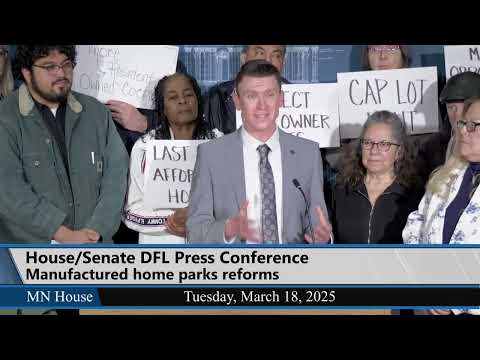
Minnesota lawmakers, residents unveil Manufactured Home Park Resident Bill of Rights
Summary
Rep. Matt Norris and Sen. Liz Bolden and resident leaders promoted legislation that would cap annual lot-rent increases at 3 percent, create a resident purchase pathway and strengthen enforcement of owner responsibilities; no formal legislative vote was recorded at the event.
State Rep. Matt Norris and Sen. Liz Bolden joined residents Wednesday to introduce the Manufactured Home Park Resident Bill of Rights, a proposal that would cap annual lot-rent increases at 3 percent, create opportunities for residents to buy parks and increase enforcement tools against owners, advocates said.
The bill came at a public event where residents from multiple parks described rising rents, service cutbacks and eviction threats after private-equity and corporate purchases of manufactured-home communities. "We need a bill that will put residents first and give us some protection under law," Tammy Fry, a 13-year homeowner at Blaine International Village, told the group.
According to Rep. Matt Norris, roughly 80,000 Minnesotans live in manufactured-home communities across about 800 parks in Minnesota, and about 90 percent of those residents own their homes but rent the lot beneath them. Norris and residents said that structure leaves homeowners vulnerable when park owners raise lot rents or cut services; he said moving a manufactured home can cost about $15,000 and often is impractical after a home settles in place.
The proposal presented at the event would do three main things, Norris said: limit rent increases to no more than 3 percent annually (with a mechanism to allow higher rates for health-and-safety spending), create a clearer pathway for resident purchase and cooperative ownership, and tighten enforcement of existing owner responsibilities such as tree care and utility maintenance. "Too often these days, working class people feel like the game is rigged against them," Norris said.
Residents described how ownership changes by out-of-state investors have affected parks. "These corporations treat us like cash machines, changing the...cost and rules to squeeze more and more money out of us and push a certain type of people out," said Joseph Coloto, who lives in Viking Terrace. Tammy Fry said her park was purchased in 2020 by Haven Park Communities and that lot rents have increased while services were cut. Natividad Seefeld, president of Park Plaza Cooperative, described converting a park to a resident-owned cooperative and investing in infrastructure after residents purchased their park in 2011.
Speakers cited a series of recent local news reports and emails alleging poor conditions and sudden closures in some parks; Norris said about 90 percent of parks sold in 2024 were bought by out-of-state real estate investment trusts and private equity firms, and that lot rents have increased "about 10 percent or more annually" in some cases. Those figures and descriptions were presented by event speakers as part of their case for the bill.
On enforcement, Norris said the bill would strengthen remedies by making equitable relief, injunctions and attorney-fee awards available; enforcement could come from the attorney general's office or through private suits by residents, he added. He also said state statute currently limits parks to "reasonable" rent increases but that the term is undefined in law and thus hard to enforce.
When asked whether the attorney general would determine exceptions to the 3 percent cap for health-and-safety spending, Norris said enforcement could involve multiple actors, including private actions by residents and advocacy groups such as the Housing Justice Center.
Sen. Liz Bolden, who said she will carry the bill in the Senate, noted petition signatures from thousands of park residents statewide and framed the legislation as part of preserving unsubsidized affordable housing in Minnesota. Speakers asked for public support; Tammy Fry specifically asked legislators to back "Bill HF 021981 in the House and SF 2691 in the Senate," as she stated at the event. Details about filing status, sponsors beyond Norris and Bolden, and legislative timing were not specified at the event.
No formal legislative vote or committee action was recorded at the event. Norris said he and advocates are seeking additional co-sponsors, including from the Republican caucus, and that conversations with Republican colleagues were underway but some provisions were causing concern for them.
The event combined resident testimony, policy advocates' context and sponsor remarks; organizers urged legislative action to prevent what they described as displacement and instability in manufactured-home communities.