Get Full Government Meeting Transcripts, Videos, & Alerts Forever!
Get email alerts on the State Tax Omnibus topic
No spam. Unsubscribe anytime.
House committee lays over $2,274 omnibus tax rehearing after debate on corporate disclosure, direct file and local aids
Summary
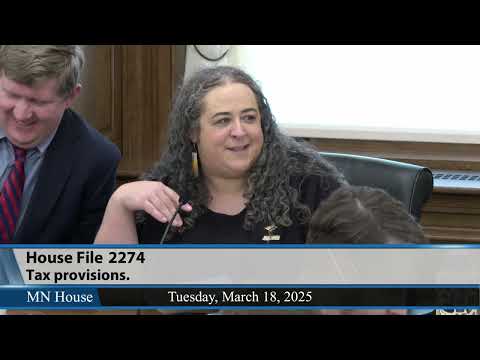
The Minnesota House Taxes Committee on March 18 laid over House File 2,274 — a rehearing of many provisions from the 2024 tax bill — after nonpartisan staff reviewed six articles and after extended public testimony on corporate tax disclosure, a state direct‑file system, child‑credit changes and local aid language.
The Minnesota House Taxes Committee on March 18 laid over House File 2,274 — a rehearing of many provisions from the 2024 tax bill — after hearing nonpartisan staff explain the bill’s six articles and receiving hours of testimony for and against key provisions.
The committee’s vote to lay the bill over follows adoption of two technical amendments (A1 and A2) by voice vote during the hearing. Chair Gomez moved the bill be laid over “for possible inclusion in the tax omnibus bill.”
Article 1 covers individual and corporate income and franchise tax changes, including (as described by nonpartisan staff) a corporate disclosure requirement for corporations with $250,000,000 in domestic sales, language to create a state-run direct free-file system for individual taxpayers, technical changes to credits (including beginning farmer credit deadlines), changes to child-credit treatment that move 18‑year‑olds from an “older child” bracket into a “younger child” bracket, and nonconformity to federal Section 530 safe‑harbor rules on worker classification.
Article 2 addresses property tax and local government aids: clarifying that property owned by charitable organizations used exclusively for rental housing is not exempt under the Alliance Housing case, utility cooperative attachment language, tribal property exemptions (including five parcels in Cook County held by the Grand Portage Band and property in Minneapolis owned by the Leech Lake Band of Ojibwe), establishment of an advanced homestead credit that allows certain seniors to receive advance property‑tax refunds, land‑bank economic development abatements, and changes to local homeless prevention aid — including language clarifying the aid cannot be used to clear encampments and provisions removing the aid’s sunset after 2028.
Article 3 contains sales and use tax provisions, including a permanent 0.5% research credit for the provider tax, creation of an amusement‑device gross receipts tax to replace state sales tax on those devices, repeal language for a controlled‑substances tax, and a Woodbury construction sales‑tax exemption with a date update adopted in the A1 amendment.
Article 4 is tax‑increment financing (TIF) special legislation for multiple cities. Article 5 includes special local taxes such as intermediaries and local lodging taxes and a reduction and boundary expansion for Minneapolis’ downtown food‑and‑beverage tax. Article 6 gathers miscellaneous provisions: allowing certain veterans organizations to use some charitable‑gambling revenue for building improvements, a land‑value taxation district pilot, grants (including $50,000 to Anoka County Soil and Water Conservation District and $100,000 for South St. Paul), emerald ash borer assistance for Minneapolis, a $10,000,000 reappropriation to Minneapolis that cancels and reauthorizes a 2023 appropriation, and a grant to Browerville Public Schools.
Public testimony split along predictable lines. Supporters of direct free filing and corporate disclosure included faith and community groups and labor coalitions. Lars Neigstead, policy director for ISAIAH, told the committee, “All Minnesotans deserve safe, decent housing, affordable care and a future in which all can thrive,” and urged support for the bill’s corporate‑transparency and direct‑file provisions. Eric Bernstein, director of We Make Minnesota, said the disclosure provisions would increase transparency and push back on corporate tax avoidance: “This disclosure is similar to that performed by non profits, labor unions and publicly traded corporations.”
Business groups and some committee members urged caution on disclosure and on the bill’s proposed nonconformity to Section 530. Brian Cook, director of tax and fiscal policy for the Minnesota Chamber of Commerce, said, “We strongly oppose the sections of article 1 that relate to the public disclosure of corporate tax returns,” arguing that public release of sensitive tax details would harm taxpayer privacy and competitiveness. Gavin Hansen of the Minnesota Business Partnership warned the disclosure requirement could put Minnesota companies at a competitive disadvantage.
Committee members pressed nonpartisan staff on scope and thresholds. Staff clarified the corporate disclosure piece would apply to corporations that file the Minnesota corporate franchise return and that the $250,000,000 figure refers to aggregate domestic sales (sales “to the water’s edge” of the United States), so the requirement could apply to multistate companies with large national sales even if Minnesota sales are a small share.
Members also debated the Woodbury construction exemption and whether the committee should hear many individual construction‑exemption requests or take up Representative Norris’s blanket construction exemption at a later hearing; staff said there are dozens of construction exemption requests statewide. On worker classification, industry witnesses urged retaining the federal‑level Section 530 safe harbor for businesses that acted reasonably and in good faith, while others said stronger enforcement is needed to prevent deliberate misclassification.
Committee members and witnesses discussed the $10 million reappropriation to Minneapolis. Nonpartisan staff and the chair explained the section would cancel the 2023 appropriation and reauthorize it in fiscal 2025, not add new funds; part of the original appropriation was intended for commercial‑corridor recovery related to civil unrest and for repurposing a warehouse, and contracting delays at DEED led to the need to reappropriate the money so the local work can proceed.
Other testimony included opposition from Joel Carlson representing online travel agencies to the lodging‑tax intermediary language; Carlson said the proposal would create compliance burdens by subjecting service fees to multiple local lodging tax rates. Witnesses in support of the direct‑file and corporate‑disclosure provisions noted federal direct‑file pilots and consumer‑protection concerns with private tax‑preparation platforms.
The committee did not take a final passage vote; Chair Gomez moved, and the committee laid HF 2,274 over for possible inclusion in the House tax omnibus. The A1 and A2 technical amendments were adopted by voice vote earlier in the hearing.