
Experts warn losing federal tax exemption for municipal bonds would raise borrowing costs for Minnesota projects
Get AI-powered insights, summaries, and transcripts
Sign Up Free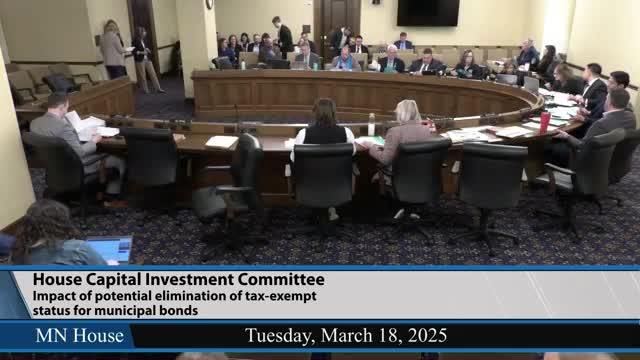
Summary
Presenters from PFM, Minnesota Management and Budget, Minnesota Housing and the Public Facilities Authority told the Capital Investment Committee that removing the federal tax exemption for municipal bonds would increase borrowing costs, reduce the number of feasible projects and raise costs for local taxpayers and state funds.
Presenters told the Minnesota House Capital Investment Committee on March 18 that eliminating the federal tax exemption for municipal bonds would raise borrowing costs for states and local governments and could reduce the number of projects that can be built.
Jessica Cameron Mitchell, managing director and partner at PFM Financial Advisors LLC, told the committee municipal tax-exemption is effectively a federal subsidy that lowers interest rates for state and local issuers. Using recent market examples, she showed tax-exempt yields have traded at roughly 60–80% of comparable taxable yields and said the spread varies by credit quality and market liquidity. "Borrowing for public infrastructure will be more expensive if municipal tax exemption is lost," she said.
Minnesota Management and Budget Assistant Commissioner Jen Hassimer told members the state would lose a key financing tool if Congress eliminates the exemption. MMB estimated interest rates on state bonds “could increase by 1.5% or more” if the federal exemption were removed. Hassimer said about $2.5 billion in previously authorized state debt has not yet been sold and would become more expensive if Congress changes the federal tax treatment.
Jennifer Ho, commissioner of Minnesota Housing, said private activity bonds — tax-exempt bonds used to finance affordable housing and mortgage assistance — are central to Minnesota Housing’s work. She said the agency issued more than $500 million in tax-exempt housing bonds and that private activity bonds helped about 40,000 Minnesotans buy homes over the past decade.
The new executive director of the Public Facilities Authority told the committee that the authority had funded $226 million in 46 loans this year to support drinking-water and wastewater projects. He said the PFA’s analysis shows borrowers would pay about $81.8 million in interest without the tax-exempt treatment compared with $53.4 million with it — a difference of about $28.4 million on loans made so far this year.
Panelists said the impact would be larger for smaller or lower-rated issuers, which face weaker market liquidity and higher credit spreads. They urged Minnesota's congressional delegation to preserve the tax-exempt status while federal lawmakers consider offsets for extensions of the 2017 Tax Cuts and Jobs Act.
Committee members received the testimony and had no formal vote on the matter. Several members said they planned to follow up with testifiers and federal partners.