Get Full Government Meeting Transcripts, Videos, & Alerts Forever!
Get email alerts on the School Infrastructure Energy topic
No spam. Unsubscribe anytime.
Committee lays over bill to fund green bank loan program for school HVAC and geothermal upgrades
Summary
House File 1598, moved March 18, would send $20 million to the Minnesota Climate Innovation Finance Authority to capitalize a revolving loan fund for school HVAC and geothermal projects; an A1 author's amendment specifying funding sources and definitions was adopted and the bill was laid over.
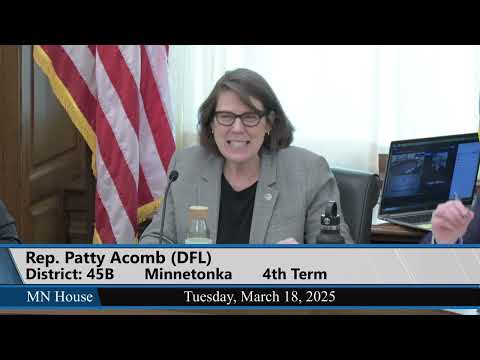
A Minnesota House committee on March 18 laid over House File 1598 after adopting an author's amendment that specifies funding amounts and definitions for geothermal systems.
Representative Hollins moved the bill and the A1 amendment; the amendment inserts $10 million from the Renewable Development Account (RDA) and $10 million from the general fund for a total $20 million appropriation to the Minnesota Climate Innovation Finance Authority (MNCIFA). "This bill, as amended, ' would provide $20,000,000 to the Minnesota Climate Innovation Finance Authority," Hollins said.
Why it matters: Sponsor testimony described MNCIFA (sometimes called the Green Bank) as a vehicle to create a low'interest revolving loan fund that would allow school districts to finance installation of new HVAC or geothermal systems and to claim the Inflation Reduction Act tax credits up front. Representative Hollins told the committee the fund is intended to leverage additional public, private and philanthropic capital to reach roughly $100 million in deployable financing for schools.
Proponents and evidence: Willie Miley, regulatory director at Darcy Solutions, described geothermal system performance and lifecycle savings, saying geothermal typically uses 25'50% less energy for heating and 20'30% less for cooling than conventional HVAC and cited expected annual operating savings for two Saint Paul schools ($200,000 at Bruce Vento Elementary and $143,000 at Hidden River Middle School) with projected paybacks around 10 years. Peter Klein, former executive director of MNCIFA, said the authority implemented about $11 million of projects in 2024 and expected the board to approve an additional $10'$15 million the next day; he described ongoing discussions with the U.S. Department of Energy Loan Programs Office to leverage federal financing for larger projects.
Key program details described in committee: - The amendment directs $10 million from the RDA and $10 million from the general fund to MNCIFA. - The program would create a revolving loan fund for school HVAC and geothermal projects, allowing schools to access the value of federal investment tax credits up front (as described by the sponsor). - Sponsor language requires funding to be divided by number of funded projects between the seven-county metro and Greater Minnesota (equal number of projects, not an equal dollar split), which prompted committee members to note that per-project costs vary between metro and rural districts.
Committee action: The A1 amendment was adopted by voice vote and the bill was laid over for omnibus consideration. No roll-call vote totals were specified in the transcript.
Concerns and next steps: Committee members asked whether smaller districts could access the program and raised questions about how an equal number-of-projects split would affect dollar distribution between metro and Greater Minnesota. Sponsor and staff said they would continue to work on language and implementation details while the bill is laid over for omnibus negotiations.