Get Full Government Meeting Transcripts, Videos, & Alerts Forever!
Get email alerts on the Substitute Teacher Policy topic
No spam. Unsubscribe anytime.
House education committee lays over bill removing $200 minimum for short‑call substitutes
Summary
Minnesota House Education Finance Committee heard testimony from rural superintendents and school officials on House File 630, which would remove a $200‑per‑day minimum pay requirement and make permanent an expanded short‑call substitute program; the committee laid the bill over for possible inclusion in an omnibus bill.
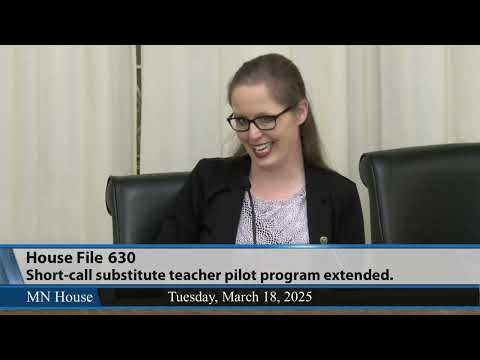
The House Education Finance Committee on March 18, 2025, laid over House File 630 after hearing testimony from district leaders who said the current $200‑per‑day minimum for short‑call substitute pay has prevented many rural districts from participating.
The bill, presented by Representative Erin Mueller, would extend and revise the short‑call substitute teacher pilot program by removing the $200 minimum pay requirement and making the program permanent rather than a pilot. That change would allow short‑call substitutes to be paid at a district’s regular substitute rate or at 90% of the daily rate for licensed teachers, whichever is greater, according to the bill language discussed in committee.
The bill drew support from rural superintendents who said their districts pay substantially less than $200 per day and therefore could not join the pilot. Lee Westrom, superintendent of Wadena‑Deer Creek Schools, told the committee, “We currently pay all of our substitute teachers $150 per day, and if this bill passes in its current form, we would definitely participate.” Westrom said his district—and others in his area—did not participate in the original pilot because of the $200 threshold and that pay in his region ranges from about $140 to $170 per day.
Kristen Demmer, assistant superintendent for business and administration at Moorhead Area Public Schools, described a persistent shortage of substitutes in her district and the region. She said Moorhead’s substitute fill rate for the 2024–25 school year averaged about 60–65 percent, with a low day in March that left roughly 30 classrooms without a substitute. “When we don’t fill classrooms,” Demmer said, “students don’t receive services or supports. We have to split classes among other classes.”
Patrick Walsh, superintendent for Belgrade‑Brimson‑Elrosa, also spoke in support and asked the committee to “support the bill as written,” citing similar rural staffing challenges.
Representative Mueller, the bill’s sponsor, said the change reflects work with the Minnesota Department of Education, the Minnesota School Boards Association and local districts. Mueller noted the pilot showed positive results where districts could participate and said the bill is meant to expand participation, particularly in rural areas.
After testimony and brief member remarks, the committee chair laid the bill over for possible inclusion in an omnibus bill or for later consideration.
Votes at the hearing were taken by voice; the committee recorded no roll‑call tally on the floor during this session. The chair’s motion to lay House File 630 over for possible omnibus inclusion was accepted by voice vote and the bill remains under consideration.
What was discussed: supporters emphasized district substitute pay levels and fill rates, the administrative changes in the bill, and the pilot’s results. Opponents or concerns were not recorded in the hearing record provided. No statutory citations or additional funding were specified during testimony.
Next steps: The committee laid the bill over for possible omnibus inclusion or future consideration.