Get Full Government Meeting Transcripts, Videos, & Alerts Forever!
Get email alerts on the Transportation Highway User Tax topic
No spam. Unsubscribe anytime.
Committee holds highway-user tax bill for further study after debate over tiered approach and exemptions
Summary
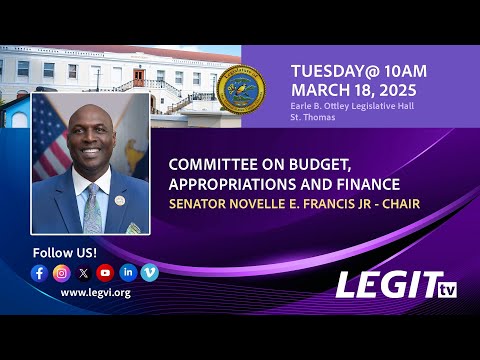
The Committee on Budget, Appropriations and Finance on March 18, 2025 took testimony on bill 36-0023, which would amend the highway user tax to a tiered schedule based on vehicle gross weight, and voted to hold the bill for further study.
The Committee on Budget, Appropriations and Finance on March 18, 2025 took testimony on bill 36-0023, which would amend Title 33, Chapter 4, Section 72 of the Virgin Islands Code to change the highway-user tax from a flat per‑pound rate to a tiered rate based on gross vehicle weight rating (GVWR).
Senator Ray Fonseca, sponsor of the measure, said the bill’s intent is to make heavier vehicles — which place greater wear and tear on roads — pay more toward road maintenance while protecting everyday drivers and encouraging more fuel‑efficient personal vehicles. The proposed scheme in the bill divides vehicles into eight weight classes with graduated per‑pound rates.
Testimony and committee discussion highlighted differences of approach. Joel Lee, director of the Bureau of Internal Revenue, said the bureau is willing to support an increase in road‑user contributions but warned that implementing eight weight classes would significantly increase administrative complexity and costs; as an alternative, Lee recommended a simpler flat rate increase, or at most a reduced number of categories. Derek Gabriel, Commissioner of the Department of Public Works, urged applying higher rates to the heaviest vehicles and suggested fewer tiers — he proposed a three‑tier model (light vehicles at the current 16¢/lb, mid‑range vehicles at 22¢/lb, and the heaviest vehicles at 30¢/lb) and recommended removing exemptions for taxis, which he said use roadways intensively and contribute to wear.
Bureau and department officials also discussed optional structures, such as annual billing for heavy commercial vehicles rather than a one‑time charge at registration, and the need to examine exemptions (for government vehicles and nonprofits) to see whether changes would be appropriate. The post auditor indicated staff can model revenue impacts of alternate approaches.
After discussion, the committee voted to hold bill 36-0023 in committee for further study and directed legislative staff and the bureau to prepare revenue and implementation impact analyses (including a reduced‑tiers option and taxi‑exemption scenarios) to inform a future session.
Ending: The measure was not advanced; committee members requested follow-up analyses on expected revenue effects and administrative costs for fewer tiers and for possible changes to exemptions and billing frequency.