
Encinitas Project nonprofit pitches fundraising partnership with PRCA; seeks ad hoc support from commissions
Get AI-powered insights, summaries, and transcripts
Sign Up Free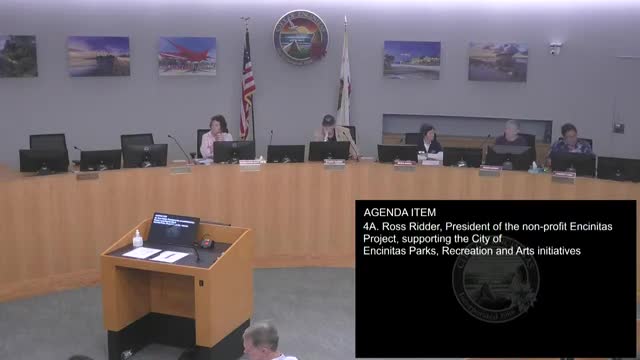
Summary
Leaders of the newly rebranded Encinitas Project briefed the Senior Citizen Commission on plans to fundraise for Parks, Recreation and Cultural Arts (PRCA) initiatives including a senior scholarship program and described a planned memorandum of understanding with the city.
Ross Ritter, president of the Encinitas Project, described the nonprofit’s rebranding, mission and planned partnership with the City of Encinitas Department of Parks, Recreation and Cultural Arts (PRCA) at the March 18 Senior Citizen Commission meeting.
Ritter said the Encinitas Project is a 501(c)(3) nonprofit rebranded from the Patrons of Encinitas Parks (PEP), a nearly 30‑year organization that previously supported park projects such as Oak Crest Park bocce shade structures, the community and senior center dance floor and the Moonlight Beach water fountain. The group’s stated mission is to “bridge the funding gap” for PRCA initiatives and to fundraise solely for projects the department requests, Ritter said.
Ritter said the project’s board has seven active members and that PRCA Director Dave Knopp serves as the city liaison. Ritter said he and Knopp are developing a memorandum of understanding (MOU) between the city and the Encinitas Project that will be taken to City Council for approval “shortly.” He said the group hopes to rebrand publicly in 2025 and that the draft website and donation systems are in development.
He asked commissioners to help with public outreach, volunteer support, letters of support for grant applications and to consider adding the Encinitas Project to commission work plans. Ritter highlighted a proposed senior scholarship patterned after the city’s youth scholarship: PRCA would administer applications and eligibility, and the nonprofit would reimburse the city for awarded scholarships or provide in‑kind donations, he said. Ritter described other possible senior supports such as transportation assistance and program enhancements depending on fundraising success.
Commissioners asked how grant writing and fiscal sponsorship would work in practice. Ritter said arrangements would be decided case‑by‑case: for small community fundraising the nonprofit could buy equipment and donate it to the city; for grants the nonprofit could serve as a fiscal agent and reimburse the city for approved services, or the city could run scholarship disbursement while the nonprofit covers costs. He said the Encinitas Project will coordinate with PRCA staff to obtain the project specifications and demographics needed to prepare grant applications.
Ritter invited the commission to appoint ad hoc members to liaise with the Encinitas Project and suggested commissioners could collect community input for PRCA needs at public forums. He said the nonprofit will only champion projects that PRCA requests and supports. No formal action or vote was taken.