Get Full Government Meeting Transcripts, Videos, & Alerts Forever!
Get email alerts on the Rental Inspections topic
No spam. Unsubscribe anytime.
City council committees hold hearing on proactive rental inspections; tenants and experts urge $10M pilot
Summary
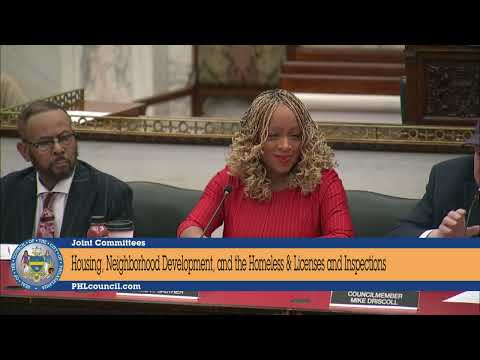
Philadelphia City Council’s joint committees on Housing, Neighborhood Development and the Homeless and Licenses and Inspections convened a public hearing on Resolution 240,267 on May 20 to examine the condition of rental housing, rental code enforcement, and the need for rental repairs across the city.
Philadelphia City Council’s joint committees on Housing, Neighborhood Development and the Homeless and Licenses and Inspections convened a public hearing on Resolution 240,267 on May 20 to examine the condition of rental housing, rental code enforcement, and the need for rental repairs across the city.
The committees heard testimony from municipal officials, researchers and tenant advocates who urged a shift from complaint-driven inspections to a targeted proactive program. Several speakers urged the council to approve an initial $10 million pilot to fund proactive rental inspections and to expand programs that help small landlords make repairs, including the city’s Rental Improvement Fund.
Why it matters: Tenants, health researchers and advocates told the council that substandard rental housing is a public-health problem that contributes to asthma, other chronic illness and displacement. Witnesses described retaliation and eviction risks for tenants who report problems; advocates framed proactive inspections and repair financing as tools to reduce emergency rehousing and improve long-term affordability.
The hearing opened with Chair Gautier and co-chair Mike Driscoll, and sponsoring councilmember Nicholas O'Rourke framing the issue as one of enforcement and public safety. Chair Gautier said the city’s proposed $800 million housing investment should be used to “repair and maintain our rental housing stock.” O'Rourke said the problem reflects power imbalances between organized landlords and renters and urged stronger enforcement paired with supports for tenants.
A regional comparison: Keith David Parsons, strategic enforcement administrator for the District of Columbia Department of Buildings, described Washington’s proactive inspections program. Parsons said DOB runs an algorithm-driven proactive inspections program and a small “alternative resolution team” (ART) that negotiates abatement and reduces court congestion. Parsons testified that a proactive team of nine inspectors performs roughly 16,000 inspections per year targeted by risk; a separate ART team works to confirm abatement and settle cases without trial. He said DOB posts violations publicly and uses an online portal for owners to submit abatement evidence, and that DC confirmed abatement of tens of thousands of violations in fiscal year 2024.
“Instead of waiting for a tenant to report a complaint … the proactive inspections program proactively schedules inspections of licensed properties using a risk based algorithm to target our efforts,” Parsons said.
City administration and program testimony: Bridget Collins Greenwald, Commissioner of Licenses and Inspections’ Quality of Life division, said L&I’s enforcement is currently complaint-driven and that the department welcomes collaboration with council to expand proactive authority. Collins Greenwald described an internal reorganization intended to let property-maintenance teams focus on housing and said L&I has launched a small virtual-inspection pilot and is working with the data nonprofit Pew to refine estimates of unr egistered rental properties.
Rachel Mulberry, director of policy and strategic initiatives at the Philadelphia Housing Development Corporation (PHDC), described the city’s Rental Improvement Fund (RIF). Mulberry said RIF has closed 324 forgivable loans totaling $8.2 million since August 2023, making forgivable loans of up to $25,000 per property in exchange for 10-year affordability commitments for small landlords (defined by PHDC as owners of up to five properties or 15 units). PHDC’s program requires scopes of work, licensed contractors and permits and partners with revenue, L&I and eviction diversion programs for referrals.
Legal and tenant advocates: Sherry Thomas, director of the Housing and Habitability Initiative at Legal Clinic for the Disabled, told the committees that Pennsylvania case law allows a tenant to withhold rent for unremedied conditions but that the remedy often exposes tenants to eviction because judges may still award landlords back rent or eviction if procedural protections are not in place. Thomas described cases in which tenants who followed existing processes lost subsidized housing or were evicted despite L&I violations.
Dr. Katherine Nelson of the Center for Law, Inequality and Metropolitan Equity summarized research showing roughly 41% of Philadelphia renters live in units needing repair and that the average needed repair cost is about $3,000 per unit. Nelson said older housing creates naturally affordable units that require maintenance; she recommended pairing targeted proactive inspections with repair financing so older stock can remain affordable.
Tenants’ testimony: Multiple tenants and organizers recounted persistent problems—mold, leaks, lack of heat or hot water, vermin, and what they described as retaliation after reporting problems. Janet White of Philly Thrive described a multi-year process that led to eviction and displacement after she called L&I, and Theresa Howe of 1PA Renters United said a child in her care contracted lead poisoning despite a landlord-submitted lead certificate; she called for stronger enforcement and protection from retaliation. Organizers repeatedly requested a dedicated displacement fund to help households temporarily rehoused when units are condemned.
Process and next steps: Collins Greenwald estimated a roughly 15-week process to scope a pilot in collaboration with Pew and said the department is enhancing its Eclipse case-management user interface for improved public interaction and data sharing. Multiple councilmembers asked for cost estimates for staffing levels and pilots; Parsons offered to share publicly available DC budget links and figures. Councilmembers and advocates discussed possible funding levels and timelines; several advocates and councilmembers urged a $10 million pilot to begin proactive inspections and also asked for comparable funding for low-income home repairs.
What the hearing produced: The committees read Resolution 240,267—authorizing the joint committees to hold hearings on rental housing conditions—and held extensive testimony. No final legislative vote or ordinance was recorded at the hearing; the committee recessed the hearing to the call of the chair.
Support and concerns raised at the hearing: Witnesses emphasized three concurrent needs—(1) a proactive inspection strategy targeted with data, (2) repair financing or forgivable loans for small landlords so repairs can be completed without displacing tenants, and (3) tenant protections against retaliation (including easier complaint anonymity, Fair Housing Commission awareness, and a displacement assistance fund). Experts from DC and PHDC described practical tools—risk algorithms, public dashboards listing open violations, and alternative-resolution teams meant to reduce court burdens.
The committees asked L&I and PHDC for follow-up materials including: DC budget and staffing details for their proactive program, L&I data on cease-and-vacate orders and court referrals (requested by council district), a clearer estimate of unlicensed rental units, and information about partnerships with utilities and revenue for data cross-checking. Commissioner Collins Greenwald said L&I has begun sharing data with utilities and is conducting internal enhancements.
The hearing record will inform the joint committees’ follow-up work on budget requests, pilot design and potential legislation. Council staff and witnesses said they would continue outreach with DC officials and research partners (Pew, Federal Reserve Bank researchers working with PHDC) to develop costed proposals for consideration during the city’s budget process.