Get Full Government Meeting Transcripts, Videos, & Alerts Forever!
Get email alerts on the School Funding Formula topic
No spam. Unsubscribe anytime.
Superintendents, business officials warn budget move that bakes curriculum line into foundation will skew funding calculus
Summary
School leaders and finance officials urged the subcommittee not to fold previously separate appropriations (curriculum materials and an Internet‑connectivity grant) into the tuition foundation and to modernize complexity measures tied to at‑risk students.
A group of superintendents, school business officials and statewide associations urged the subcommittee to preserve transparency and separate line items for curriculum materials and internet connectivity rather than folding those appropriations into the tuition support foundation.
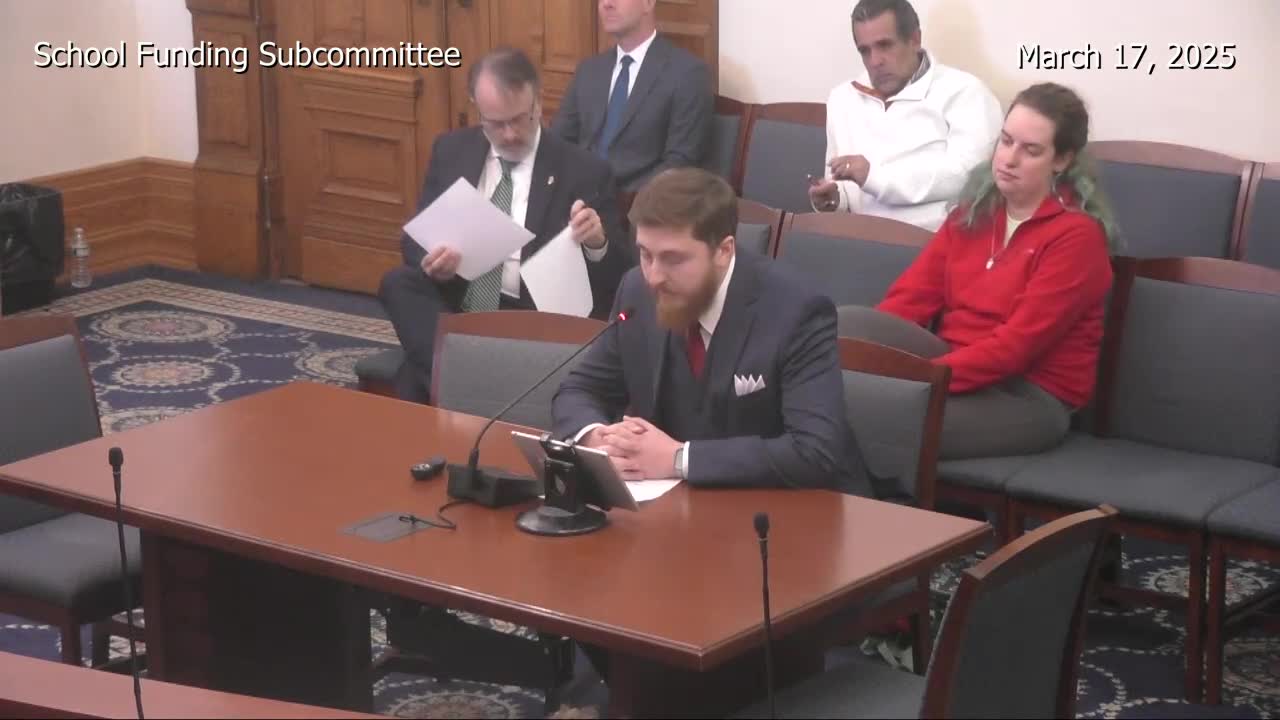
Paul Ketcham, superintendent of Batesville Community Schools, called inclusion of curriculum material reimbursements into the foundation “a budgetary stressor for our school districts” and said the structure reduces local flexibility to meet teacher‑compensation expectations. LSA analysts and senators raised the same arithmetic point: moving a previously separate appropriation (about $160 million per year, per testimony) into the foundation changes the baseline the foundation uses, which in turn changes voucher calculations tied to the foundation amount.
School business officials — represented by Denny Coste Harrison and David Marquette — highlighted another operational pressure: the property‑tax‑funded operating fund now bears high fixed costs. Marquette said statewide averages show transportation, utilities and property‑casualty insurance consume roughly 75.5% of operating‑fund expenditures, and even higher shares in some rural or high‑circuit‑breaker districts. He explained districts often transfer education‑fund balances to cover operating costs and that those transfers stress classroom budgets.
Terry Spradlin (Indiana School Boards Association) and other witnesses warned the subcommittee that the state had also removed a $3.4 million school Internet‑connection grant from the budget and cautioned the subcommittee to restore it because E‑rate funding is potentially at risk in federal litigation; Spradlin described the state match as critical for broadband, WAN and fiber construction in rural districts.
Witnesses recommended: restore a separate curriculum/materials appropriation, restore the Internet‑connectivity grant, and modernize the complexity index (which determines extra weights for at‑risk students) to use broader data sources and make complexity follow students more accurately.
Why it matters: How the state presents and structures appropriations affects both the apparent foundation increase for traditional schools and the calculation used for voucher payments tied to that foundation. Witnesses said separate line items improve transparency and protect local flexibility to set teacher pay and buy instructional materials.
The subcommittee asked for technical follow‑up and LSA confirmation of arithmetic questions; no votes were taken at the hearing.