Get Full Government Meeting Transcripts, Videos, & Alerts Forever!
Get email alerts on the Gifted And Talented topic
No spam. Unsubscribe anytime.
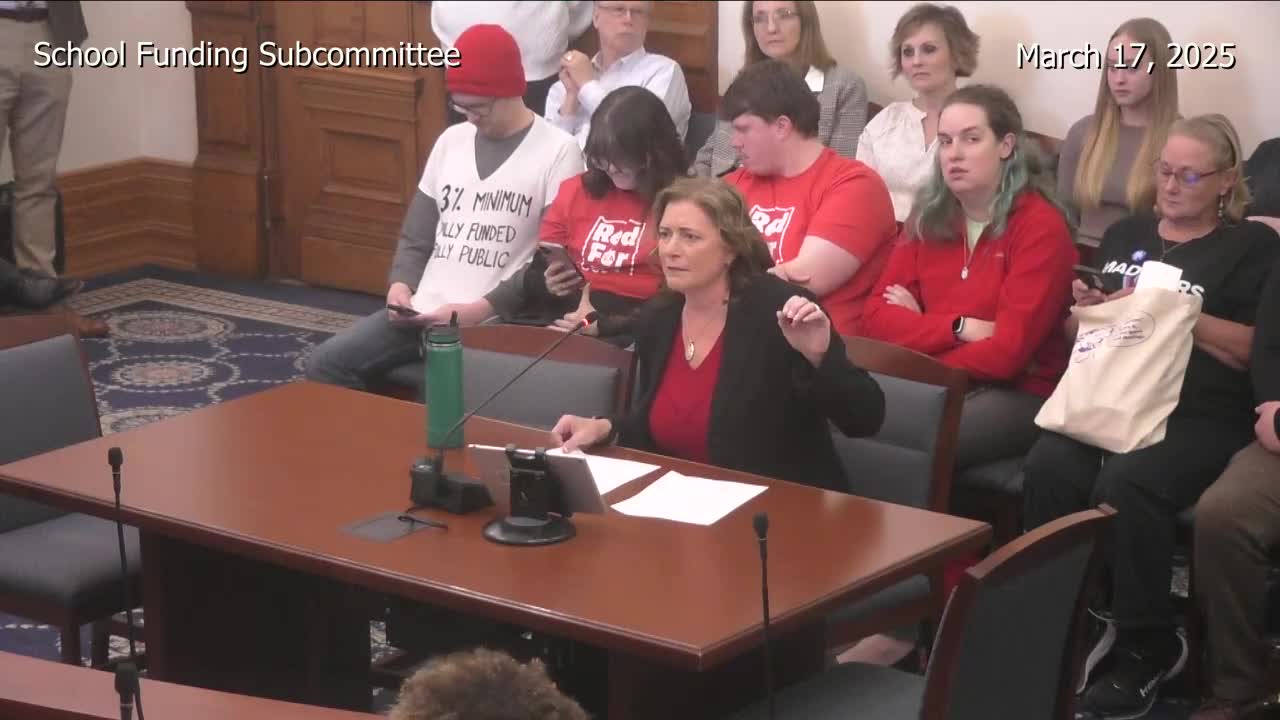
Teachers, students urge lawmakers to maintain gifted‑and‑talented line item at $15 million
Summary
Advocates — teachers, parents and students — described Indiana’s funded gifted program as a national model and asked the subcommittee to keep the budget line at $15 million. Witnesses outlined program requirements, screening costs, and how funds are used for identification, professional development, curriculum and program evaluation.
Indiana’s funded program for high‑ability (gifted and talented) students drew a steady stream of testimony from advocates who said the line item is essential to comply with state law and to identify and serve about 130,000 high‑ability students statewide.
Julie Klusas Gasper, executive director of the Indiana Association for the Gifted, told senators: “Indiana is 1 of only 15 states that has a funded gifted program. We are the gold standard among state gifted programs.” She described the statutory framework enacted in 2007 that requires every public and charter school to identify high‑ability students and provide appropriate services in core content (math and English language arts). Gasper said program components include a broad‑based planning committee, universal screening to identify students by ability and achievement, professional development for teachers, differentiated curriculum developed for high‑ability learners, and program evaluation.
Gasper gave the committee a recent funding history and a request: “In 2023, '15 million was allocated to the gifted and talented line. This year, initially, Governor Brown proposed 13,000,000. The House amended that to restore it to the 15,000,000. So what we are asking you today is to restore it, to to keep it at the 15,000,000.”
Students and classroom teachers described outcomes they attribute to the program. Adeline Davis, a junior at Southport High School, said advanced coursework and specialized instruction helped her pursue aviation studies at Central Nine Career Center. Kimberly Jovic, a high‑ability coordinator in Perry Township, emphasized universal kindergarten/2nd/5th screening and the program’s role in finding students “who may not be noticed otherwise,” including lower‑income and underrepresented children. Teachers testified that professional development funded by the grant changes instruction: “I can now design curriculum that is not harder, but it's deeper and more complex,” said Nina Bowman, a teacher with two decades’ experience in high‑ability instruction.
Program advocates provided some quantitative detail for the committee. Gasper said testing and universal screening are “very expensive,” and Jovic described district screening practices and stated that her district holds broad‑based planning committees and sets measurable grant goals each cycle. Witnesses also offered outcome statistics — for example, Gasper cited high proficiency rates among identified high‑ability students on state assessments — as evidence the program works.
Why it matters: The gifted and talented line is the only dedicated state funding for high‑ability programming. Advocates said cuts would reduce universal screening, professional development, and specialized curriculum — all elements they called essential to comply with existing state code and to identify students who otherwise would be missed.
The committee did not take immediate action. Advocates urged senators to preserve the House allocation and to consider inflation in future appropriations.