Get Full Government Meeting Transcripts, Videos, & Alerts Forever!
Get email alerts on the School Choice Voucher topic
No spam. Unsubscribe anytime.
Hoosier parents, educators clash over plan to remove income limits for school vouchers
Summary
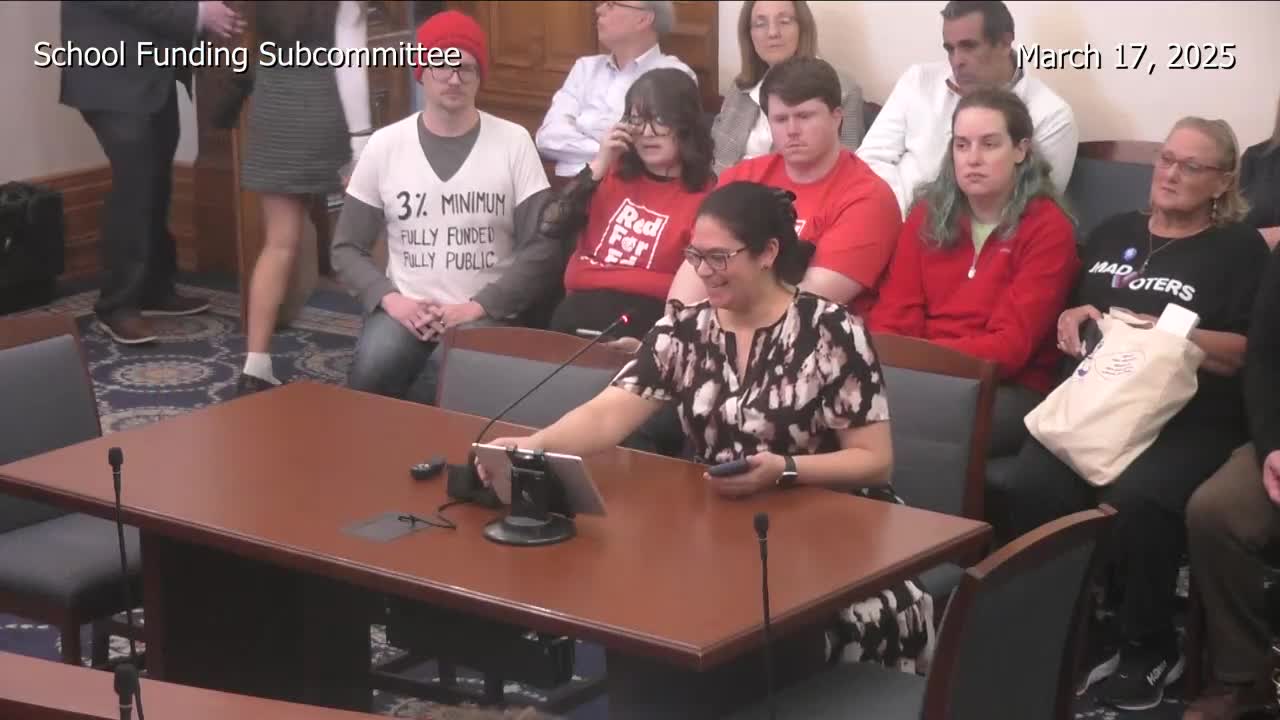
Members of the Senate School Funding Subcommittee heard sharply divided testimony on a budget provision (House Bill 1001) that would remove income limits for Indiana’s Choice Scholarship program and expand voucher eligibility.
Members of the Senate School Funding Subcommittee heard sharply divided testimony on House Bill 1001 — the budget provision that would remove income limits and expand eligibility for Indiana’s Choice Scholarship (voucher) program.
Proponents told the committee that the policy helps families access the schools they prefer and reduces administrative friction. Sophia Andrews, a parent whose son attends St. Thomas More Academy in South Bend, said the family benefited directly: “Universal vouchers would remove the burden on families to annually prove that they qualify by submitting tax documents to the school.” Andrea McLeod, a parent and school staffer, told senators the program had been essential for her family’s planning and that “there’s not a 1 size fits all” in education.
Opponents said expansion would shift limited state education money away from neighborhood public schools and would often subsidize families who can already afford private tuition. Diane Hannah of Carmel argued, “focus on fully funding Indiana’s traditional neighborhood public schools before we even think about subsidizing the lifestyle choices of wealthy Hoosiers by eradicating income limits for vouchers.” Several other speakers — parents, public-school educators and representatives of local school advocacy groups — made similar equity and fiscal arguments.
A set of recurring concerns emerged from testimony and committee questions:
- Tuition inflation: Research presented by Jim May (Indiana Coalition for Public Education) suggested many private schools raised tuition after vouchers became available; May said some schools’ tuition growth substantially outpaced inflation, and that a large share of voucher funds may be used to make private education more affordable for families who were already able to pay. He urged the legislature to require more financial transparency from participating private schools.
- Administrative burden and verification: Nonpublic-school principals and small private-school leaders described heavy income-verification work. Jenny Crane, principal at St. Albert Catholic School, said income checks can take “about 2 hours, per family per kiddo” and can consume scarce staff time at schools that serve low‑income families.
- Means-tested intent vs. universality: Opponents noted that under current law many lower‑income families already qualify and that an unlimited expansion would also benefit high‑income families. Proponents said the yearly paperwork and eligibility tests themselves can deny access to families in flux, and that universal eligibility would simplify administration and remove annual verification barriers.
- Program scale and budget effects: Joel Hand (Indiana Coalition for Public Education) noted that the number of Hoosiers using choice scholarships had grown substantially — “now almost over 74,000 students” — and that making the program universal would increase state expenditures for vouchers and reduce the dollars available to traditional public schools unless the legislature increases overall K‑12 funding.
Committee members also raised technical issues about how changes in the education funding formula interact with vouchers. Several senators and witnesses discussed how the budget moves the curriculum/materials appropriation into the tuition formula — a change that affects the 90%‑of‑foundation calculation used to determine voucher amounts. Senator Liz Brown and others asked for clarification on those mechanics; LSA and multiple witnesses described that change as materially affecting how much state money will flow to vouchers.
Why it matters: The proposal would change who is eligible for state-funded private-school scholarships and shift the distribution of state K‑12 dollars. Testimony showed broad disagreement on whether the policy expands parental choice equitably or redirects public resources away from neighborhood schools and programs that serve high‑need students.
The subcommittee did not take a vote during this hearing. Advocates on both sides urged lawmakers to weigh impacts on school budgets, student access, and administrative workload as they consider the bill.