Get Full Government Meeting Transcripts, Videos, & Alerts Forever!
Get email alerts on the Public Works topic
No spam. Unsubscribe anytime.
Meridian public works lays out 10-year financial plan for water and wastewater capacity and compliance
Summary
Public Works Director Lorelei McVay presented a 10-year comprehensive financial plan to the Meridian City Council on March 18, outlining near- and mid-term staffing, treatment upgrades, and major trunk and plant projects tied to growth and a 2027 wastewater permit.
Public Works Director Lorelei McVay told the Meridian City Council at its March 18 work session that the department’s 10-year comprehensive financial plan (CFP) focuses on growth-driven capacity, regulatory compliance and operational resiliency across water and wastewater systems.
McVay outlined near-term staffing and capital requests and longer-term placeholders. “Most things in public works are driven by one of the three things ... growth, regulations, or operational resiliency,” McVay said, and presented a phased schedule of hires and projects covering fiscal years 2026–2035.
Why it matters: the CFP contains projects and hiring that affect service capacity, regulatory compliance under the city’s upcoming wastewater permit cycle, and long-range operating costs that could influence rates and capital planning.
Near-term staffing and administrative items: McVay proposed several FTE additions and professional services in the five-year near term, including a compliance-focused position in 2027, an additional public-works inspector (2028), a GIS analyst (2028), a second SCADA programmer, and support for two cost-of-service studies (2028 and 2033). McVay said the city relies increasingly on a LIMS/WIMS data system and that programmed staffing would reduce dependence on outside consultants.
Water program highlights: McVay reported ongoing work to add treatment at well 24 to remove iron and manganese and said the eighth filter installation is now online; the system is planned to eventually have 11 such filters. Annual water main extension and adjustment funding was presented as a recurring line (approximately $300,000 per year, subject to change depending on roadway projects by ACHD and ITD). The CFP also includes a meter-replacement program (meters have an approximately 20-year lifespan), a planned booster-station pump upgrade (2027), SCADA additions for a pressure-reducing valve, a cross-connection control inspector to manage backflow assemblies, and a new well (Well 33) anticipated in 2029 to serve Zone 2.
McVay said the city produces an annual water quality report and posts it on the city website. On emerging contaminants, she said Meridian has monitored PFAS for about a decade and is not seeing concerning detections; the department performs additional monitoring beyond regulatory requirements and evaluates treatment or blending options if detections appear. “We do produce an annual water quality report, and it is on our website,” McVay said.
Wastewater program highlights: McVay described permit-driven investments required by the plant’s 2027 permit cycle, including remodeling older aeration basins, adding two new aeration basins and phased membrane skids to expand capacity. She said the city is undergrounding plant power lines to improve resiliency, and noted the plant can tolerate roughly 30 minutes of full power loss before raw sewage overflows would be a concern.
Other wastewater items in the CFP include a potential third boiler (to convert digester gas to hot water), additional operators and mechanics to maintain 24/7 coverage as equipment and processes expand, parking expansion at the plant, odor-control upgrades (covering clarifier launders), and a fermentation upgrade that could reduce purchases of external carbon sources such as methanol or acetic acid. McVay said chemical costs at the plant are expected to exceed $1.2 million annually under the 2027 final limits, and the fermentation upgrade is evaluated against capital and operational costs as a potential offset.
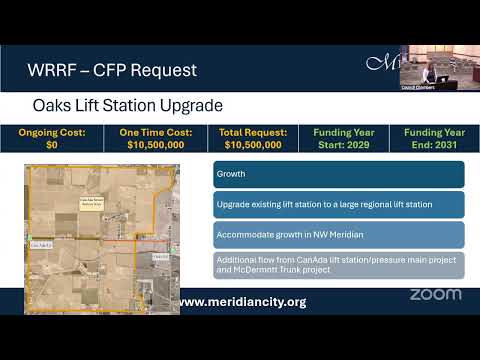
Longer-term and collection-system projects: the CFP includes work on the McDermott sewer trunk — a deep, multi-phase trunk-line project to extend sewer main down McDermott Road and enable development — presented as phased design/construct segments. The director said the city will fund the trunk and collect costs through assessment fees rather than direct per-project reimbursements from individual developers. Council members asked for analysis to ensure costs do not unduly shift to all ratepayers because of the trunk’s depth or localized benefit.
The CFP also anticipates additional hydro cleaners and CCTV vans, another centrifuge and digester capacity as flows grow, a potential biosolids-dryer expansion (partially funded with ARPA funds already in use for an initial dryer), analysis of a struvite harvester to recover phosphorus, and a second pressure main from the influent pump station to headworks as demand warrants.
Council discussion and next steps: council members asked about monitoring for contaminants such as uranium and PFAS and about centralized recruitment vs. department-level hiring. McVay said the department conducts regular monitoring, maintains historic water-quality records online, and coordinates workforce needs with human resources where appropriate. The CFP presentation concluded after council questions and comments; finance and council members were thanked for their work preparing the document and moving the city toward budget preparation for the coming fiscal year.
The work session then moved to procedural business, including a motion to enter executive session.