Get Full Government Meeting Transcripts, Videos, & Alerts Forever!
Get email alerts on the Carbon Storage topic
No spam. Unsubscribe anytime.
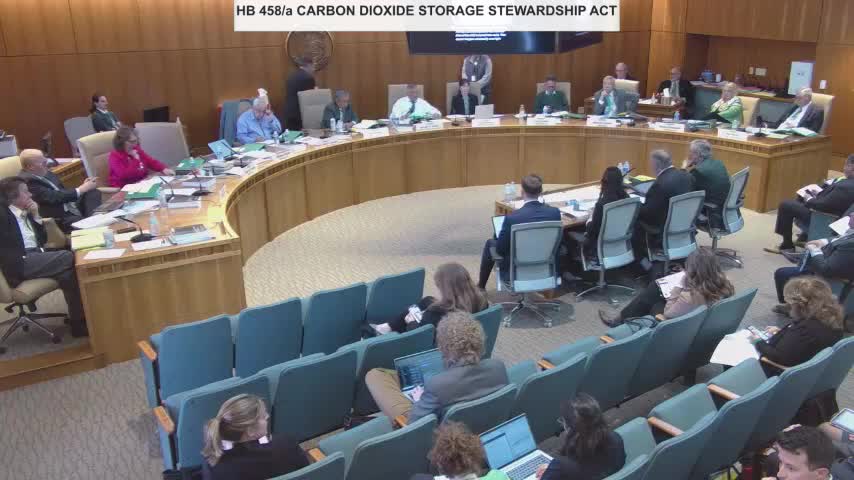
Panel backs bill to create long‑term stewardship fund for CO2 storage, 10‑1
Summary
Lawmakers advanced HB 458 to establish a state stewardship fund paid by a per‑ton fee on CO2 injections and to set a minimum five‑year post‑injection monitoring period; the bill drew support from utilities and labor and opposition from youth and environmental advocates.
Representative Dixon introduced HB 458, a bipartisan, bicameral bill to create a long‑term stewardship fund for carbon dioxide storage projects in New Mexico. The measure would require operators to pay an initial fee of no less than $0.10 per metric ton of CO2 injected over the operating life of a project, with the Department of Energy, Minerals and Natural Resources (MERND/MNERD in testimony) authorized to publish a fee schedule to meet projected stewardship needs. The bill also requires continued monitoring and reporting and bars issuance of a certificate of closure until at least five years after injection ceases.
Why it matters: supporters said the fund and related statutory language would position New Mexico to host commercial carbon storage safely, create jobs, and give the state tools to oversee long‑term monitoring if operators cease active management. Opponents said carbon capture and storage (CCS) can act as a “false solution” that prolongs fossil‑fuel infrastructure and raises risks for frontline communities.
What sponsors and experts told the committee Representative Dixon opened the hearing and described the bill’s key elements, and introduced two technical witnesses: Dr. Robert Balch of New Mexico Tech and Ben Shelton, deputy secretary at the Energy, Minerals and Natural Resources Department. Dr. Balch and other experts described Class VI injection wells, deep geologic formations used for storage, monitoring programs, and the mechanics of injection and long‑term containment. Dr. Balch said commercially mature projects exist and pointed to acid‑gas disposal wells and pilot projects in New Mexico and the U.S.
Supporters at the hearing included PNM (represented by Jerk Roanhorse) and the New Mexico Federation of Labor (John Lipshoots in testimony). PNM told the committee CCS remains a developing technology but that HB 458 would help New Mexico be positioned to sequester CO2 if CCS becomes feasible and cost effective. Labor testified the bill could support high‑paying jobs connected with the industry.
Opponents included Youth United for Climate Crisis Action (Sofia Jenkins Nieto) and the Sierra Club Rio Grande chapter (Camilla Feibelman). Testimony in opposition argued CCS risks extending the life of the oil and gas industry, can be energy‑intensive and costly, and may not deliver the emissions reductions advocates seek. Witnesses asked for more tribal consultation and raised questions about liability if an operator declares bankruptcy.
Liability, stewardship and rules Witnesses and committee members discussed how stewardship responsibilities would transfer to the state at a minimum of five years after injection ceases, and that the bill—together with companion legislation (HB 457 referenced in testimony)—is intended to secure state primacy for Class VI wells (permitting authority under EPA rules) so New Mexico can add state requirements beyond federal standards. Witnesses said the house amendments narrowed the state’s assumed responsibilities largely to long‑term monitoring; other legal obligations could remain with operators. Financial assurance and bonding mechanisms were discussed as subject to rulemaking and companion bills.
Economic and program details Witnesses explained the $0.10/ton baseline fee was a conservative estimate to build a stewardship fund under assumptions about annual storage volumes; one example projection assumed up to 10 million tons per year for 35 years and estimated a stewardship fund on the order of hundreds of millions of dollars depending on interest rates and fee adjustments. Committee members pressed on royalty and landowner payments, federal incentives (Section 45Q tax credits), and whether projects would be privately financed, publicly contracted, or a mix.
Questions from members focused on risks (seismicity, leakage), monitoring timeframes, who pays response costs if a leak is discovered after stewardship transfers, how sites are sited and characterized, and whether rulemaking and companion bills provide adequate financial assurance. Experts described monitoring systems, the chemical and physical trapping mechanisms that reduce leak risk over time, and remediation techniques used if well integrity problems arise.
Vote and next steps After extended discussion, the committee moved a motion for a due pass on HB 458. On a roll call the Senate committee recorded 10 votes in favor and 1 opposed; the measure was given a “do pass” recommendation to the next committee or floor stage.
Provenance: the committee record includes the sponsor’s introduction, technical witness testimony, public support and opposition statements, a question‑and‑answer period with senators, and the recorded roll‑call vote.