Get Full Government Meeting Transcripts, Videos, & Alerts Forever!
Get email alerts on the Supported Decision Making topic
No spam. Unsubscribe anytime.
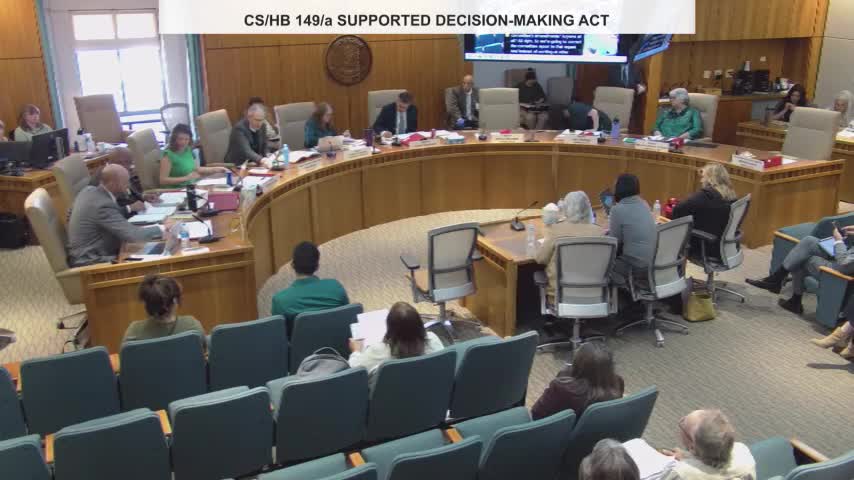
Committee adopts amended supported-decision-making language, forwards bill for full chamber
Summary
A House Judiciary committee voted to advance legislation adding a supported-decision-making option and model form, adopting multiple amendments addressing capacity determinations, witness/notary formalities and limitations on supporters’ compensation and authority.
The House Judiciary Committee voted to advance legislation that would add a statutory supported-decision-making framework as an alternative to guardianship and provide a model form for use in the state.
The measure, discussed as an amendment to House Bill 149, was presented and discussed in committee and ultimately adopted as amended. Senator Wirth, who introduced the proposed amendment language for committee consideration, said the change would create “a process whereby the judge can consider, to do something that’s less restrictive,” and that the amendment draws from existing uniform statutes and courts’ practices.
The amendment makes several substantive changes to the draft language. Among them, the committee adopted a requirement that supported-decision-making agreements follow the model statutory power-of-attorney or health-care decision forms promulgated by the Supreme Court rather than leaving an unstructured “form” to be drafted locally. The amendment also adjusted the witnessing/notary requirement: instead of allowing either two witnesses or a notary, the updated text requires two witnesses and their signatures be acknowledged by a notary public (the committee discussion referred to the mechanism used for wills).
On capacity determinations, the amendment replaced language that read “presumed to have capacity … unless otherwise determined by a court” with a medical-team standard. The adopted text defers to a decision maker’s primary care practitioner and one other qualified health professional — or a court — to determine inability to make decisions, a change supporters said would reduce the need to bring routine capacity disputes to court.
The amendment also added prohibitions and limits on supporters’ authority. As adopted, a supporter “shall not receive compensation as a result of the supporter's duties under [a] supported decision-making agreement,” and must stop serving if the supporter questions the decision maker’s capacity. The committee inserted additional prohibitions on certain acts by supporters, including “signing legal documents on behalf of the decision maker,” but later agreed to an additional qualification so that those prohibitions would not nullify an otherwise applicable power-of-attorney. Senator Brown (committee discussion) offered language making the prohibitions “subject to any authority or powers granted in a power of attorney” so that a separate power of attorney would remain effective.
Supporters of the amendment said the changes reflect work by the state’s judicial leadership and model statutes adopted elsewhere (committee members cited Arizona’s 2023 statute as an influence). Alice McGlick, a committee adviser who spoke during debate, urged adding the adjective “qualified” to the description of the additional health professional and recommended that, when mental illness or developmental disability is at issue, the second professional be someone with training in assessing functional impairment. The committee added that wording.
Representative Ferrari formally moved the amendment in committee and committee leadership said the bill would move out “with a due pass” as amended. The committee recorded no roll-call tally in the transcript; the chair declared the motion carried after there was no objection and instructed staff to prepare the revised committee report.
Committee members said they expect to continue refining technical language as the bill moves toward the floor, but several expressed support for the overall approach as a less-restrictive alternative to guardianship that preserves the decision maker’s autonomy while adding court-accessible safeguards.
The committee also discussed procedural questions — including whether the model form should be mandatory or labeled a model. Committee members agreed the Supreme Court should promulgate the form as a model, and the committee left room for minor future tweaks.
The bill was reported out of committee as amended for further consideration by the full chamber.