Get Full Government Meeting Transcripts, Videos, & Alerts Forever!
Get email alerts on the Carbon Capture topic
No spam. Unsubscribe anytime.
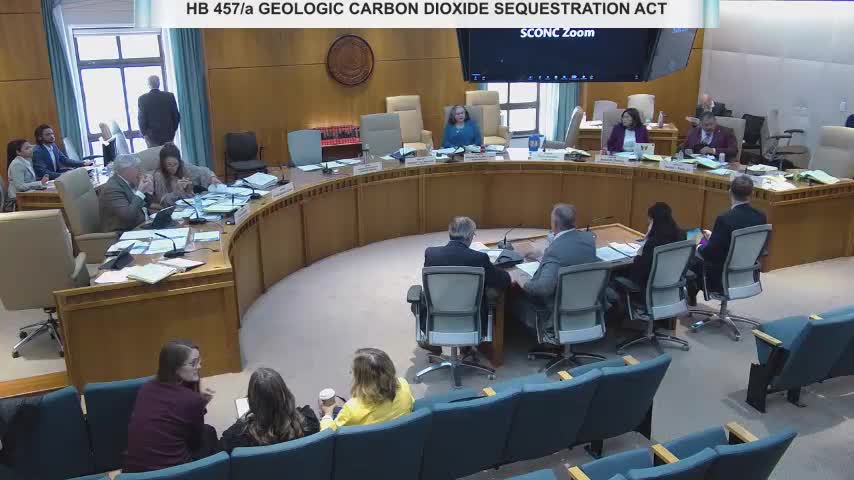
Senate committee deadlocks on carbon sequestration bill after tie votes
Summary
A Senate committee heard extensive testimony on carbon capture and underground sequestration but split on a do-pass motion, leaving the bill without a committee recommendation after a tie vote.
At a Senate Tax Committee hearing (date not specified), lawmakers and experts debated a bill addressing carbon capture and underground sequestration, including notification requirements for property owners, injection pressure limits and whether the state should set standards in addition to federal oversight. The committee voted on a do-pass motion and later on a motion for no recommendation; tie votes left the bill without a committee recommendation and the legislation did not proceed from the committee.
Committee members and witnesses discussed technical and administrative provisions that would require identifying and notifying owners of surface estates, mineral rights and pore space within a half mile of a proposed sequestration unit. Senator Izzo raised concerns that the notification and title-search requirements on page 6 — which would require names and addresses for owners of surface estate, mineral rights and pore space for lands within a half mile of a sequestration unit — would be “a nightmare for any title attorney.” An expert witness told the committee that the notification approach in the bill is modeled on current oil-and-gas practice and is feasible but acknowledged the complexity when ownership of surface, minerals and pore space is split.
Witnesses and lawmakers also addressed injection safety and storage permanence. An expert witness described maximum injection pressure as a calculation analogous to saltwater-disposal permitting and said pressure limits would be set by formula or modeling to avoid fracturing the caprock that seals stored CO2. The expert said, “You’re going to be well below what could break the rock at the injection interval,” explaining that regulations and permitting would be designed to prevent injection that would create new fractures.
Committee members and witnesses discussed carbon-capture technologies and climate rationale. Witnesses described direct-air capture as an extension of point-source carbon capture and said efficiency and net climate benefit vary by technology and the emission source. One witness noted that global storage projects have been operating in the North Sea since the 1990s and that the U.S. stored 6,750,000 tons of CO2 in 2023, largely in New Mexico and West Texas, citing the need for regulatory clarity and “room to grow” the industry.
On procedure, Senator Scott moved a do-pass recommendation; Senator Charlie seconded. The first roll call produced a 3–3 split among voting members (several members were excused or passed), and the committee later considered a separate motion for no recommendation by Senator Townsend, seconded by Senator Azelle. That motion also produced a 3–3 result; the chair announced that, with the tie, the committee would return no recommendation and the bill would not proceed from committee.
The bill’s supporters argued that state standards would allow New Mexico to require tribal consultation, community engagement and community benefits agreements in addition to federal requirements, and that legislative standards could encourage investment and jobs tied to carbon-removal projects. Critics and some members expressed caution about state primacy in permitting and deferred enforcement capacity, noting that federal standards (including EPA oversight) currently play a central role.
Votes at a glance: the committee recorded a split on the do-pass motion; the subsequent motion for no recommendation carried no net majority because of a tie, and the chair stated the bill would not proceed from committee. The transcript lists individual yeas and nays in the roll calls but multiple members were excused or passed during the calls; the committee report therefore shows no committee recommendation.
The committee hearing record includes technical exchanges about how pore-space ownership can be severed from surface or mineral ownership, how injection pressures are established in permit modeling, and how direct-air capture and point-source capture differ in scale and cost. Several senators sought clearer environmental and safety assurances; proponents emphasized economic and climate benefits, including potential credits tied to federal Internal Revenue Code Section 45Q incentives.
With no recommendation from the committee, the bill’s next steps are not specified in the hearing record.