Get Full Government Meeting Transcripts, Videos, & Alerts Forever!
Get email alerts on the Timber Grading topic
No spam. Unsubscribe anytime.
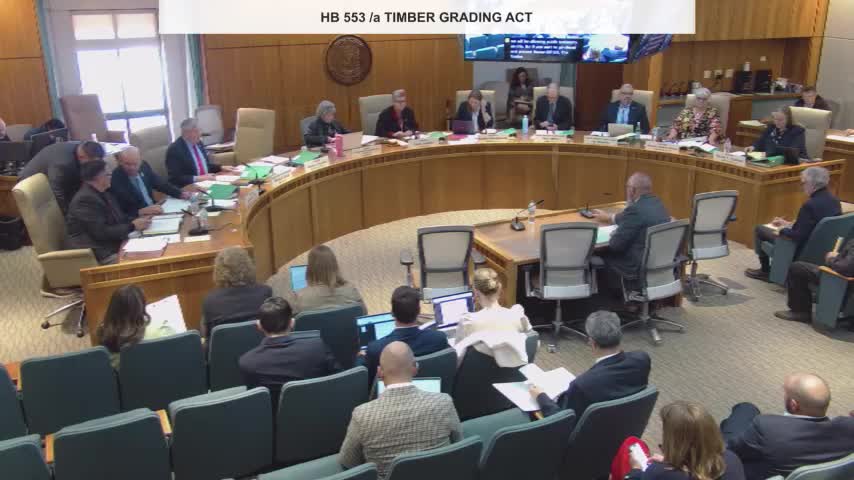
Senate committee advances Timber Grading Act after mixed testimony on grading standards
Summary
The committee voted to advance House Bill 553, which would allow use of locally produced lumber, vigas and beams; supporters said it would boost local mills and help post‑fire rebuilding, while national standards groups warned the bill could undermine PS 20 grading traceability and liability safeguards.
A Senate taxation committee voted to advance House Bill 553, the Timber Grading Act, after a public hearing that included support from local governments and tribal representatives and technical objections from national lumber‑standards organizations.
The bill, presented by Representative Vincent, would allow residential and commercial construction in New Mexico to use locally produced lumber, vigas and beams graded under a state certification system. Vincent and backers said the change would expand markets for wood removed during tree‑thinning and post‑fire hazard removal, help rebuild after wildfires and support multigenerational and tribally owned sawmills statewide.
Why it matters: supporters say HB 553 would create local economic opportunities for about 18 sawmills and three beam facilities cited by the sponsor and could lower costs and increase supply during post‑fire recovery. Opponents warned it could weaken national grading systems relied on by building codes and engineers.
At the hearing, Carrie Romba Brunder, speaking for Lincoln County, said the bill was designed to work with the Construction Industries Division (CID) so local certification would not require changes to building codes and would reduce reliance on out‑of‑state graders. A representative of the Mescalero Apache Tribe said the tribe supports HB 553 and plans to expand its two sawmills.
Industry witnesses raised concerns. David Kretchman, president of the American Lumber Standard Committee, said the bill as drafted "cuts the very heart out of the ALC system," and argued it lacked liability links and other cadence of checks that give designers and owners recourse when structural lumber fails. Shane Nellis, regional manager for codes and standards at the American Wood Council, warned that field verification relies on PS 20 grading and that any program not meeting that standard could make span tables and other code provisions unusable.
Representative Vincent replied that sponsors had consulted CID and that the bill would meet PS 20 standards; he argued the effort was aimed at growing local supply and reducing costs tied to imported lumber and external graders.
The committee recorded a due pass for HB 553 after the hearing. The committee chair asked the secretary to record the members present as in favor of the due pass; the transcript does not supply a numeric roll call tally for that motion.
The bill includes specification language listing the data to be recorded by a local grader — grader name, sawmill name and location, species, grade and structural classification, intended use location, cut/processing dates and moisture content at grading — intended by sponsors to enable traceability within the state.
What’s next: The bill will move forward from the committee to the next stage of the legislative process.