Get Full Government Meeting Transcripts, Videos, & Alerts Forever!
Get email alerts on the Behavioral Health topic
No spam. Unsubscribe anytime.
House committee advances Medical Psilocybin Act after public testimony from clinicians, veterans and advocates
Summary
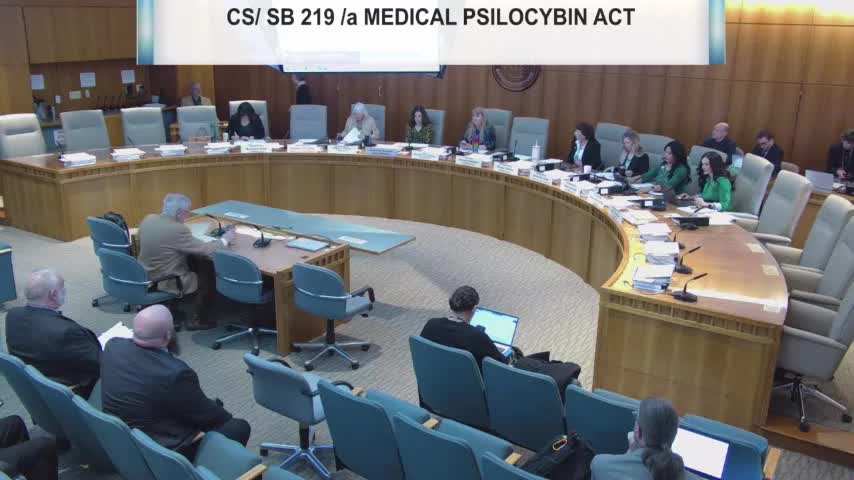
Lawmakers on the House Health and Human Services Committee voted 8–1 to recommend passage of Senate Bill 219, the Medical Psilocybin Act, which would create a state-regulated psilocybin-assisted therapy program for four qualifying conditions.
Lawmakers on the House Health and Human Services Committee voted 8–1 to recommend passage of Senate Bill 219, the Medical Psilocybin Act, after more than an hour of testimony from clinicians, veterans, advocacy groups and Department of Health officials.
The bill would create a state-regulated program authorizing supervised administration of naturally occurring psilocybin in clinical settings for four qualifying conditions — major depressive disorder, post-traumatic stress disorder, substance use disorder and end-of-life anxiety — and establish an advisory board and licensing process run by the New Mexico Department of Health (DOH). Proponents said the program is modeled on Oregon’s and Colorado’s implementations and would be rolled out gradually to prioritize safety.
Supporters described psilocybin-assisted therapy as a guided, multi-day clinical intervention in which a trained guide supports patients through an intense dosing session followed by integrative therapy sessions. Amy Wong Hope, a clinical social worker who testified in support, said the treatment offers a different pathway for people with treatment-resistant trauma and depression and can shorten the time to meaningful improvement compared with weeks or years of typical psychotherapy.
Veterans and first responders gave personal testimony about symptom relief following psychedelic-assisted therapy. A Marine Corps veteran who testified said he found healing through psychedelic treatment; James Brown, a registered pharmacist and veteran, told the committee that expanded access could allow “holistic” options and further clinical study in New Mexico.
Department of Health staff said DOH would license producers and clinical sites and set dosing and practitioner qualifications through rulemaking. Dr. Dominic Zirlo of DOH told the committee that, because the treatment would be administered in clinical settings rather than dispensed for home use, interstate transport of the product would not be an expected issue. DOH staff said there are currently no FDA-approved whole-mushroom psilocybin products; the bill would exclude FDA-approved drugs from the statute once they exist.
On several procedural and program details, committee members pressed sponsors and DOH staff. Questions addressed whether psilocybin could legally be transported across state lines (DOH: illegal), whether federal funds such as Medicaid might be jeopardized (sponsors pointed to state scheduling flexibility and experiences in other states), and whether program costs and equity provisions were built into the bill. Sponsors described an equity fund in the bill to subsidize access for qualifying patients who cannot pay out of pocket; otherwise patients would pay privately because the treatment is not covered by Medicaid under current rules.
Committee members also asked about safety and adverse events. Sponsors and witnesses cited Oregon’s experience — roughly 9,000 participants with a small number of adverse events and no documented deaths in clinical settings — and emphasized contraindications, screening and the presence of trained guides. Dr. Zirlo and other witnesses said DOH would develop outcome metrics and reporting requirements as part of the rulemaking and would provide regular program reports to the legislature if the bill passes.
Supporters included the ACLU of New Mexico, End of Life Options New Mexico (which endorsed use of psilocybin for terminal agitation), clinicians and local lawyers who described personal or clinical benefits. Opponents were not recorded during the public comment period in the transcript.
After testimony and questioning, Representative (Acting Chair) moved the committee substitute to pass; the motion was seconded and the committee returned an 8–1 do-pass recommendation.
The bill language delegates key technical details to DOH rulemaking, including producer licensing, dosing protocols, permitted formulations (the bill’s text focuses on whole-mushroom psilocybin and excludes synthetic or FDA-regulated derivatives), practitioner qualifications, the equity fund’s eligibility and reporting requirements. Sponsors emphasized a phased timetable and cited a program start date in the bill’s text, with at least one sponsor remarking that treatments would not begin until late 2027/early 2028 to allow for rulemaking and program setup.
Votes at a glance
- Motion to move committee substitute for Senate Bill 219 as amended: Passed, do pass recommendation, tally 8 yes, 1 no.
What’s next
With the House committee’s do-pass recommendation recorded in the transcript, the substitute bill moves forward in the legislative process for further House floor action and conference with the Senate as needed. The Department of Health testimony indicates that most operational details would be developed in administrative rulemaking if the bill becomes law.