Get Full Government Meeting Transcripts, Videos, & Alerts Forever!
Get email alerts on the Offshore Wind topic
No spam. Unsubscribe anytime.
Louisiana committee studies wind energy potential, supply-chain and wildlife concerns
Summary
State lawmakers and industry, conservation and port representatives urged planning for offshore and land‑based wind in Louisiana, highlighting economic opportunity, permitting gaps for onshore projects, grid and transmission needs, and environmental safeguards.
The Louisiana House Natural Resources Committee held a March 17 hearing to study onshore and offshore wind development, hearing from state energy staff, industry groups, ports and conservation organizations about economic opportunities, permitting gaps and wildlife protections.
Representative Guymon, chairman of the House Natural Resources Committee, opened the hearing by noting that "this study resolution was passed in the spring session of 2024 to deal with solar and wind" and that the session was intended to identify areas that "need to be addressed legislatively in the future." The committee did not take votes at the hearing.
The session centered on three topics: how Louisiana can capture supply‑chain and workforce opportunities from offshore wind; whether state and local permitting and ordinances are adequate for anticipated land‑based projects; and environmental and marine‑use concerns to be addressed in federal and state permitting.
Blake (Department of Energy and Natural Resources), testifying for the department, said the agency’s primary role focuses on offshore wind through its offices that manage state water bottom leases and coastal permitting. He told lawmakers the department has no statewide, wind‑specific permitting program for land‑based projects: "We don't have any wind specific permitting programs. So right now... your coastal permitting would be the only thing that would be involved," he said, describing the current regulatory gap for non‑coastal onshore projects.
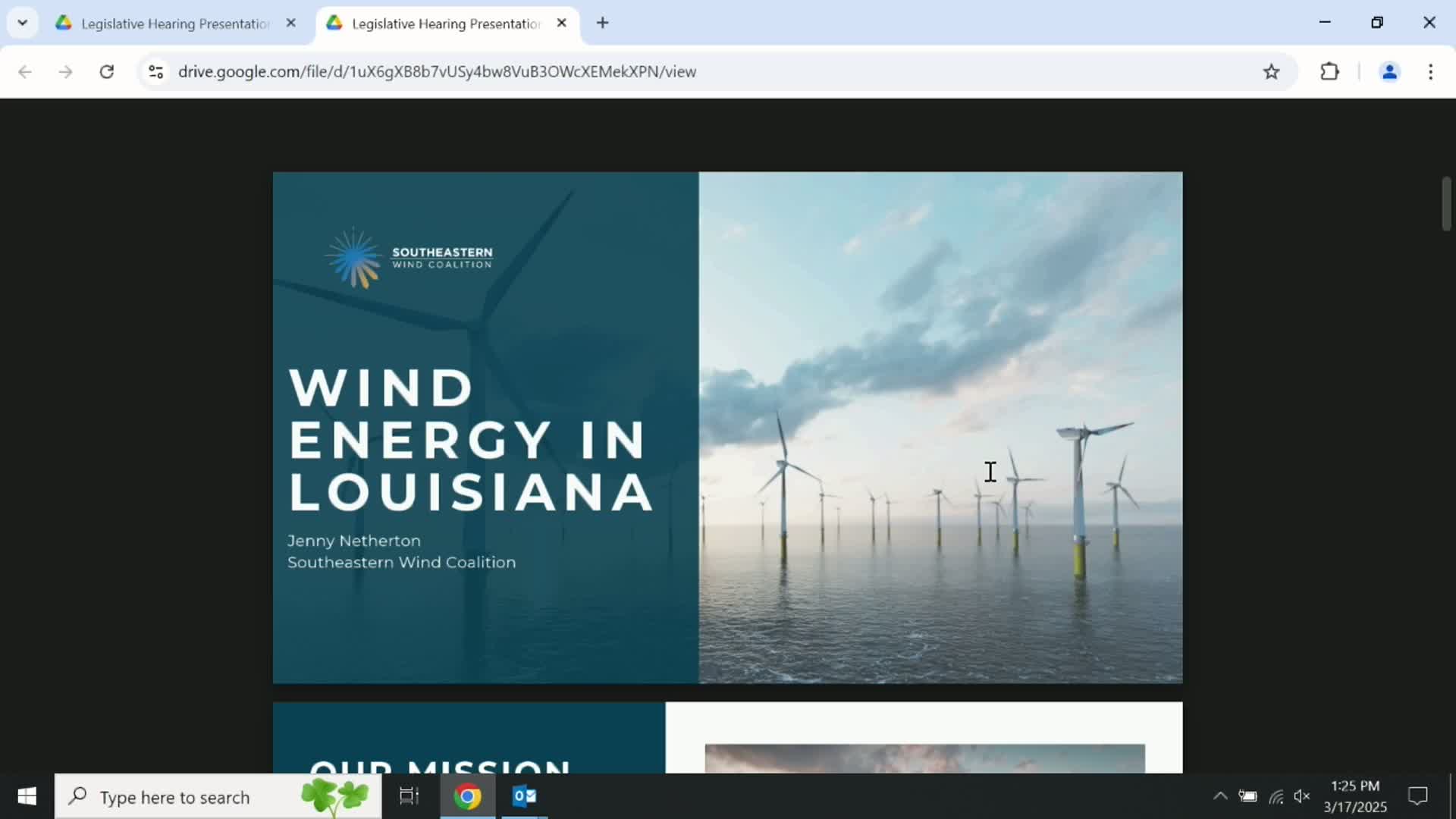
Jenny Netherton, Louisiana program director for the Southeastern Wind Coalition, framed offshore wind as a long‑lead, utility‑scale resource and contrasted permitting regimes for offshore and land‑based projects. "Offshore wind projects are generally larger in scale and in size," she said, and she estimated a typical offshore project takes roughly 10 years from lease to generation. Netherton also summarized federal permits and regulatory touchpoints that can apply to land‑based projects, including the Coastal Zone Management Act, Army Corps (Clean Water Act 401/404) permits, Federal Aviation Administration authorizations for turbine height and Endangered Species Act consultations for incidental take.
Economic development groups emphasized existing Louisiana strengths. Cameron Poole, Energy and Innovation Manager at Greater New Orleans, Inc., said recent analysis identified hundreds of Louisiana companies with the potential to participate in offshore wind supply chains and that about 26% of early domestic industry contracts have gone to Louisiana and Gulf Coast suppliers. He described ongoing workforce and supplier‑identification efforts, including partnerships with community colleges and port operators.
Conservation and ocean‑use groups spoke in favor of "responsible development." Stacy Ortego of the National Wildlife Federation said the group supports offshore wind if development follows measures to "avoid, minimize, mitigate, and monitor" impacts on wildlife and habitat and stressed consultation with tribes and underserved communities. Scott Eustace of Healthy Gulf said his group supports wind "when done right," noting offshore projects typically have smaller coastal footprints than comparable oil and gas infrastructure but urging careful spatial planning and cleanup of legacy debris and pipelines.
Committee members pressed several recurring issues. Multiple legislators asked whether local parishes and the state should adopt model ordinances to avoid a patchwork of rules like what occurred with some solar development. Representative Mack asked about turbine spacing and workforce impacts; witnesses said spacing offshore can be location dependent (East Coast projects have standardized on roughly 1 nautical mile separation) and that manufacturing, installation and long‑term operations and maintenance create a range of local jobs, from ship and vessel crews to factory and maintenance workers.
Witnesses provided technical and market details discussed by the committee: onshore turbines typically range from about 4 to 6 megawatts and modern land turbines sit on taller towers (developers now often use hub heights above 80 meters); offshore turbines cited in testimony can be 12–18 megawatts each; land‑based projects often take about 4–5 years to develop once landowner agreements and interconnection work are in place; and large offshore projects can have substantial upfront costs but low ongoing fuel costs, producing stable long‑term energy prices.
Representatives and witnesses also discussed transmission and grid integration. Gulf‑region witnesses urged planning for shared offshore transmission corridors, interconnection studies (MISO was discussed as the relevant regional transmission operator for parts of Louisiana) and coordination among federal, state and utility planners to ensure offtake and coastal transmission capacity.
No committee action or votes were taken. Committee members and witnesses repeatedly recommended continued stakeholder engagement — including local governments, ports, fisheries, tribes and conservation organizations — and further work by the Department of Energy and Natural Resources and the state’s offshore wind roadmap advisory council to refine permitting, workforce and environmental protections before any legislative proposals are drafted.
The committee adjourned after the panel of witnesses concluded; lawmakers asked staff to assemble model ordinances, supply‑chain and workforce studies, and additional technical materials for further review.